
Trolley
You have no items in your shopping cart

 Budgets
 Dumbers
 Discs
Discs
 Benches
 Racks and Rigs
 Weights Holders
 Isotonic machines
 Calisthenics
 Cardio
 Kettlebells
 Flooring
 Gym Set
 Accessories
 Combat
 ARTI MARZIALI
 CONTAINER GYM
 Tug-Of-War
 Used Gym Equipment
 PILATES MACCHINARI
 GINNASTICA ARTISTICA
 CAMPI DA PADEL
 Prodotti in Pronta Consegna
 Informazioni
 IRONMAN
 Gift Card
- Donatif
- General information
- 0 I like it
- 503 Views
- 0 comments
- gym flooring, safety flooring, gym safety, shock-absorbing materials
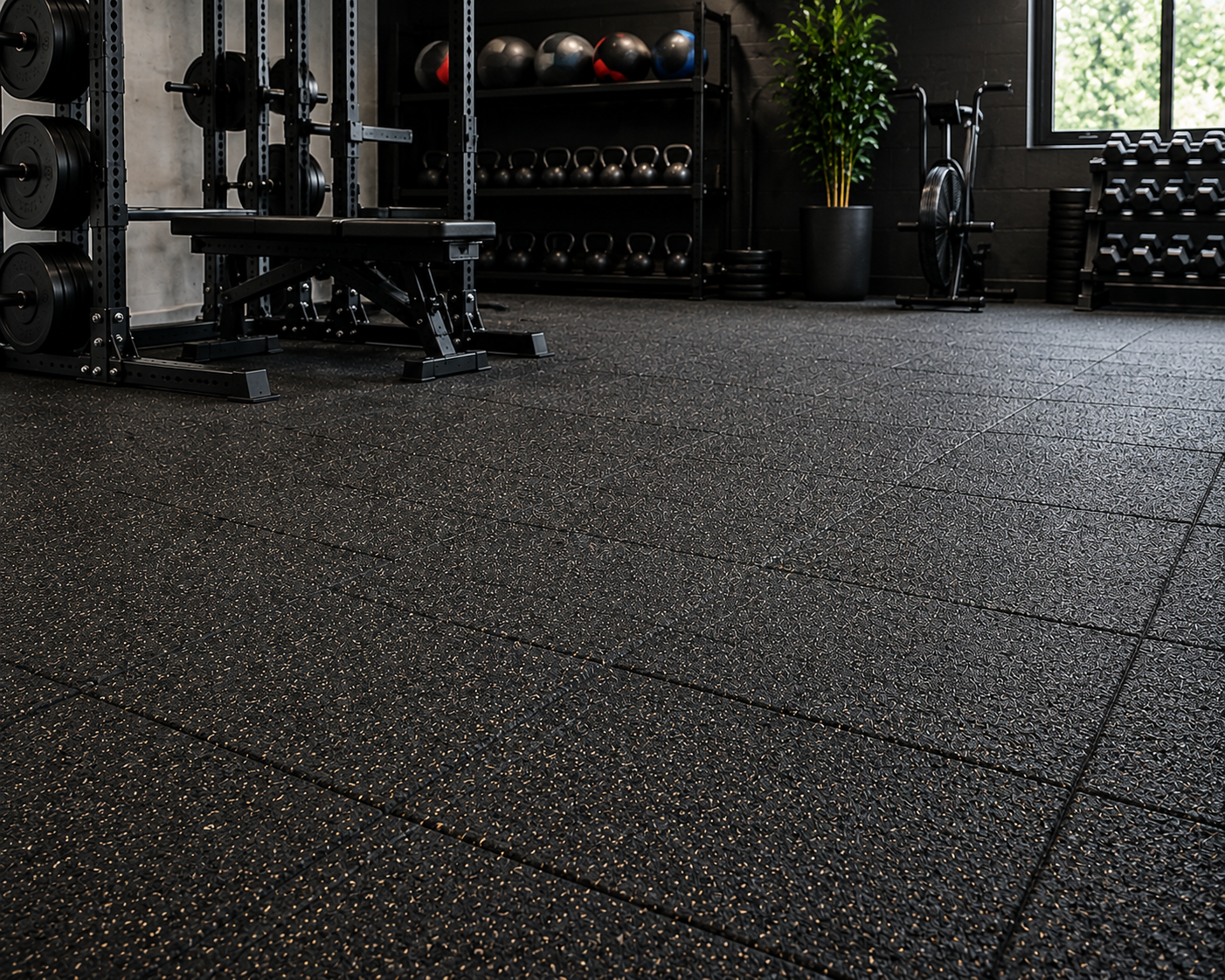
Fine-Grained vs. Coarse-Grained Rubber Flooring: Which to Choose?
Choosing between fine-grained vs. coarse-grained rubber flooring is one of the most underestimated aspects when designing a professional gym or a home gym. Many buyers focus exclusively on the thickness of the tiles, forgetting that the surface finish directly influences durability, maintenance, aesthetics, grip, and comfort during training.
Reconstituted rubber flooring is produced using granules of different sizes bonded together with specific polyurethane adhesives. The grain size determines not only the aesthetic appearance of the floor but also its behavior during daily use, its ability to resist wear, and the ease with which the surface can be kept clean.
For gym owners, personal trainers, and enthusiasts building a home gym, understanding the differences between a fine-grained and a coarse-grained surface means making a more informed investment and choosing flooring that is truly suited to their needs. In this guide, we analyze the technical characteristics of the two solutions, their advantages, disadvantages, and the criteria for identifying the most suitable product.
- What is rubber grain size
- Fine-grained flooring: characteristics
- Coarse-grained flooring: characteristics
- The role of rubber density
- Daily cleaning and maintenance
- Which to choose based on usage
- The most common mistakes
- How to evaluate the investment
What is rubber grain size
When talking about reconstituted rubber flooring, the term grain size identifies the size of the granules used during the production process. A fine grain uses very small particles that create a more uniform and compact surface, while a coarse grain uses larger fragments, easily recognizable even to the naked eye.
The choice of grain size does not only concern aesthetics. It affects tactile perception, the ability to trap dirt, the mechanical behavior of the surface, and the resistance to wear generated by the continuous passage of people and equipment.
Understanding this difference allows you to avoid purely aesthetic evaluations and to orient yourself toward a solution that is truly consistent with the intensity of the gym's usage.
How the flooring is produced
The tiles are made by mixing recycled or virgin rubber granules with polyurethane binders. The size of the granules and the compaction pressure determine the final structure of the material.
The aesthetic impact of the finish
Fine-grained surfaces generally appear more elegant and homogeneous, while coarse-grained ones convey a more technical and robust image, often appreciated in professional weight rooms.
Fine-grained flooring: characteristics
Fine-grained flooring is appreciated for its uniform and modern appearance. The surface is smoother to the touch and has fewer surface cavities, a feature that helps facilitate daily cleaning.
This type of finish is often chosen for personal training studios, boutique fitness centers, functional areas, group class rooms, and environments where aesthetics represent an important element of the customer experience.
A more compact finish also makes the floor less prone to dust accumulation in surface micro-cavities, simplifying routine maintenance operations.
The main advantages
A compact surface improves ease of cleaning, offers a more refined aesthetic, and helps maintain a well-kept appearance over time even in high-traffic environments.
Possible limitations
In contexts characterized by extremely intensive use, it is essential to verify that the product maintains adequate levels of mechanical resistance and grip by choosing high-quality professional materials.
Coarse-grained flooring: characteristics
Coarse-grained surfaces are immediately recognizable thanks to the presence of more evident granules. This configuration is frequently used in rooms dedicated to powerlifting, cross-training, and weightlifting.
The more technical and industrial look immediately communicates robustness and is often associated with spaces oriented toward athletic performance rather than aesthetics.
In this case, too, quality depends on the composition of the material and the precision of the production process, not just the size of the granules.
High robustness
Coarse-grained surfaces are particularly suitable for environments where barbells, Olympic plates, and heavy equipment are frequently moved.
Behavior during training
The particular texture can help maintain a good level of grip even during intense workouts, provided the product is specifically designed for fitness use.
The role of rubber density
One of the most frequent mistakes is believing that grain size automatically determines the quality of the flooring. In reality, an even more important parameter is gym rubber density.
Density affects the tile's ability to absorb shock, maintain its shape over time, and resist static and dynamic loads. Two floors with identical surface finishes can offer completely different performance if made with different densities.
A correctly sized density ensures greater durability, less permanent deformation, and better performance during workouts.
Why density is fundamental
A more compact rubber distributes loads better and maintains its characteristics even after years of intensive use.
The role of reconstituted SBR flooring
SBR rubber flooring represents one of the most widespread solutions thanks to the good balance between performance, cost, and durability, provided they are produced with high quality standards.
Daily cleaning and maintenance
Ease of cleaning is an aspect often underestimated when choosing flooring. A professional gym requires daily intervention, and every minute saved in maintenance operations helps reduce operating costs.
More compact surfaces generally tend to retain less surface dirt, while those characterized by greater roughness may require more thorough cleaning in the presence of dust or magnesium residue.
The choice must, in any case, take into account the actual intended use and the maintenance procedures provided by the facility.
Advantages of fine-grained rubber cleaning
A uniform surface facilitates the use of vacuum cleaners and floor scrubbers, reducing the time needed to keep the gym in optimal condition.
Preventive maintenance
Regular cleaning and specific products allow you to preserve both the aesthetic appearance and the mechanical performance of the flooring over time.
Which to choose based on usage
There is no universally better solution. The choice depends on the type of gym, the target audience, and the intensity of use in the different areas.
For boutique fitness centers, personal training studios, and environments where aesthetics and ease of cleaning are priorities, a fine-grained surface can offer numerous advantages. In weight rooms dedicated to extremely intense training, however, many managers prefer more technical and robust finishes.
Carefully evaluating the mix of activities performed allows you to identify the product capable of offering the best balance between performance, durability, and maintenance.
Home gym
Those building a home gym can prioritize a solution that combines comfort, ease of cleaning, and aesthetic appeal, while still maintaining adequate resistance to the expected loads.
Professional gyms
High-traffic facilities should carefully evaluate usage cycles, the type of training, and the frequency of maintenance before making a final choice.
The most common mistakes
Many buyers choose flooring by looking exclusively at online photographs without requesting samples or verifying the technical characteristics declared by the manufacturer.
Another mistake consists of comparing only the price per square meter without considering density, adhesive quality, dimensional precision, and the expected durability of the material.
Finally, ignoring the specific destination of the different areas of the gym can lead to installing flooring that is poorly suited to actual operational needs.
Evaluating only the appearance
A surface that is aesthetically pleasing does not automatically guarantee better performance during training.
Comparing only the cost
Higher-quality professional flooring can significantly reduce replacement and maintenance costs in the long run.
How to evaluate the investment
The choice between fine grain and coarse grain should be approached by considering the total life cycle cost of the flooring and not just the initial purchase price. Durability, simplicity of maintenance, user comfort, and wear resistance directly affect the profitability of the investment.
Before proceeding with the purchase, it is advisable to request detailed technical data sheets, verify the density of the material, compare available certifications, and evaluate the supplier's experience in the professional sports flooring sector.
Relying on specialized manufacturers and choosing a solution designed for fitness allows you to obtain a more durable and high-performing result. To learn more about the best solutions dedicated to sports surfaces, you can consult fine-grained vs. coarse-grained rubber flooring and evaluate the configuration most suitable for your gym, obtaining the best balance between aesthetics, functionality, and durability over time.
Comments (0)