
Trolley
You have no items in your shopping cart

 Budgets
 Dumbers
 Discs
Discs
 Benches
 Racks and Rigs
 Weights Holders
 Isotonic machines
 Calisthenics
 Cardio
 Kettlebells
 Flooring
 Gym Set
 Accessories
 Combat
 ARTI MARZIALI
 CONTAINER GYM
 Tug-Of-War
 Used Gym Equipment
 PILATES MACCHINARI
 GINNASTICA ARTISTICA
 CAMPI DA PADEL
 Prodotti in Pronta Consegna
 Informazioni
 IRONMAN
 Gift Card
- Donatif
- General information
- 0 I like it
- 25 Views
- 0 comments
- gym flooring, safety flooring, gym safety, shock-absorbing materials
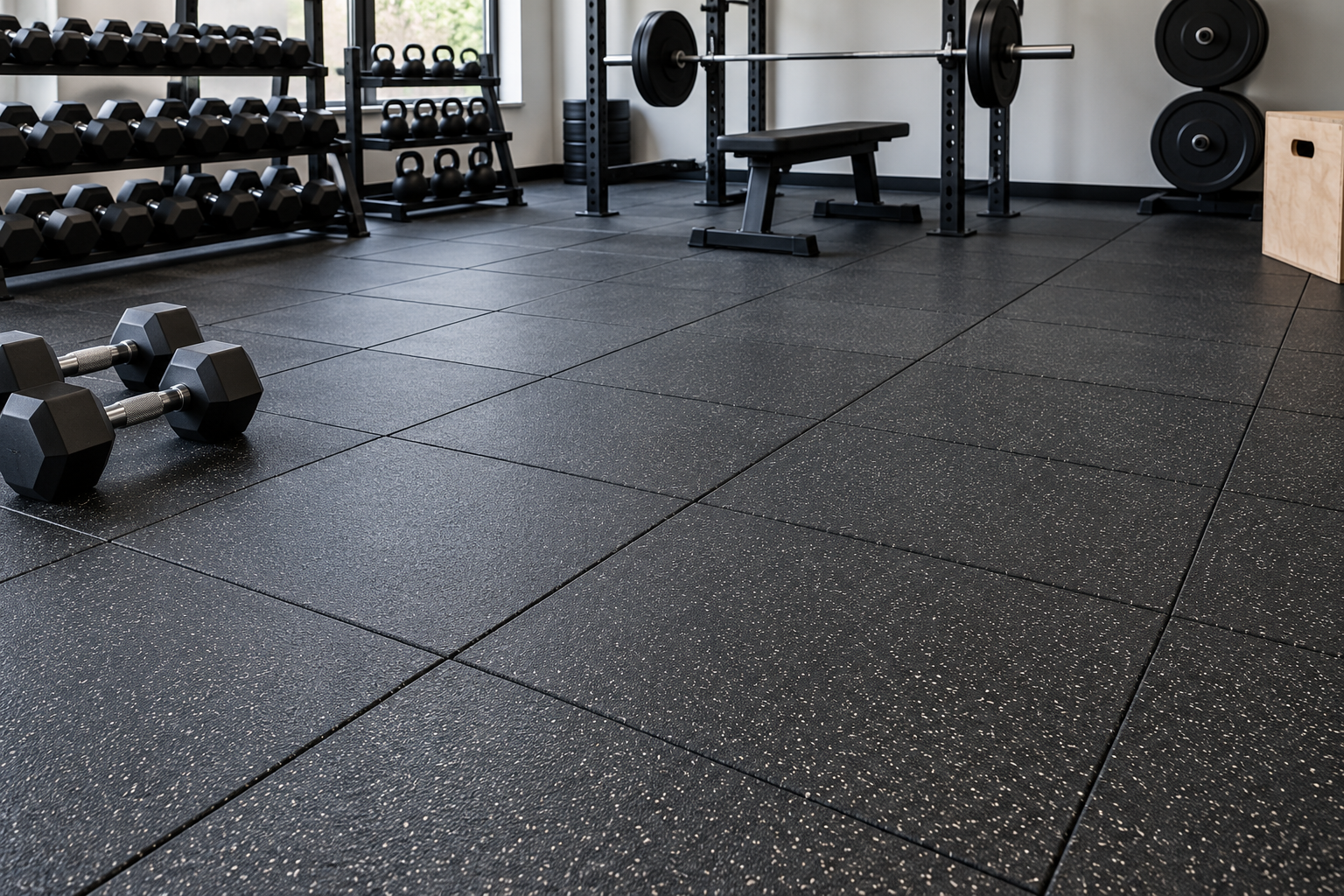
Rubber Flooring in Rolls or Tiles: Which to Choose?
The choice between rubber flooring in rolls or tiles represents one of the main aspects to evaluate when designing a gym, fitness room, or space dedicated to functional training. Both solutions can offer high performance if correctly selected and installed, but they respond to different operational needs.
The flooring format impacts installation, maintenance, the possibility of replacing individual parts, and long-term environmental management. For this reason, it is important to consider not only the initial cost but also the intended use, frequency of use, type of equipment present, and any need to modify the gym layout.
This guide illustrates the main differences between rolls and tiles, explaining when it is better to choose one solution over the other and what technical criteria to use for an informed decision.
- Quick Answer
- What Are the Differences
- How to Choose the Correct Format
- When to Use Rolls
- When to Prefer Tiles
- Practical Choice Criteria
- Errors and Safety
- FAQ
- Evaluating the Investment
Is rubber flooring better in rolls or tiles?
Shock-absorbing flooring in rolls is generally recommended for large, continuous surfaces, whereas tiles are particularly suitable when modularity, localized replacements, or future space modifications are needed. The choice should consider use, thickness, density, subfloor characteristics, and maintenance methods.
Both solutions can guarantee high performance if installed correctly and dimensioned according to the intended activities.
When applicable to indoor sports facilities, it is useful to verify the compliance of the technical documentation with reference standards, such as the EN 14904 series, along with the manufacturer's instructions.
Usage guides the choice
Before comparing formats, it is necessary to define the type of activities performed, the number of users, and the stresses to which the flooring will be subjected.
Design comes before format
A correct analysis of the space allows you to identify the most suitable solution without relying exclusively on aesthetic appearance or price.
What are the main differences between rolls and tiles?
Rolls consist of long strips of material laid continuously, reducing the number of visible joints. Tiles, on the other hand, are modular elements that can be installed individually and replaced if necessary.
From a functional standpoint, both solutions can be made of rubber with different thicknesses and densities, offering varying performance depending on the material composition and construction quality.
Therefore, the format alone does not determine the quality of the flooring but represents one of the parameters to be evaluated together with other design aspects.
Continuous surface
Rolls allow for a uniform effect that is particularly appreciated in large environments.
Modular configuration
Tiles facilitate localized interventions and future modifications without having to replace the entire surface.
How to choose the correct format?
The choice should start from the analysis of the available space, the planned sports activities, and the presence of permanent equipment.
A multifunctional gym may require different solutions in different areas, combining surface continuity and ease of maintenance where necessary.
To learn about the main available types, you can consult the section dedicated to shock-absorbing flooring, which is useful for comparing systems intended for different sports applications.
Room size
Very large surfaces can benefit from the continuity of rolls, while articulated spaces may be easier to manage using modular elements.
Possible layout modifications
If gym expansions or reconfigurations are planned, modularity can represent an operational advantage.
When is it convenient to choose rolls?
Rolls are particularly recommended for environments where you want to limit the number of joints and obtain a continuous surface.
They can be used in fitness rooms, cardio areas, multifunctional spaces, and environments where aesthetic continuity is an important requirement.
Installation generally requires a carefully prepared subfloor and installation carried out according to the manufacturer's instructions.
Strengths
Reduction of joints, surface continuity, and aesthetic uniformity represent the main characteristics of rolls.
Aspects to evaluate
Any localized interventions may be more complex compared to modular flooring.
When are tiles preferable?
Tiles represent a very widespread solution in areas where it is important to be able to quickly replace individual elements subject to wear.
Modularity also facilitates subsequent expansions, layout modifications, and maintenance work without affecting the entire flooring.
These features make the system particularly flexible for environments subject to frequent changes.
Ease of replacement
The ability to work only on the affected area reduces maintenance time and costs.
Greater adaptability
Modular configurations make it easier to modify the layout of spaces during the gym's life cycle.
What practical criteria should be used in the choice?
The comparison between rolls and tiles should simultaneously consider format, thickness, density, intended use, frequency of use, and subfloor quality.
It is also advisable to check the availability of spare parts, technical documentation, installation methods, and the simplicity of routine maintenance.
An overall evaluation allows you to correctly compare seemingly similar solutions designed for different uses.
Density matters as much as format
Two floorings with identical thickness can offer different performances depending on the material composition.
Importance of the support
The quality of the subfloor directly impacts the stability and durability of the entire system.
What errors are best avoided?
One of the most frequent errors consists in choosing the format exclusively based on price without considering the real needs of the gym.
Another critical issue concerns the failure to check the subfloor or the choice of a thickness inconsistent with the planned activities.
It is also advisable to avoid comparisons based solely on aesthetic appearance while neglecting maintenance, durability, and future replacement possibilities.
Evaluating only the format
Rolls and tiles must be compared together with the other technical parameters that determine the behavior of the flooring.
Neglecting installation
Even high-quality flooring can offer inferior performance if installed on a not adequately prepared support.
Frequently Asked Questions
Do rolls and tiles have the same lifespan?
Lifespan depends mainly on the quality of the material, the intensity of use, maintenance, and correct installation rather than the format.
Which solution contributes most to noise reduction?
Acoustic performance depends on thickness, density, material composition, and system configuration, not exclusively on whether the flooring is in rolls or tiles.
Which solution facilitates maintenance?
Modular floorings generally allow for easier replacement of individual elements, whereas rolls prioritize surface continuity.
How to evaluate long-term investment?
The choice between rolls and tiles should be made considering the entire life cycle of the flooring, including maintenance, expansion possibilities, future replacements, and the operational continuity of the facility.
Analyzing technical documentation, manufacturer warranties, installation methods, and material characteristics allows you to make decisions based on verifiable criteria rather than exclusively economic evaluations.
Proper design allows for a more efficient surface, easier to manage, and better adapted to the specific needs of the gym over time.
Comments (0)