
Trolley
You have no items in your shopping cart

 Budgets
 Dumbers
 Discs
Discs
 Benches
 Racks and Rigs
 Weights Holders
 Isotonic machines
 Calisthenics
 Cardio
 Kettlebells
 Flooring
 Gym Set
 Accessories
 Combat
 ARTI MARZIALI
 CONTAINER GYM
 Tug-Of-War
 Used Gym Equipment
 PILATES MACCHINARI
 GINNASTICA ARTISTICA
 CAMPI DA PADEL
 Prodotti in Pronta Consegna
 Informazioni
 IRONMAN
 Gift Card
- Donatif
- General information
- 0 I like it
- 3214 Views
- 0 comments
READING TIME: 10 MINUTES ➤➤
Choosing the right tatami is not just a matter of aesthetics or price: it is a decision that directly affects safety, training quality, and product durability. The market offers many solutions, from professional tatami mats used in certified sports environments to more affordable models designed for home use. But how can you understand which one is truly right for you?
Understanding the differences between sports, gym, and home tatami mats is essential for making an informed choice. In this article, we compare materials, performance, maintenance, and costs to help you understand which tatami best suits your needs, whether you manage a gym or want to train safely at home.
Why choosing the right tatami matters
Two contexts, two different needs
A home tatami is not the same as a tatami designed for professional competitions. The first focuses on practicality, lightness, and aesthetics that integrate well into domestic spaces. The second must guarantee high safety standards, durability under intense loads, and compliance with sports regulations. Understanding this distinction is essential to avoid evaluation mistakes.
People practicing disciplines such as judo, karate, or MMA need adequate technical support. At the same time, a parent purchasing a tatami for children to play on or for stretching exercises at home looks for completely different features: easy cleaning, lightweight structure, and good floor grip.
Comfort, safety, and performance
The right tatami combines comfort during use, ease of installation, and safety during movement. Excessive thickness may create instability, while a surface that is too thin will not absorb impacts effectively. Surface grip and slip resistance are also parameters that should never be overlooked.
Finally, every tatami should be evaluated according to its usage intensity: occasional use does not require the same performance level as a professional training facility where hundreds of people walk and train on the flooring every week.
Tatami for professional and sports use
Essential technical features
A professional tatami is designed to provide high-level performance in terms of shock absorption, anti-slip properties, and durability. These models usually feature a thickness of 4–5 cm and very high density to guarantee maximum protection during falls and throws. They are ideal for combat sports and martial arts.
Often equipped with textured surfaces and anti-slip edges, professional tatami mats also stand out for the quality of their materials: high-density expanded EVA foam, PVC coatings, or certified fire-resistant materials. Their modular structure allows quick installation while maintaining stability and resistance.
Materials and reference regulations
A crucial aspect when choosing a professional tatami concerns certifications: many sports federations require compliance with specific European standards (such as EN 12503 for gymnastic mats). In addition, the composition must be non-toxic, washable, and resistant to sweat and abrasion.
Investing in a certified product guarantees not only superior performance but also compliance with regulations for official events or public sports facilities. The higher cost is justified by long-term durability and the possibility of replacing only damaged sections thanks to modularity.
When a professional tatami is truly necessary
A professional tatami is essential in all environments where high-intensity training, competitions, or continuous use by multiple users are expected. Gyms, martial arts schools, and sports centers cannot do without this type of equipment.
Even personal trainers working in specialized studios should consider using professional tatami mats to provide clients with a safe environment that meets industry standards.
Tatami for home use: what to evaluate
Most common types and intended uses
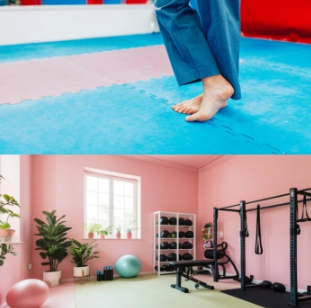
Home tatami mats are aimed at a broad audience: people practicing yoga, Pilates, or stretching at home, those wanting to create a mini fitness area, or parents building a safe play area for children. On the market, you can find expanded EVA foam panels that are lightweight, easy to transport, interlocking, or rollable, with thicknesses ranging from 1.5 to 3 cm.
The variety of colors and their lightweight design also make them ideal for multifunctional rooms where the tatami needs to be assembled and removed frequently. However, floor grip and resistance to localized loads such as weights or gym equipment should not be underestimated.
Pros and cons for home training
The main advantages of home tatami mats are their affordable price, ease of use, and versatility. They do not require complex installation, are easy to clean, and adapt well even to small spaces. They are an excellent solution for bodyweight exercises, functional training, or light physical activities.
On the other hand, the level of protection is lower than professional models, especially in the event of falls. Durability may also decrease with prolonged use or exposure to heat and humidity. For this reason, it is essential to choose products made from certified and anti-slip materials.
How to recognize a good home tatami
A good home tatami should provide a balanced combination of comfort and stability. EVA foam is the most common material, but not all panels are the same: check density, elastic recovery capacity, and tear resistance. An embossed surface helps prevent slipping.
Finally, ensure that the edges are compatible if you choose an interlocking system and that the materials do not contain harmful substances. A home tatami should also be easy to clean and odor-free so that it integrates naturally into everyday life.
Comments (0)