
Trolley
You have no items in your shopping cart

 Budgets
 Dumbers
 Discs
Discs
 Benches
 Racks and Rigs
 Weights Holders
 Isotonic machines
 Calisthenics
 Cardio
 Kettlebells
 Flooring
 Gym Set
 Accessories
 Combat
 ARTI MARZIALI
 CONTAINER GYM
 Tug-Of-War
 Used Gym Equipment
 PILATES MACCHINARI
 GINNASTICA ARTISTICA
 CAMPI DA PADEL
 Prodotti in Pronta Consegna
 Informazioni
 IRONMAN
 Gift Card
- Donatif
- General information
- 0 I like it
- 4814 Views
- 0 comments
READING TIME: 12 MINUTES ➤➤
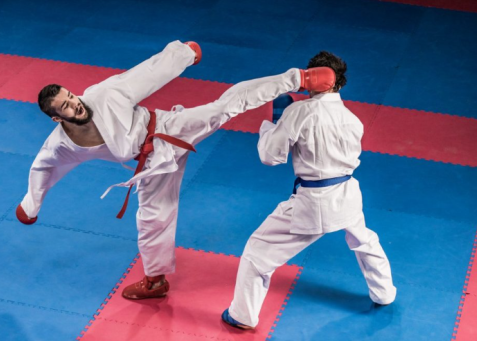
When it comes to performance in karate, tatami is not just a technical detail but a strategic choice. Whether for daily training or official competitions, the quality of the surface on which kata are performed or kumite is practiced directly affects stability, safety, and fluidity of movement. For schools and instructors affiliated with the WKF, choosing the right tatami means investing in an optimal experience for practitioners.
In this article, we explore all the essential features of karate tatami, analyzing materials, thickness, anti-slip properties, and, above all, the certifications required for official competitions. An essential guide for those seeking quality, reliability, and compliance with international standards.
Read also:
Why choose WKF-certified tatami
Official requirements for training and competitions
The World Karate Federation (WKF) regulations establish precise criteria for the certification of WKF karate tatami. These standards ensure that every flooring element meets requirements of safety, grip, and performance, allowing athletes to compete under uniform and regulated conditions. Key requirements include a thickness of 2 cm, a certified anti-slip surface, shock absorption properties, and compliant dimensions for defining the competition area.
Using approved tatami not only ensures compliance with regulations but also guarantees a safe and professional environment. For karate schools aiming to host events or train competitive athletes, this is an essential investment. WKF-recognized models are tested to provide the right balance between durability and dynamic comfort, minimizing the risk of slipping or injury.
Advantages of certified tatami
Choosing WKF-certified tatami offers clear benefits in terms of both credibility and quality. First, it provides assurance for instructors: the training area mirrors exactly the conditions athletes will face in competition. Additionally, these tatami are designed to withstand intensive use, maintaining performance even after years of wear.
Another important aspect is the perceived value among students and families. A school equipped with certified materials communicates professionalism and attention to safety. This can enhance the gym’s attractiveness, making it a preferred choice for those seeking a technically advanced and well-prepared environment.
Technical features that make the difference
Recommended thickness: why 2 cm is the standard
The 2 cm thickness has become the universal standard for karate tatami due to its ability to combine comfort and stability. This dimension provides sufficient cushioning to absorb jumps and landings typical of kumite, without compromising the firmness required for kata execution. Thicker mats may be too soft, while thinner ones can expose athletes to harsher impacts.
Beyond safety, the 2 cm thickness also supports modularity and easy installation. These tatami fit together seamlessly, creating a uniform surface without unevenness that could interfere with rapid movements. This makes them ideal for both professional gyms and school environments dedicated to martial arts.
Materials and anti-slip technologies
One of the most critical aspects when choosing an anti-slip tatami is the surface composition. The most commonly used materials include EVA (ethylene vinyl acetate), a high-density foam that provides controlled elasticity, mechanical resistance, and good grip even barefoot. The surface is often textured in a “rice straw” pattern to enhance traction and reduce slipping risks.
Modern solutions also incorporate technologies that improve floor grip of the panels themselves, preventing movement during use. This is especially important in dynamic contexts such as kumite, where quick movements and rotations can challenge floor stability. A well-designed anti-slip tatami protects athletes and helps maintain a smooth and safe training rhythm.
Durability and maintenance
A high-quality tatami must not only perform well but also be durable over time. Premium products are designed to withstand heavy loads, impacts, bending, and friction wear. High-quality EVA panels retain their shape and density even after thousands of sessions, without deforming or losing uniformity.
Maintenance is simple: regular cleaning with neutral detergents and proper ventilation is enough to prevent mold formation. Panel edges are shaped to prevent moisture infiltration and facilitate assembly and disassembly. For gym managers, investing in durable karate flooring means reducing long-term costs while ensuring a consistently safe surface.
Stability, comfort, and movement control
The importance of grip in kata
In kata, every detail matters: posture, balance, and precision are essential. This is why tatami grip plays a crucial role. A surface that is too slippery can compromise stability, while excessive grip may hinder fluid transitions. The best tatami for kata provide the right balance, allowing secure footing without limiting mobility, supporting both elegance and power in technique execution.
This feature is not only essential for performance but also for learning. Beginners training on unsuitable surfaces may develop incorrect movement patterns. For this reason, choosing karate tatami with balanced friction properties is essential for safe and progressive development.
Optimal support for kumite
Kumite, with its explosive movements and rapid transitions, requires flooring that absorbs impact without slowing action. The ideal karate flooring for sparring has a density designed to protect knees, ankles, and joints from repeated microtrauma. At the same time, controlled elasticity enables fast reactions, enhancing speed and responsiveness.
Another key aspect is surface continuity. Uneven or poorly installed tatami can create hazards and lead to injuries. This is why experienced instructors prefer high-quality modular systems with interlocking mechanisms that ensure a continuous and stable surface, closely replicating official competition conditions.
Injury prevention and performance improvement
Choosing a quality tatami is not just a technical decision but a preventive measure. A surface designed for professional karate reduces the risk of slips, sprains, and injuries, creating a safer training environment. Shock absorption and energy return are optimized to support every phase of movement.
At the same time, safety enhances performance. A proper tatami allows athletes to train more confidently, experiment with techniques, and move fluidly. It is on these surfaces that true technical skills are developed over time. For this reason, selecting a high-quality anti-slip tatami is a strategic decision for any dojo aiming for excellence.
How to evaluate the right tatami for your gym
Selection criteria for instructors and schools
Every dojo has specific needs, but some universal criteria can guide the selection of the best karate tatami. These include WKF certification, foam density, anti-slip properties, wear resistance, and ease of installation. Color can also play a functional role, such as distinguishing competition areas.
Budget is another important factor. Professional tatami are available at different price levels, but quality and safety should never be compromised. The initial investment is offset by durability, lower replacement costs, and improved training experience. Working with specialized suppliers is often the best way to obtain tailored solutions.
Installation and optimal configuration tips
Once the right model is selected, proper installation is crucial. The base surface must be flat, clean, and dry. A small gap should be left around the perimeter to allow for expansion. Edges should be properly finished to prevent lifting or unevenness, and surface patterns should be aligned consistently to ensure uniform grip.
For multifunctional spaces, it is possible to choose modular or reversible tatami, allowing adaptation to different activities. Some models include carrying systems for easy transport. In all cases, proper installation enhances performance and preserves product quality over time.
Comments (0)