
Trolley
You have no items in your shopping cart

 Budgets
 Dumbers
 Discs
Discs
 Benches
 Racks and Rigs
 Weights Holders
 Isotonic machines
 Calisthenics
 Cardio
 Kettlebells
 Flooring
 Gym Set
 Accessories
 Combat
 ARTI MARZIALI
 CONTAINER GYM
 Tug-Of-War
 Used Gym Equipment
 PILATES MACCHINARI
 GINNASTICA ARTISTICA
 CAMPI DA PADEL
 Prodotti in Pronta Consegna
 Informazioni
 IRONMAN
 Gift Card
- Donatif
- General information
- 0 I like it
- 699 Views
- 0 comments
- gym flooring, safety flooring, gym safety, shock-absorbing materials
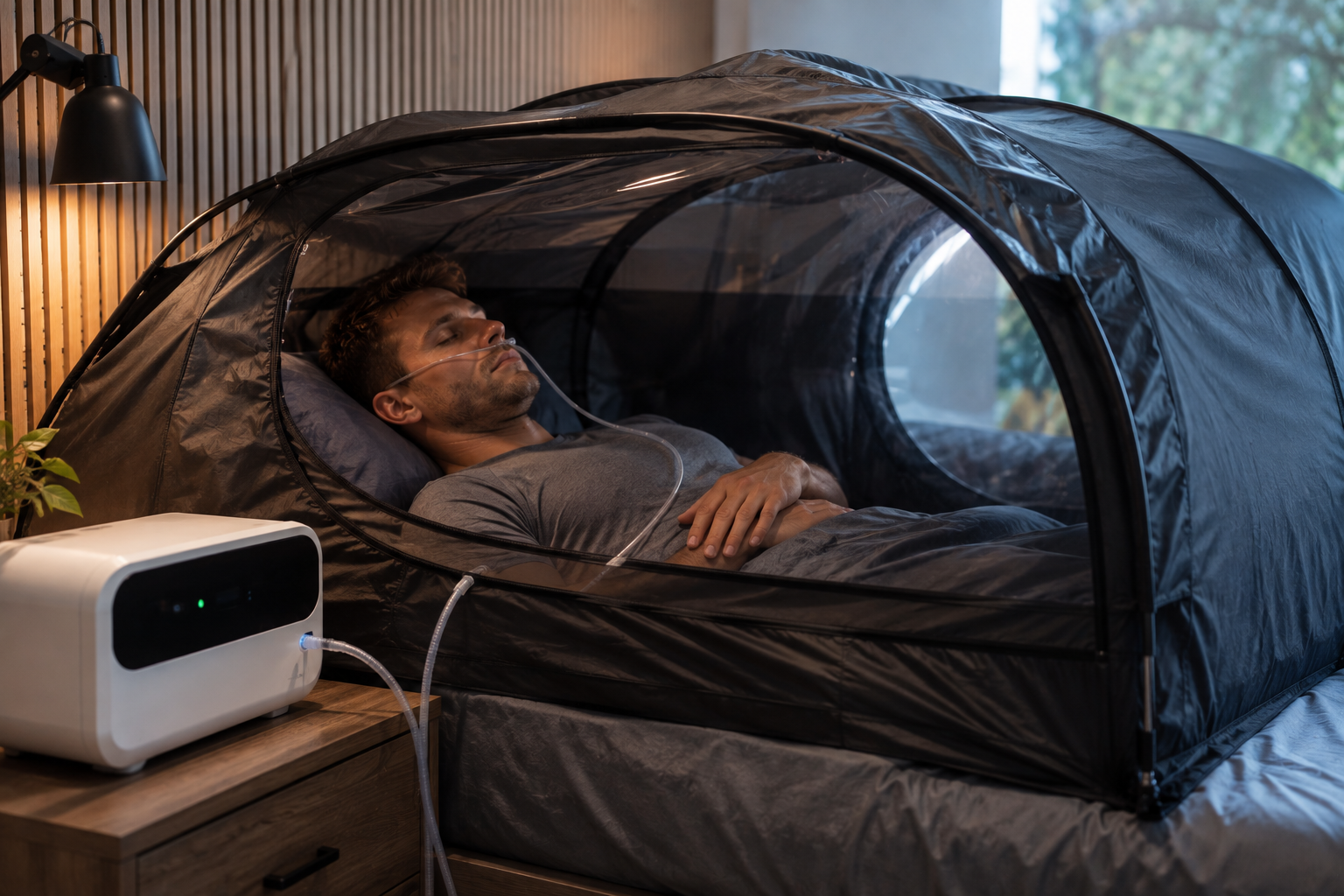
Hypoxic Tents vs. Rigid Chambers: which accessories change?
The choice between a hypoxic tent and a rigid chamber represents one of the most important decisions for those wishing to introduce altitude training into a home or professional environment. Both systems allow for the simulation of conditions with reduced oxygen availability, but the way they are designed, installed, and managed presents significant differences that influence performance, comfort, and technical requirements.
Many users initially evaluate this choice by considering only the available space. However, the real difference does not concern exclusively the dimensions of the environment, but above all the way in which the airflow is controlled, the management of the generator, and the quality of the accessories necessary to maintain stable hypoxic conditions. An effective system depends, in fact, on the interaction between all its components.
For an athlete practicing cycling, triathlon, or endurance disciplines, or for a biohacking enthusiast interested in sleeping at simulated altitude, understanding the characteristics of the two approaches allows for the creation of a more efficient setup. Analyzing hypoxic tent accessories, air distribution systems, and setup differences helps in choosing a solution that is truly consistent with personal goals.
Differences between hypoxic tents and chambers
Hypoxic tents and rigid chambers share the same general principle: creating an environment where the oxygen concentration is modified through a controlled system. However, the physical structure and the way the air is contained determine very different characteristics in daily use.
A hypoxic tent is generally a more flexible and modular solution. It can be installed over a bed or in a space dedicated to rest, proving particularly interesting for those who wish to use hypoxia during sleep without completely transforming a room.
A rigid chamber, on the other hand, represents a more structured solution, with walls and materials designed to create a dedicated environment. This configuration offers greater control of the internal space and may be more suitable for professional centers, private studios, or users seeking an experience more similar to a specialized facility.
Advantages of the hypoxic tent
The main advantage of the tent is its modularity. It can be installed in environments where a complete chamber would be difficult to build and allows one to begin a hypoxic journey with a generally more contained investment.
This feature makes it particularly interesting for endurance athletes who wish to integrate simulated altitude sleep into their preparation without permanently modifying their home.
Advantages of the rigid chamber
The rigid chamber instead offers greater environmental stability thanks to the closed structure specifically designed to contain the airflow. This allows for more precise management of internal conditions and greater freedom of use.
For professional facilities that want to offer a premium service, a rigid chamber can represent a distinctive element because it communicates greater technological completeness and the possibility of customization.
Airflow management in the hypoxic system
One of the most important aspects in choosing between a tent and a rigid chamber concerns airflow management. The effectiveness of a hypoxic system does not depend solely on the generator's ability to produce air with a certain oxygen concentration, but also on the ability to distribute it correctly within the environment.
Each configuration requires a different approach. A hypoxic tent, having more flexible materials and generally smaller volumes, requires a precise balance between air intake and internal exchange. A rigid chamber instead requires a design more similar to that of a controlled environment.
Flow control directly influences the stability of the values reached. Non-uniform distribution can create differences in oxygen concentration and reduce the quality of the user experience.
Importance of air exchange
Air exchange is fundamental for maintaining consistent conditions during use. Every opening, movement, or internal variation can temporarily modify the environment created by the system.
For this reason, components must be correctly sized in relation to the volume of the structure used and the goals of the hypoxic protocol.
Control of hypoxic stability
A well-designed system must be able to maintain constant parameters over time. This aspect is particularly important for those who use hypoxia during sleep, where frequent variations could compromise the quality of the protocol.
Stability depends on the interaction between the generator, piping, sensors, and containment structure.
Accessories necessary for hypoxic tents
Hypoxic tents require a series of specific components to function correctly. The apparent simplicity of the structure should not lead one to think of a system devoid of complexity: the final result depends on the quality of the accessories used.
Among the most important elements are the hypoxia generator, air connection systems, control sensors, and tools dedicated to monitoring environmental parameters. Each component contributes to the precision of the system.
For those wishing to create an effective home hypoxic system, the choice of accessories must be made considering not only technical compatibility but also the ease of daily use.
Generator for hypoxic tents
The hypoxia generator for tents represents the heart of the system. It must be able to provide a constant flow adequate for the dimensions of the tent used.
A correctly sized generator allows for reaching the desired conditions quickly and maintaining them throughout the session.
Sensors and monitoring
Monitoring systems allow for verifying that the set parameters are actually maintained. For athletes following structured protocols, having reliable data allows for better adaptation of the journey.
Continuous control also improves safety and makes it easier to identify any anomalies in the system's operation.
Components of rigid hypoxic chambers
Rigid chambers require a more complete design approach because they represent true controlled environments. The structure must integrate insulation, air distribution, and control systems to ensure constant performance.
Setting up a chamber requires more attention to initial design, but it also offers greater possibilities for customization compared to a temporary solution.
For fitness centers and professional facilities, this configuration allows for creating a more advanced service that is easily integrated with other training protocols.
Hypoxic chamber setup
The hypoxic chamber setup includes various elements that must work together: structure, generator, ventilation systems, sensors, and electronic control.
A complete design allows for obtaining a more stable environment and a more professional experience for users.
Advantages of the professional configuration
A well-designed rigid chamber allows for greater freedom in organizing the space and can support more intensive use compared to a simple home installation.
This feature makes it interesting for those who want to turn hypoxia into a continuous service.
Generator and oxygen distribution
The generator represents the operational center of any hypoxic system. Its capacity must be consistent with the volume of the environment and the type of use intended.
A home system dedicated to sleep will have different needs compared to a chamber used by multiple people during consecutive sessions.
The quality of air distribution directly influences the perception and effectiveness of the system.
Generator sizing
Choosing an adequate generator means evaluating volume, frequency of use, and goals. An undersized system might have difficulty maintaining stable conditions.
Correct sizing ensures greater efficiency and longevity of the system.
Integration between components
The generator never works in isolation. Piping, sensors, and structure must be considered as parts of a single system.
The quality of integration determines the final result and the simplicity of daily management.
How to choose the most suitable setup
The choice between a hypoxic tent and a rigid chamber must start from personal goals and the context of use. There is no universally better solution, but rather a configuration more consistent with specific needs.
An athlete looking for flexibility might prefer a modular solution, while a professional facility might value a permanent configuration more.
The evaluation must consider space, frequency of use, level of control required, and the possibility of future evolution.
Needs of the endurance athlete
Cyclists and triathletes often use hypoxia as a tool complementary to preparation. The possibility of sleeping at simulated altitude represents an interesting element for integrating advanced strategies.
In this case, the practicality and reliability of the system become fundamental factors.
Needs of home biohacking
Biohacking enthusiasts often look for customizable and monitorable solutions. The choice of accessories allows for building an environment adapted to one's needs.
Modularity therefore becomes a key element for progressively modifying and improving the system.
Investment and system customization
Creating an effective hypoxic system means evaluating the investment as a whole. It is not enough to choose a tent or a chamber: the result depends on the quality of the components that allow the system to function correctly.
Customization represents one of the main advantages of modern solutions. Through adequate accessories, it is possible to adapt the setup to one's needs, improving comfort, control, and performance.
Choosing quality components means building a solution that is more reliable over time. A well-designed hypoxic system can accompany the athlete's evolution or become a high-value-added professional service.
Modularity as a strategic advantage
The possibility of adding or replacing components makes the system more flexible. This allows for starting with an essential configuration and expanding it later.
Modularity reduces the risk of non-optimized investments and allows for progressive growth.
Choice based on space and goals
The final decision must take into account both the available environment and the desired results. Space is important, but the true distinctive element remains the correct management of the system.
Careful design of the airflow and accessories allows for getting the most out of the chosen hypoxic technology.
Comments (0)