
Trolley
You have no items in your shopping cart

 Budgets
 Dumbers
 Discs
Discs
 Benches
 Racks and Rigs
 Weights Holders
 Isotonic machines
 Calisthenics
 Cardio
 Kettlebells
 Flooring
 Gym Set
 Accessories
 Combat
 ARTI MARZIALI
 CONTAINER GYM
 Tug-Of-War
 Used Gym Equipment
 PILATES MACCHINARI
 GINNASTICA ARTISTICA
 CAMPI DA PADEL
 Prodotti in Pronta Consegna
 Informazioni
 IRONMAN
 Gift Card
- Donatif
- General information
- 0 I like it
- 11 Views
- 0 comments
- gym flooring, safety flooring, gym safety, shock-absorbing materials
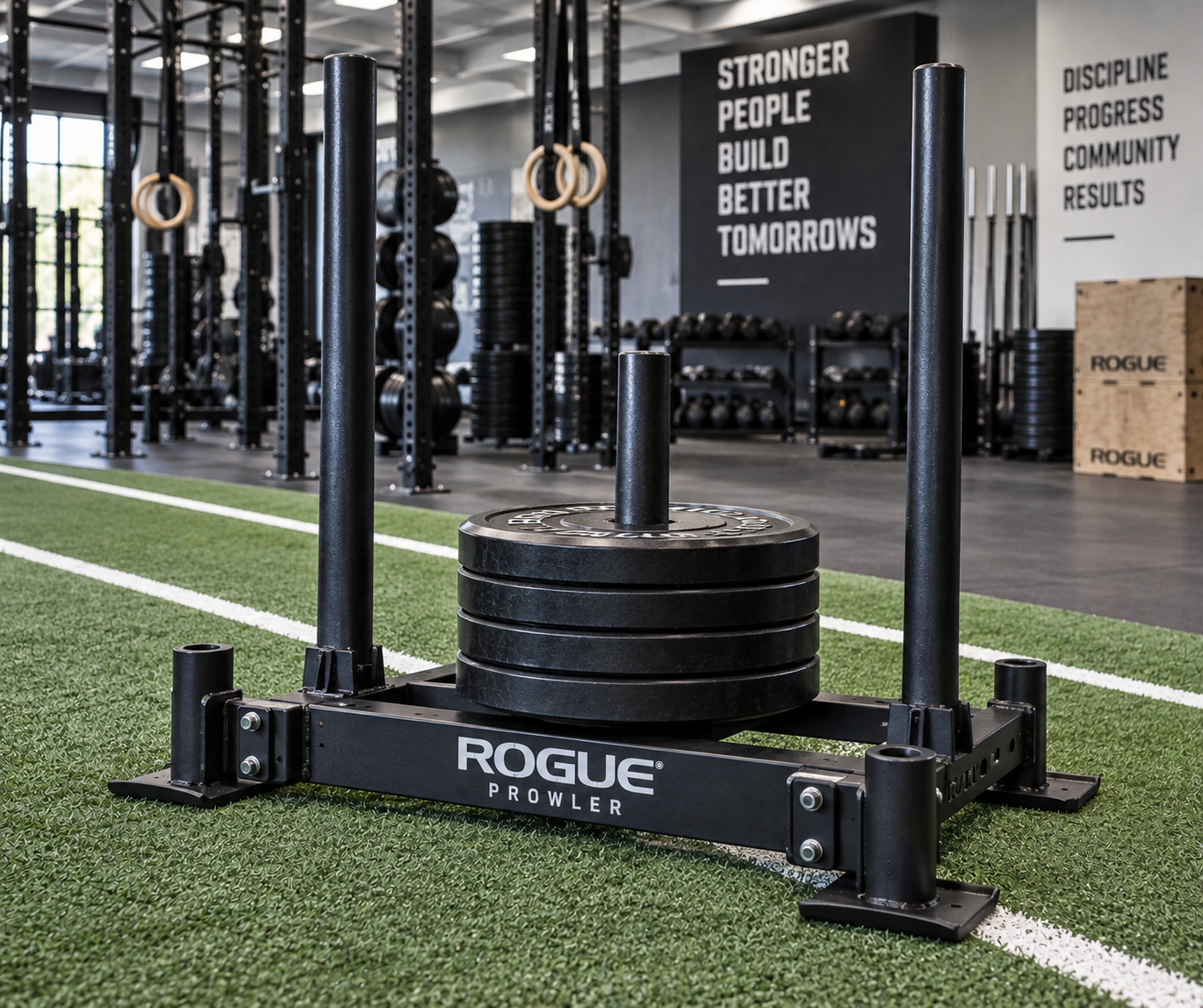
Prowler sled in professional gyms: lane length and floor protection
Designing an area dedicated to the prowler sled requires careful evaluation of available space, flooring, and the organization of training flows. A correct setup improves the user experience, reduces surface wear, and facilitates the use of the sled during high-intensity sessions.
Unlike much other functional training equipment, the prowler sled requires a lane free of obstacles, with a homogeneous surface that is resistant enough to withstand the continuous friction generated during sled push and sled drag exercises.
This guide analyzes the main design criteria for creating a professional workstation dedicated to the prowler sled, focusing on lane length, floor protection, area configuration, and operational checks to be performed before installation.
- Quick answer
- What requirements the area must have
- How to organize space and layout
- Lane configuration
- Floor protection
- Safety and maintenance
- Design errors to avoid
- How to evaluate the project over time
Quick answer
A professional area dedicated to the prowler sled must include a lane free of obstacles, flooring compatible with the friction generated by the sled, and sufficient space for acceleration, stopping, and reversing movement. Final dimensions must be defined according to the model used and the manufacturer's instructions.
Proper design reduces interference with other gym activities and helps preserve both the equipment and the training surface.
Before installation, it is also advisable to check user pathways and the compatibility of the lane with other existing stations.
Why a dedicated lane is needed
Separating the area intended for the sled push from other training spaces reduces the risk of interference and improves flow management.
Evaluating the project as a whole
The choice of configuration should consider the intensity of use, number of users, and planned training methods.
What requirements the area must have
The lane should be straight, easily accessible, and kept free of mobile equipment during use.
The surface must allow smooth sliding of the sled while avoiding sudden friction changes due to different materials or irregular joints.
The design must also provide adequate entry and exit spaces to allow the start and end of the exercise in a controlled manner.
Area without obstacles
Benches, racks, free weights, and other elements should not interfere with the sled's path.
Flow management
The position of the lane should limit crossing by other users during exercises.
How to organize space and layout
The length of the lane depends on the programmed exercises, the level of the athletes, and the type of training planned.
Rather than seeking a standard measurement valid for every situation, it is preferable to design a space that allows the complete execution of movement without forced stops.
The width of the lane must also allow stable guidance of the sled while maintaining safety margins from surrounding areas.
How to define length
The operational length must be consistent with the training program and the sled manufacturer's instructions, avoiding interrupting the movement before completing the test.
Lateral space
It is useful to provide a free margin on the sides of the lane to facilitate passage and reduce the risk of accidental collisions.
How to configure a professional workstation
A dedicated station should facilitate both sled push and sled drag exercises without requiring continuous movement of the equipment.
The availability of space for loading plates and storing accessories helps keep the area tidy.
To integrate the station with other equipment, you can consult the section dedicated to gym accessories by choosing solutions compatible with the facility's layout.
Load management
Loading and unloading operations of the sled should be carried out in an area that does not obstruct the path of other users.
Accessory organization
Harnesses, ropes, and other accessories should be easily reachable but stored away from the working lane.
What flooring to use
The surface intended for the prowler sled must be compatible with the expected level of friction and the intensity of use of the facility.
Different materials can affect both the sliding of the sled and the level of floor wear. For this reason, it is important to check the instructions provided by the sled manufacturer and the flooring manufacturer.
A sports flooring kept clean and in good condition promotes greater uniformity of use over time.
Protecting the floor
The choice of surface should consider abrasion resistance, ease of maintenance, and compatibility with the continuous use of the sled.
Periodic checks
Regular inspections allow early detection of signs of wear on both the flooring and the sled's contact points.
Safety and maintenance
Before each session, it is advisable to check that the lane is completely clear and that the load is properly secured.
The contact surfaces of the sled should also be checked periodically to identify any deformations or damage.
Scheduled maintenance helps maintain the consistent operational characteristics of the equipment and the training area.
Preliminary checks
Check load stability, sled condition, lane conditions, and the absence of obstacles before starting any exercise.
Scheduled maintenance
Recording control interventions facilitates equipment management in facilities with intensive use.
Design errors to avoid
One of the most common errors is placing the lane in a transit area shared with other gym activities.
Also, the use of unsuitable surfaces or surfaces characterized by material changes along the path can affect the sled's behavior.
Neglecting the spaces intended for stopping and exercise preparation makes the daily use of the area less efficient.
Lane too short
A limited space may force the athlete to interrupt movement before completing the planned exercise.
Inefficient organization
Equipment distributed without a functional logic increases the risk of interference during training.
How to evaluate the project over time
A well-thought-out design promotes operational continuity, simplified maintenance, and better space management in sports facilities.
When evaluating the investment, it is useful to consider not only the sled but also the quality of the flooring, ease of maintenance, the possibility of reconfiguring the layout, and compatibility with future expansions of the functional area.
When applicable, it is advisable to consult the sled manufacturer's manual, the flooring instructions, and any references to relevant technical standards, avoiding the use of materials or configurations not provided for by the respective manufacturing guidelines.
Elements to compare
Flooring resistance, lane configuration, simplicity of maintenance, and integration with the rest of the gym represent useful criteria in designing a professional area.
Designing with growth in mind
A flexible configuration makes it easier to update the functional area should the number of users, available equipment, or proposed training types increase.
Comments (0)