
Trolley
You have no items in your shopping cart

 Budgets
 Dumbers
 Discs
 Benches
 Racks and Rigs
 Weights Holders
 Isotonic machines
 Calisthenics
 Cardio
 Kettlebells
 Flooring
 Gym Set
 Accessories
 Combat
 ARTI MARZIALI
 CONTAINER GYM
 Tug-Of-War
 Used Gym Equipment
 PILATES MACCHINARI
 GINNASTICA ARTISTICA
 CAMPI DA PADEL
 Prodotti in Pronta Consegna
 Informazioni
 IRONMAN
 Gift Card
- Donatif
- General information
- 0 I like it
- 48 Views
- 0 comments
- gym flooring, safety flooring, gym safety, shock-absorbing materials
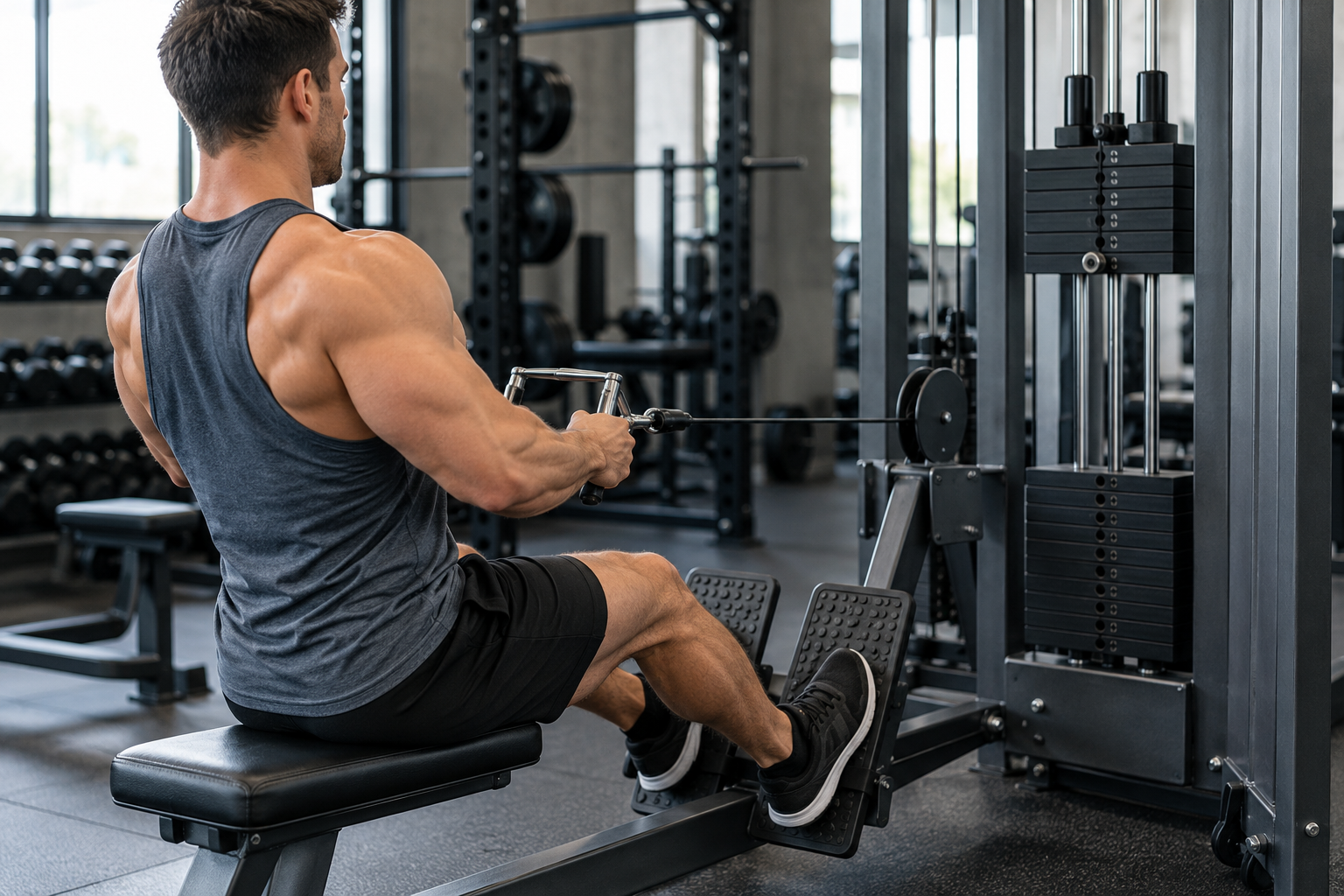
Back Training Machines: Lat Pulldowns, Rows, Cables and Pullovers
Back-training machines are not a uniform category. Lat pulldowns, guided rows and cable stations train pulling movements with different supports and control demands. To choose equipment for a programme or gym, distinguish pulling direction from the machine's appearance.
In everyday language, lats sometimes refers broadly to the back. The latissimus dorsi is actually one participant alongside other shoulder muscles, scapular controllers and elbow flexors. A product photograph cannot establish complete isolation or guaranteed results.
This guide compares the main machine families without universal rankings. Start with the required work: path, adjustments, supports, user capabilities and programme organisation. Manuals and technical sheets remain necessary for specific dimensions, limits and intended use.
- Lat machines and vertical pulling
- Rows and horizontal pulling
- Cable stations and seated cable rows
- Pullover machines and straighter-arm movements
- Weight stacks and plate-loaded machines
- Match equipment to user and programme
- Layout, maintenance and professional use
- Compare without absolute rankings
Lat machines and vertical pulling
A lat machine generally moves an overhead grip towards the torso, with configurations depending on design. Some use cables and a bar; others use levers or handles following defined paths. The category does not explain every difference. Identify seat and support adjustments, intended path and permitted accessories. Load selection can be manageable, but does not remove the need to learn coordination between arms, shoulder blades and torso.
Choose a usable grip
Pronated, neutral and supinated grips, where provided, alter hand orientation and may change comfort. Greater width is not automatically more effective. Before changing an attachment, check that the start is reachable without forcing and recovery remains controlled. Do not select difficulty simply for variety. The grip should support repeatable movement consistent with instructions, with individual adaptations assessed practically by a competent instructor.
Rows and horizontal pulling
Rows organise pulling in a predominantly more horizontal direction relative to the torso. Models may include chest supports, adjustable seats and different handles. Chest support can change postural demands compared with unsupported exercises, but does not automatically make execution correct or suitable for everyone. The user must reach the grips and follow the path while keeping intended supports. Specific design matters more than the commercial label.
Assess support and path
Check that settings permit the prescribed position without forcing an unmanageable posture. Elbow and hand paths depend on handles and variation. Rowing need not become a contest to drive the elbows as far back as possible. Maintain an appropriate range without swinging through excessive resistance. A demonstration connects machine information with actual practice.
Cable stations and seated cable rows
Cable stations offer configurations according to outlet heights, attachments and supports. A seated cable row is one particular application, not a synonym for all cable exercises. Versatility helps when the required settings are permitted and practical. It does not authorise invented connections, extensions or positions. Check attachment method and compatibility rather than assume every connection is universal.
Versatility and everyday operations
In a shared room, a multifunction station can serve different programmes but also create queues when many activities depend on one point. Consider adjustment time, attachment storage and staff ability to check connections. A large theoretical exercise count does not alone demonstrate value. Identify movements that will actually be performed and whether the station can be reset without leaving accessories in walkways.
Pullover machines and straighter-arm movements
Pullover machines and some cable variations organise shoulder movement differently from pulls with substantial elbow flexion. They do not eliminate all other muscles or automatically provide a more specific exercise. Supports, levers and settings establish the machine's path. Users must understand entry, limb placement and how to finish. Two products called pullover may require different setups and should not be considered identical without their instructions.
Define their role in the programme
A straighter-arm variation can serve a defined purpose, but is not compulsory after every pulling exercise. Assess overlap with other work and the ability to maintain the movement. Adding a machine to increase local fatigue does not establish programme improvement. Give every exercise a clear role rather than promise complete isolation or transformation of a particular back region.
Weight stacks and plate-loaded machines
Loading systems influence preparation and resistance characteristics, but do not determine quality alone. Stack machines use their designed selector; plate-loaded models require loading and unloading designated posts. Geometry, levers and transmission can change force requirements through the movement. Kilograms shown on different machines therefore cannot be treated as identical performance or difficulty.
Prepare the station neatly
Check pins, fasteners and selection method according to the manual. With plates, consider storage and the route needed to move weights. Do not increase load using improvised or unapproved elements. In a busy gym, user changeover can affect operations more than a marginal price difference. Establish responsibility for tidying and how abnormalities should be reported before training.
Match equipment to user and programme
Combine objectives, experience and the ability to control the machine. A guided path can simplify parts of the task, but must fit both adjustments and user. One person's comfort does not establish universal suitability. A trial helps assess entry, grip access and recovery control. Stop for pain or unexpected symptoms and seek appropriate advice rather than interpreting discomfort as proof of effectiveness.
Avoid collecting similar exercises
A programme does not automatically improve by adding more machines for the same area. Separate complementary functions from near-duplicates. Vertical and horizontal pulling can be organised coherently without an identical universal prescription. Consider volume, recovery and other planned activity. Record equipment and settings to understand progress instead of changing variations constantly and losing comparability. Stable technique provides more useful information than simply increasing a displayed number.
Layout, maintenance and professional use
For gym purchases, check intended use, operating dimensions and space for adjustment, access and servicing. Structural footprint does not automatically include moving levers, users and accessories. Minimum clearances come from documents and applicable site requirements rather than one category-wide measurement. Equipment that suits the programme can still create problems if it interferes with walkways or adjacent stations.
Organise checks and support
Cables, pulleys, joints, upholstery and fasteners need manufacturer-prescribed inspections according to design. Do not copy intervals or lubricants from another model. Establish staff checks and when qualified support is required. Report damaged parts, abnormal play and irregular movement before continued use. Retain model references and documents for replacement identification. Continuity depends on maintaining prescribed conditions, not only perceived sturdiness at purchase.
Compare without absolute rankings
Start with a table of pull direction, supports, adjustments, loading system and required functions. Include dimensions, delivery and services for a gym investment. Exclude offers missing essentials and ask about undocumented points. No category automatically wins: choose equipment that supports the intended work without avoidable operational difficulties.
Move from selection to use
The Donatif catalogue can help explore equipment for comparison. Consult technical sheets and instructions for each proposal and connect information with a demonstration where available. Once installed, arrange user information, initial settings and inspection responsibilities. Back training needs a clear programme and equipment suited to the movement; a large machine count does not replace learning, control and organised progression.
Comments (0)