
Trolley
You have no items in your shopping cart

 Budgets
 Dumbers
 Discs
Discs
 Benches
 Racks and Rigs
 Weights Holders
 Isotonic machines
 Calisthenics
 Cardio
 Kettlebells
 Flooring
 Gym Set
 Accessories
 Combat
 ARTI MARZIALI
 CONTAINER GYM
 Tug-Of-War
 Used Gym Equipment
 PILATES MACCHINARI
 GINNASTICA ARTISTICA
 CAMPI DA PADEL
 Prodotti in Pronta Consegna
 Informazioni
 IRONMAN
 Gift Card
- Donatif
- General information
- 0 I like it
- 491 Views
- 0 comments
- gym flooring, safety flooring, gym safety, shock-absorbing materials
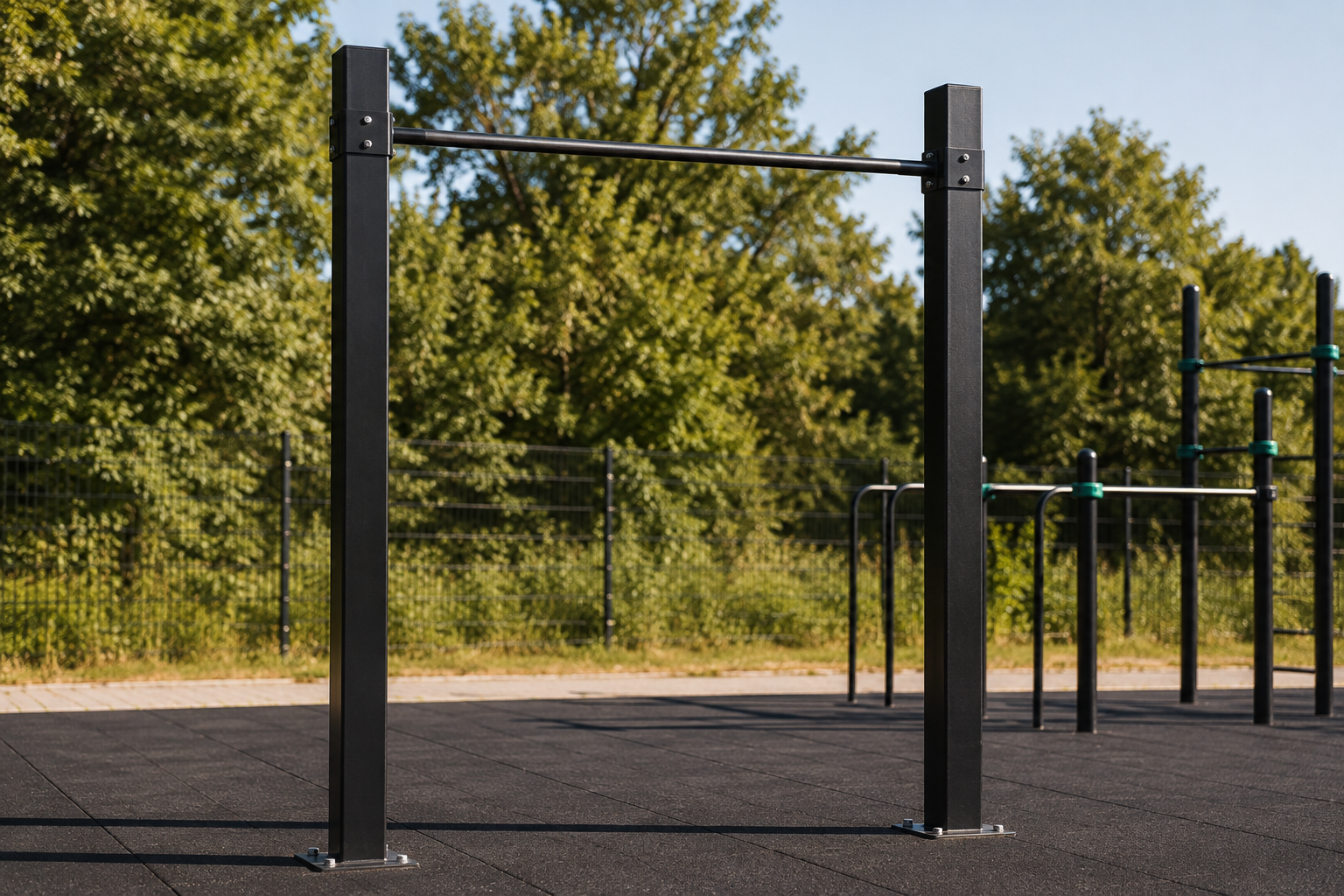
Outdoor Pull-Up Bar: Stainless Steel or Galvanized? The Rust Challenge
Installing an outdoor pull-up bar means creating a training space that is always available, ideal for those who want to train in the garden, in a private area, or within a calisthenics park. However, a structure intended to remain outdoors must face much harsher conditions than equipment installed in an indoor gym. Rain, humidity, temperature fluctuations, UV rays, and atmospheric agents can quickly compromise materials and finishes if the structure has not been designed for this type of use.
For this reason, the choice of material and surface treatment takes on fundamental importance. Many users wonder whether it is preferable to purchase a stainless steel structure or to opt for a galvanized steel solution. The answer depends on the installation environment, the available budget, and above all, the quality of the treatments applied during production.
In this guide, we analyze the differences between stainless steel and galvanized steel, the advantages of different corrosion protection technologies, and the aspects to evaluate in order to choose a bar destined to last for many years even in the most demanding climatic conditions.
- Why rust is the main enemy
- Stainless or galvanized steel: the comparison
- How galvanization works
- Why painting alone is not enough
- How to choose the right structure
- Maintenance and durability
- The most common mistakes
- An investment designed to last
Why rust is the main enemy of outdoor structures
Steel is one of the most used materials in the construction of sports equipment thanks to its high mechanical resistance. However, when it is exposed to humidity and oxygen without adequate protection, it tends to oxidize, forming rust. This process not only compromises the aesthetic appearance of the structure but can progressively reduce its strength and durability.
Outdoor installations are subjected to extremely variable conditions. Rain, snow, temperature changes, salt air in coastal areas, and persistent humidity accelerate the deterioration of metal surfaces. For this reason, a structure designed for indoor use should never be permanently installed outdoors.
Corrosion protection must therefore be considered an essential technical requirement and not a simple aesthetic element.
The most aggressive atmospheric agents
Water, humidity, ultraviolet rays, temperature fluctuations, and environmental pollution work simultaneously on the steel surface, increasing the risk of corrosion over time.
How corrosion affects safety
Advanced corrosion can compromise the quality of the surface, the welds, and the points most stressed during training, making it essential to choose suitable materials and treatments from the start.
Stainless steel or galvanized steel: which one to choose?
Stainless steel offers high natural resistance to corrosion thanks to the presence of chromium in the alloy. This characteristic makes it particularly interesting for installations in very aggressive environments, such as marine areas or locations characterized by high humidity.
Galvanized fitness steel, on the other hand, uses structural steel protected by a layer of zinc that isolates the material from the external environment and also performs a galvanic protection function. When galvanization is performed correctly, it represents an extremely effective solution for outdoor sports structures.
Both technologies can offer excellent performance, but it is essential to evaluate the quality of the workmanship, the thickness of the protection, the intended use, and the environmental conditions in which the structure will be installed.
The strengths of stainless steel
Stainless steel guarantees excellent corrosion resistance and requires reduced maintenance, making it ideal for contexts particularly exposed to atmospheric agents.
Why galvanized is so widespread
Quality galvanization combines high protection, excellent robustness, and an excellent ratio between performance and investment, making it one of the most used solutions in professional sports structures.
How steel galvanization works
Galvanization consists of applying a protective layer of zinc to the surface of the steel. This coating creates a barrier against humidity and atmospheric agents, significantly slowing down the formation of rust.
Among the available technologies, hot-dip galvanization represents one of the most effective solutions for outdoor installations. Immersing the component in molten zinc allows for uniform protection even in areas that are most difficult to reach.
The result is a structure capable of facing years of exposure to atmospheric agents while maintaining high mechanical performance and a good level of surface protection.
Why hot-dip galvanization is so effective
The zinc layer adheres uniformly to the steel surface, offering long-lasting protection even in the presence of small abrasions or surface wear.
Galvanic protection
Zinc protects the steel even when the coating suffers slight damage, slowing down the oxidation process compared to a simple painted surface.
Why painting alone is not enough
One of the most widespread beliefs is that powder coating is sufficient to protect a structure intended for outdoor use. In reality, paint mainly represents an aesthetic finish and a surface barrier, but it does not offer the same protection as galvanization when it is damaged.
Small bumps, scratches, or chips can directly expose the steel to humidity, favoring the appearance of corrosion right at the most stressed points.
For this reason, many professional structures intended for outdoor use combine galvanization and subsequent painting, obtaining double protection that improves both durability and aesthetic appearance.
The effect of surface damage
Even a small scratch can become the starting point for corrosion if the underlying metal is not adequately protected.
Galvanization and painting together
The combination of the two treatments offers superior protection compared to using paint alone, increasing resistance in the long term.
How to choose a structure for the garden or a calisthenics park
The choice of structure must consider the installation site, the intensity of use, and local climatic conditions. A garden pull-up bar used occasionally has different needs than one installed in a sports center open to the public.
It is also important to evaluate the construction quality, the thickness of the tubes, the robustness of the welds, and the anchoring system to the ground. A stable structure improves safety, comfort, and durability.
For facilities intended for numerous users, it is advisable to opt for an outdoor calisthenics structure designed specifically for intensive use and constant outdoor exposure.
Domestic installations
In a private garden, it is important to find the right balance between robustness, dimensions, and integration with the available space.
Sports centers and public areas
Structures intended for continuous use require certified materials, high-quality anti-corrosion treatments, and a design oriented toward maximum durability.
Maintenance and periodic checks
Even the most resistant structures require regular checks to maintain high performance over time. Periodically checking bolts, fixing points, and the state of the surfaces allows for the timely identification of any signs of wear.
Periodic cleaning helps remove residues of soil, leaves, dust, and substances that can trap humidity on the metal surface.
Simple but constant maintenance prolongs the useful life of the structure and allows its safety and functionality to be preserved for many years.
Scheduled inspections
A regular visual inspection allows you to verify the state of the surfaces and the integrity of the anchoring points, preventing any critical issues.
Surface cleaning
Eliminating dirt and deposits helps keep the surface protection in the best operating conditions.
The most common mistakes in choosing
Many users evaluate only the initial price without considering the quality of the anti-corrosion treatments. An inexpensive but poorly protected structure could require frequent maintenance or early replacement.
Another mistake is to install products designed for indoor environments directly outdoors, exposing them continuously to rain and humidity.
Neglecting proper installation can also compromise the durability of the facility, especially when anchoring points favor water stagnation or infiltration.
Looking only at the cost
Evaluating durability, construction quality, and corrosion protection allows you to obtain a more cost-effective investment in the long term.
Neglecting positioning
Correct installation facilitates water drainage and helps preserve the characteristics of the structure over time.
An investment designed to last for years
Choosing the right outdoor structure requires a technical evaluation that takes into account materials, surface treatments, and the installation environment. Stainless steel and galvanized steel both represent reliable solutions when made with high quality standards, but the quality of the production process remains the true element that determines durability over time.
A structure designed to withstand atmospheric agents maintains high mechanical performance, requires less maintenance, and offers a safe training experience season after season.
To compare professional solutions dedicated to outdoor training, you can consult the range of outdoor pull-up bars available in the Donatif catalog, developed to offer reliability, construction quality, and resistance to the most demanding climatic conditions.
Comments (0)