
Trolley
You have no items in your shopping cart

 Budgets
 Dumbers
 Discs
Discs
 Benches
 Racks and Rigs
 Weights Holders
 Isotonic machines
 Calisthenics
 Cardio
 Kettlebells
 Flooring
 Gym Set
 Accessories
 Combat
 ARTI MARZIALI
 CONTAINER GYM
 Tug-Of-War
 Used Gym Equipment
 PILATES MACCHINARI
 GINNASTICA ARTISTICA
 CAMPI DA PADEL
 Prodotti in Pronta Consegna
 Informazioni
 IRONMAN
 Gift Card
- Donatif
- General information
- 0 I like it
- 467 Views
- 0 comments
- gym flooring, safety flooring, gym safety, shock-absorbing materials
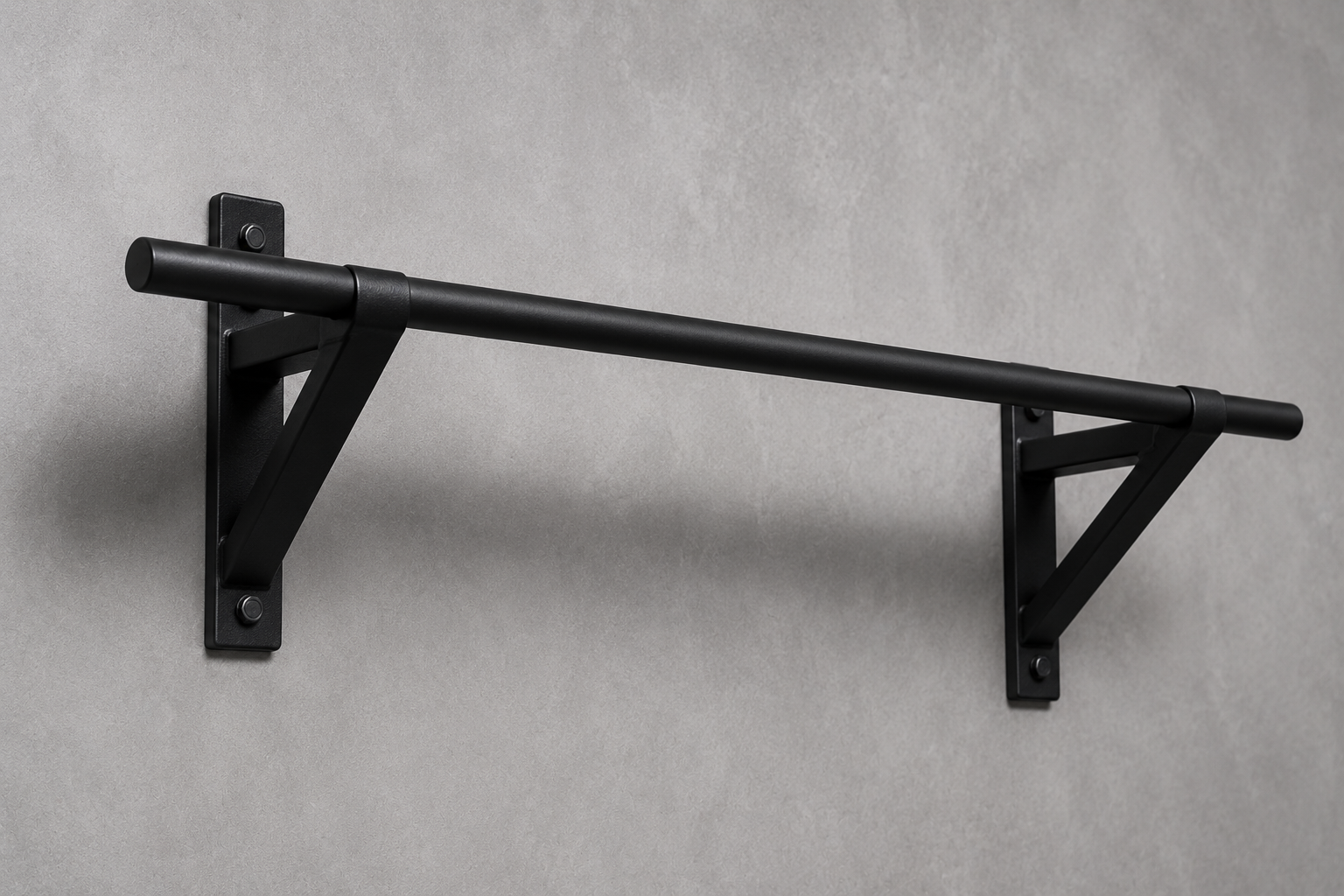
Pull-up Bar and Grip Diameter: Which One to Choose for Maximum Strength?
When it comes to bar training, most athletes pay attention to the number of repetitions, the added weight, or the programming, while an apparently secondary detail is often ignored: the pull-up bar diameter. Yet, just a few millimeters can profoundly change the biomechanics of the grip, muscle engagement, and the ability to develop strength during every exercise.
The bars available on the market have different diameters, generally ranging between 25 mm, 28 mm, and 32 mm, to which even thicker solutions dedicated to grip strength development are added. Each size produces specific effects on forearm work, wrist stability, and the ability to transfer force to the rest of the body. Therefore, there is no universally better diameter, but rather a solution more suited to the athlete's goals and the type of training.
In this guide, we analyze in detail how the grip diameter influences performance in pull-ups, what advantages the different sizes offer, and why more experienced athletes often choose different diameters compared to traditional standards.
- Why grip diameter is important
- 25 mm, 28 mm, or 32 mm
- Biomechanics of the grip
- Thick bar and strength development
- Fat Grip and specific training
- How to choose the ideal diameter
- Most common mistakes
- The right choice to improve performance
Why grip diameter is important
Every bar exercise begins with the contact between the hand and the grip. It is precisely at this point that all the force necessary to perform a pull-up, maintain an isometric position, or complete explosive movements like the muscle-up is transmitted. The diameter of the bar determines how much the hand can wrap around the surface and how much force is required to maintain control.
A stable grip allows for reduced energy dispersion and enables the main muscle groups involved in the movement to work more efficiently. Conversely, when the diameter is not suitable for the size of the hand or the training goals, forearm work increases and the ability to transfer force to the lats, biceps, and shoulders decreases.
For this reason, the bar diameter represents a design element that directly affects training quality, safety, and long-term progression.
Grip as the first link in the chain
The strength developed during a pull-up depends on the ability to maintain a stable grip for the entire duration of the movement. If the grip fatigues prematurely, the other muscles also inevitably reduce their performance.
Force transfer
An adequate diameter allows for a more uniform distribution of pressure on the palm of the hand and improves control during every phase of the exercise.
25 mm, 28 mm, or 32 mm: what are the differences?
The most common sizes are 25 mm, 28 mm, and 32 mm. Each has different characteristics that significantly influence the feeling during training.
A 25 mm bar is generally perceived as very easy to grasp. It favors a complete hand grip and allows for maintaining high endurance even during very long sets. For this reason, it is often appreciated by those who perform numerous repetitions or have smaller hands.
The 28 mm diameter represents the most used compromise in professional facilities. It offers an excellent balance between comfort, control, and strength development, making it suitable for both calisthenics and functional training.
32 mm bars, on the other hand, require superior grip strength. The greater thickness increases forearm work and makes every repetition more demanding, especially during high-volume exercises.
When to choose 25 mm
A reduced diameter facilitates complete hand closure and allows for limiting grip fatigue during endurance-oriented workouts.
When to choose 32 mm
A greater thickness increases the effort required by the hand and forearm muscles, making it particularly interesting for athletes focused on developing grip strength.
Biomechanics of the grip and muscle activation
The pull-up bar grip changes the way the fingers distribute pressure along the surface of the bar. When the diameter increases, the hand must produce greater force to maintain the same stability.
This phenomenon leads to greater involvement of the finger flexor muscles, forearm muscles, and structures responsible for wrist stabilization.
At the same time, a diameter that is too large relative to the size of the hand can cause premature grip fatigue, limiting the number of repetitions that can be performed even if the lats and biceps could continue to work.
Forearm involvement
The demand for strength increases progressively with the increase in bar thickness, turning every exercise into a grip workout as well.
Comfort and control
An appropriate size allows the wrist to be kept in a natural position, improving the technical quality of the movement.
Thick bar and strength development
The thick pull-up bar is used by many experienced athletes as a specific tool to increase grip strength and improve control during more advanced exercises.
Training regularly with a larger diameter bar forces the hand musculature to produce higher levels of force, favoring adaptations that can also be useful when using standard bars.
For this reason, some professional facilities install multiple bars with different diameters, allowing users to customize their training based on their goals.
Gradual progression
Switching suddenly from a standard bar to a very thick one can increase fatigue. A gradual progression allows for developing strength without compromising technical quality.
Applications in calisthenics
Advanced athletes often use different diameters to improve control during front levers, planches, muscle-ups, and other skills that require high grip strength.
Fat Grip and grip training
Fat grips for pull-ups are an accessory designed to temporarily increase the diameter of the bar. It is a practical solution to transform a normal bar into a tool dedicated to grip development.
The use of fat grips significantly increases the work required by the hand and forearms, making even apparently simple exercises more demanding.
This type of training is often included as a supplement in the preparation of strength athletes, calisthenics practitioners, and sportspeople who need a particularly resistant grip.
Main benefits
The increase in thickness makes it more difficult to close the hand completely, forcing the flexor muscles to work with greater intensity.
When to use them
Fat grips are particularly recommended during phases dedicated to developing grip strength and not necessarily during every training session.
How to choose the ideal diameter
The choice depends mainly on hand size, technical level, and personal goals.
Those seeking the maximum number of repetitions or prioritizing comfort can opt for reduced or intermediate diameters. Athletes interested in developing grip strength can instead benefit from thicker bars or dedicated accessories.
To evaluate models designed for different needs, you can consult the selection of pull-up bar diameters available in the Donatif catalog.
Hand size
A smaller hand tends to work better with smaller diameters, while large hands can effectively utilize even thicker grips.
Training goals
Maximal strength, endurance, calisthenics, and athletic preparation require different grip characteristics.
The most common mistakes in choosing
Many buy a bar without checking the grip diameter, focusing exclusively on load capacity or price.
Another mistake is believing that a thicker bar is automatically better. In reality, excessive thickness can limit performance if it is not consistent with the athlete's level.
It is also important to consider that the diameter is only one element of build quality, along with materials, structural rigidity, and surface finish.
Looking only at the cost
The choice should be based primarily on technical characteristics and the intended use of the equipment.
Imitating professional athletes
The needs of a high-level athlete can be very different from those of someone training to improve health, general strength, or physical preparation.
The right choice to improve performance
The bar diameter directly influences the quality of the grip, muscle engagement, and the ability to develop strength during every exercise. Understanding these differences allows you to choose equipment that is truly consistent with your goals.
A bar designed with the correct diameter improves comfort, favors more precise execution, and allows for better management of the training load over the long term.
Whether the goal is to increase the number of pull-ups, develop grip strength, or improve performance in calisthenics, paying attention to even a few millimeters can make a significant difference in the quality of training and the results obtained.
Comments (0)