
Trolley
You have no items in your shopping cart

 Budgets
 Dumbers
 Discs
Discs
 Benches
 Racks and Rigs
 Weights Holders
 Isotonic machines
 Calisthenics
 Cardio
 Kettlebells
 Flooring
 Gym Set
 Accessories
 Combat
 ARTI MARZIALI
 CONTAINER GYM
 Tug-Of-War
 Used Gym Equipment
 PILATES MACCHINARI
 GINNASTICA ARTISTICA
 CAMPI DA PADEL
 Prodotti in Pronta Consegna
 Informazioni
 IRONMAN
 Gift Card
- Donatif
- General information
- 0 I like it
- 1028 Views
- 0 comments
- gym flooring, safety flooring, gym safety, shock-absorbing materials
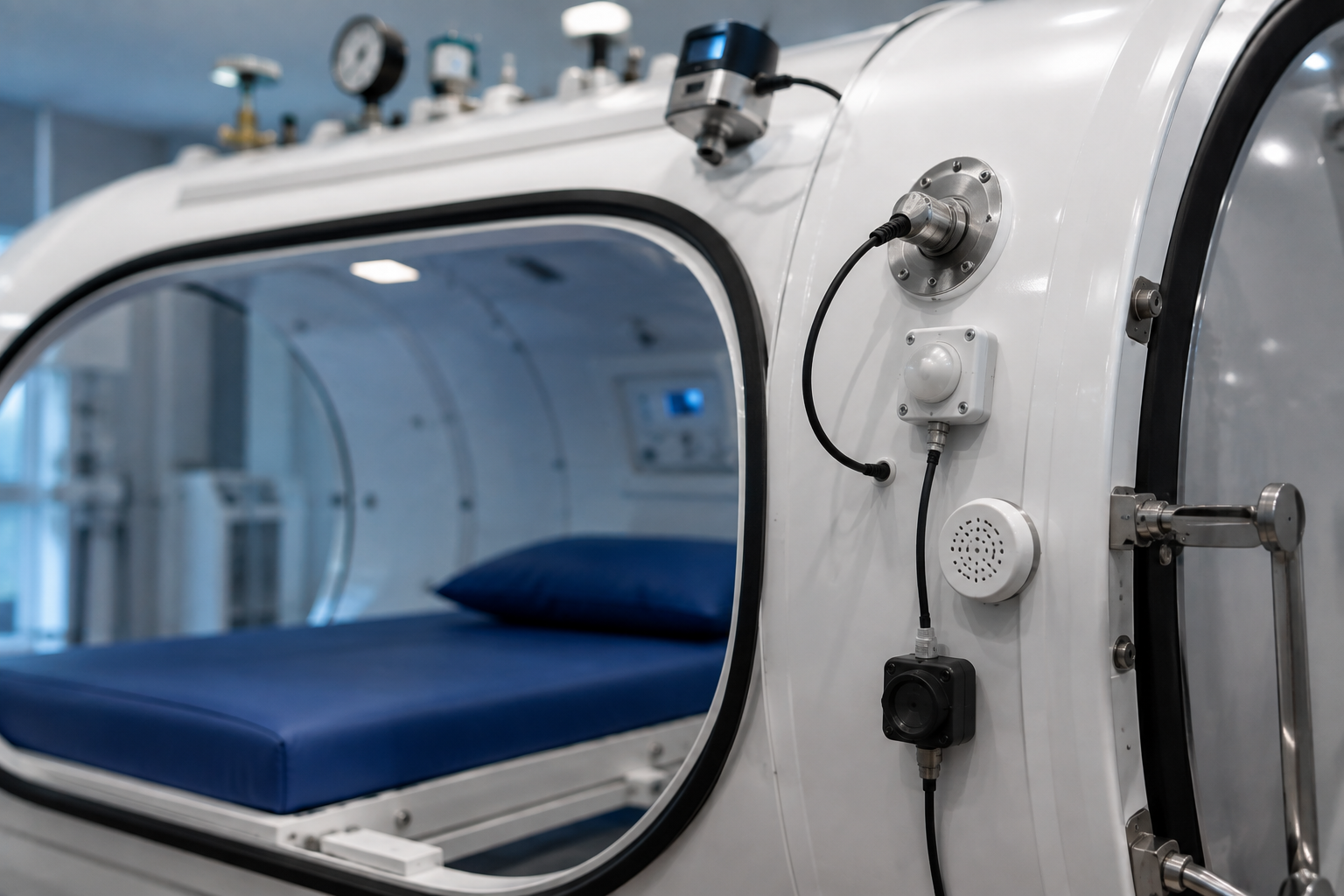
Hyperbaric chamber sensors: digital monitoring and advanced safety during every session
The safety of a modern hyperbaric chamber does not depend on a single element, but on the precise integration of mechanical components, electronic systems, and control procedures. In an environment where pressure, oxygen, and operating parameters must be managed with extreme precision, on-board electronics represent one of the most important elements to ensure reliability and continuity of use.
The most advanced technological systems use sensors and monitoring tools capable of collecting information in real time throughout the session. This data allows for constant monitoring of the internal conditions of the chamber, supporting operators in managing the device and increasing the level of safety perceived by users.
For sports center managers, maintenance technicians, and professional facilities, understanding how digital control systems work means better evaluating the quality of an investment. An advanced hyperbaric chamber must not only reach certain parameters, but must also be able to monitor, record, and react quickly to any variations.
- Importance of on-board electronics in hyperbaric chambers
- Hyperbaric chamber sensors and real-time monitoring
- Pressure control and operational stability
- Hyperbaric oxygen monitoring and parameter management
- Hyperbaric safety valves and system protection
- Hyperbaric chamber remote control and digital management
- Integration between Donatif electronics and mechanics
- Digital safety as a strategic investment
Importance of on-board electronics in hyperbaric chambers
A professional hyperbaric chamber is a complex system in which various elements must work in perfect harmony. The mechanical structure guarantees resistance and containment of pressure, while electronics make it possible to continuously control and interpret what is happening inside the environment.
On-board electronics represent the collection center for operational information. Through sensors distributed throughout the system, it is possible to detect fundamental parameters and verify that the session proceeds according to predefined conditions.
This technological evolution has transformed the management of hyperbaric chambers, moving from a primarily manual control to an approach based on data, automation, and continuous monitoring.
From manual control to intelligent monitoring
In modern systems, the operator does not have to rely exclusively on their own direct observation. Electronic devices provide constant information that allows for more precise management.
Digital monitoring makes it possible to identify operational variations and intervene quickly when necessary, improving overall efficiency.
The value of data precision
Sensor quality directly influences the reliability of available information. Accurate data allows for more informed decisions and safer management of the technology.
For this reason, the choice of electronic components represents a fundamental element in the design of a professional hyperbaric chamber.
Hyperbaric chamber sensors and real-time monitoring
Hyperbaric chamber sensors have the task of continuously detecting the internal conditions of the system. These devices collect essential information that is processed by the control system to keep the chamber within established parameters.
Real-time monitoring makes it possible to have a constant view of the operational status, reducing the risk that any variations go undetected. Technology thus becomes concrete support for operators and safety managers.
In a professional facility, the availability of up-to-date data also contributes to better organization of procedures and maintenance.
Types of sensors used
A hyperbaric chamber can integrate different sensors dedicated to detecting specific parameters. Each device performs a precise function within the overall system.
The combination of multiple tools allows for more complete control of the internal environment.
Continuous monitoring for greater reliability
Constant monitoring of parameters makes it possible to maintain more stable management throughout the entire session.
This approach reduces dependence on occasional checks and increases the level of operational precision.
Pressure control and operational stability
Pressure represents one of the main parameters to be managed inside a hyperbaric chamber. Maintaining correct values requires reliable systems capable of detecting variations and supporting system regulation.
Sensors dedicated to pressure make it possible to constantly check internal conditions and provide immediate information to the control system.
Precise pressure management contributes to the quality of the session and the overall safety of the environment.
Detection of pressure variations
Even small variations can be important in an advanced technological system. For this reason, continuous monitoring represents a fundamental requirement.
The collected data makes it possible to maintain greater stability during all operational phases.
Automatic control and regulation
Modern electronic systems can support operators through more precise regulation procedures.
Automation makes it possible to improve daily management and reduce the possibility of manual errors.
Hyperbaric oxygen monitoring and parameter management
Oxygen control represents an essential aspect in the management of a hyperbaric chamber. Hyperbaric oxygen monitoring makes it possible to constantly check the levels present and ensure that the system operates according to expected settings.
Continuous measurement allows for greater awareness of internal conditions and supports more precise session management.
For facilities that use the chamber frequently, the ability to monitor these parameters represents an important element of reliability.
Importance of oxygen control
Oxygen must be managed through systems designed to ensure precision and continuity.
Effective monitoring contributes to the overall safety of the device.
Integration between sensors and alarm systems
Data collected by sensors can be used to activate warnings when unforeseen conditions are detected.
This allows operators to have immediate support in managing the session.
Hyperbaric safety valves and system protection
Hyperbaric safety valves represent one of the fundamental elements for system protection. These components work together with electronic systems to ensure controlled management of operating conditions.
The safety of a hyperbaric chamber stems in fact from the integration between reliable mechanical components and digital systems capable of continuously monitoring operation.
This dual-control principle makes it possible to create a safer and more predictable environment.
Function of protection valves
Valves play an essential role in managing flows and internal conditions.
Their efficiency must be maintained through checks and scheduled maintenance.
Redundancy and system reliability
The integration between electronics and mechanical components creates additional levels of safety.
Each element contributes to building a more robust system.
Hyperbaric chamber remote control and digital management
Digitization has introduced new possibilities in the management of professional equipment. Hyperbaric chamber remote control makes it possible to improve monitoring and offer operators more advanced tools for system supervision.
Through digital solutions, it is possible to access operational information and support more efficient management of the technology.
This evolution is particularly interesting for facilities that want to optimize processes, maintenance, and quality control.
Advantages of digital management
The availability of organized data facilitates performance analysis and intervention planning.
Smarter management makes it possible to better utilize the facility's resources.
Technical support and advanced monitoring
Digital systems can also facilitate the relationship with technical assistance.
More complete information allows for more targeted and efficient interventions.
Integration between Donatif electronics and mechanics
A reliable hyperbaric chamber stems from the balance between physical and electronic components. Donatif technology interprets this principle through systems in which sensors, digital control, and the mechanical structure work together.
Safety therefore does not derive from a single component, but from the ability of the entire system to operate in a coordinated manner.
This approach makes it possible to offer solutions designed for professional facilities that require continuity and precision.
Dual control as a design principle
The union between electronic monitoring and mechanical safety creates more complete management.
This principle increases the confidence of operators and users.
Innovation and reliability over time
Technology must maintain consistent performance even after years of use.
Careful design contributes to the durability and sustainability of the investment.
Digital safety as a strategic investment
The safety of a modern hyperbaric chamber increasingly depends on the ability to integrate monitoring, automation, and intelligent control. Sensors and on-board electronics represent fundamental tools to guarantee precise management of the system.
For sports centers, maintenance technicians, and safety managers, choosing technology equipped with advanced systems means investing in reliability and operational continuity.
Donatif hyperbaric chambers combine electronic and mechanical components to create a controlled environment in which innovation and safety work together, offering a professional solution ready to face the demands of the future.
Comments (0)