
Trolley
You have no items in your shopping cart

 Budgets
 Dumbers
 Discs
Discs
 Benches
 Racks and Rigs
 Weights Holders
 Isotonic machines
 Calisthenics
 Cardio
 Kettlebells
 Flooring
 Gym Set
 Accessories
 Combat
 ARTI MARZIALI
 CONTAINER GYM
 Tug-Of-War
 Used Gym Equipment
 PILATES MACCHINARI
 GINNASTICA ARTISTICA
 CAMPI DA PADEL
 Prodotti in Pronta Consegna
 Informazioni
 IRONMAN
 Gift Card
- Donatif
- General information
- 0 I like it
- 694 Views
- 0 comments
- gym flooring, safety flooring, gym safety, shock-absorbing materials
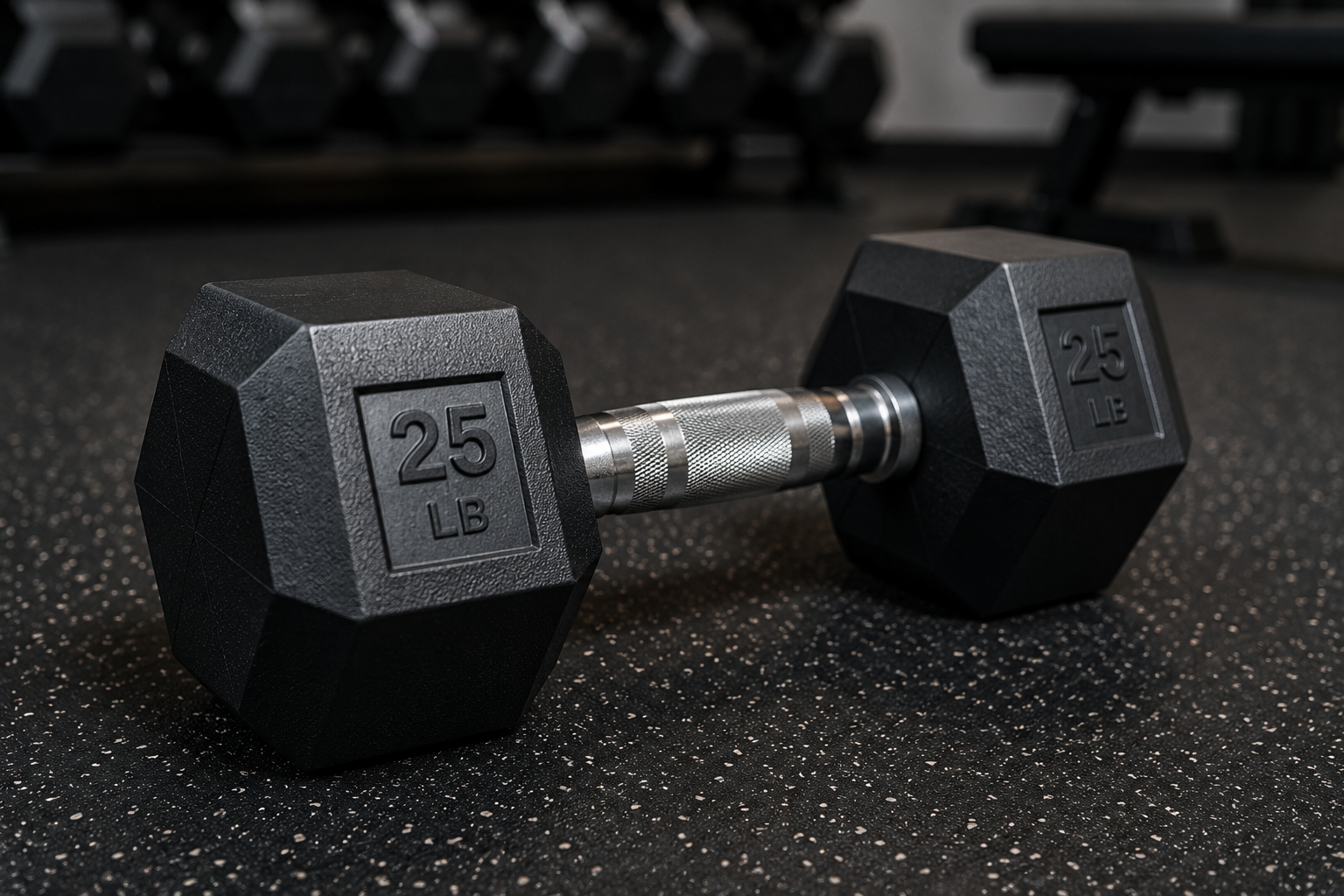
How to choose dumbbell weight: a practical guide for every training level
Choosing the correct dumbbell weight is one of the most important aspects of building an effective, safe, and progressive workout. Many beginners buy weights that are too light, thinking they can improve later, while others choose excessive weights in search of faster results, thereby increasing the risk of performing incorrect movements and compromising the quality of the exercise.
Understanding dumbbell weight selection means evaluating several elements: training goal, type of exercise, experience level, technical ability, and the possibility of gradually increasing the load. In fact, there is no universal weight valid for everyone, because every person has different physical characteristics and goals.
To create an effective progression, it is necessary to learn to read your body's signals and use practical criteria that allow you to understand when to increase or reduce the weight. Proper load management allows you to improve strength, muscle mass, and endurance while maintaining a sustainable approach over time.
- Why choose the correct dumbbell weight
- How to evaluate weight based on your goal
- How many kg of dumbbells to start with
- Dumbbell load progression
- How to know when to increase the weight
- Common mistakes in load selection
- Organizing an efficient dumbbell set
- Building a progressive training path
Why choose the correct dumbbell weight
The weight used during an exercise directly determines the stimulus received by the muscles. A load that is too low may not be sufficient to generate a significant adaptation, while an excessive weight can compromise technique, movement control, and joint safety.
Load selection must therefore be considered a technical decision, not a simple choice based on the number indicated on the dumbbell. Two people performing the same exercise might use very different weights while still obtaining an adequate stimulus.
For those training at home or in the gym, learning to choose the weight correctly allows you to optimize every session and build constant progression without buying unnecessary equipment.
The relationship between load and execution technique
Technique is the first criterion to evaluate. An adequate weight allows you to complete repetitions while maintaining control, correct posture, and full range of motion.
When the load becomes excessive, the body often seeks strategies to compensate by using momentum, reduced movements, or involving muscles that should not be the protagonists of the exercise.
Why more weight is not always better
Continuously increasing the load without considering the quality of execution can slow down progress. The goal of training is not simply to lift more weight, but to create the correct stimulus to achieve the desired result.
An intelligent approach considers weight as a tool to be used strategically.
How to evaluate weight based on your goal
The ideal load changes based on the purpose of the training. A strength-oriented program generally requires higher weights and fewer repetitions, while muscle endurance work uses more moderate loads with higher volumes.
For hypertrophy, or the increase of muscle mass, the weight must allow you to reach a significant level of fatigue while maintaining correct execution throughout the set.
Understanding this relationship allows you to avoid the mistake of always using the same weight for every type of exercise.
Load for strength increase
Strength-oriented workouts generally use high loads because the main goal is to improve the ability to produce muscle tension. Exercises are often performed with fewer repetitions and greater attention to the quality of movement.
With dumbbells, it is important to choose a weight that allows you to maintain stability and control even during complex exercises.
Load for muscle hypertrophy
To stimulate muscle growth, the weight must create sufficient tension without compromising the number of planned repetitions. The choice of load therefore depends on the balance between intensity and work volume.
An adequate weight allows you to accumulate training stimulus while maintaining effective technique.
How many kg of dumbbells to start with
One of the most frequent questions among those starting to train concerns how many kg of dumbbells to start with. The answer depends on gender, experience, the chosen exercise, and initial strength level. There is no value valid for everyone, but there are useful criteria for identifying the correct starting point.
A beginner should choose a weight that allows them to learn the movement without excessive difficulty. The priority in the early stages is to build good technique and create a solid foundation to progressively increase the load.
Starting with a manageable weight does not mean training with low intensity, but rather preparing the body to improve consistently.
Choosing the first weight based on the exercise
Every movement requires different capabilities. Exercises involving large muscle groups can generally use higher loads compared to more isolated movements.
For this reason, it is not correct to buy a single weight thinking it can be suitable for the entire training program.
Evaluating experience level
Those who are beginners must dedicate time to learning fundamental movements. The initial weight should allow you to focus on technique and muscle perception.
As your abilities improve, it will be possible to gradually increase the load.
Dumbbell load progression
Progression represents the principle through which the body continues to adapt over time. If the load remains unchanged for months, the stimulus may become insufficient and slow down improvements.
However, increasing the weight must not be a random process. It is necessary to follow measurable criteria that allow you to understand when the body is ready for a new level of difficulty.
Intelligent management of progression reduces the risk of errors and makes training more effective.
The 2x2 method for increasing load
The 2x2 rule is a practical criterion used to evaluate the right time to increase weight. When you can complete two consecutive sets with two additional repetitions beyond the planned goal while maintaining correct technique, it may be time to move to a heavier dumbbell.
This approach avoids overly frequent increases and allows for controlled progression.
Increasing weight without losing quality
The increase in load must always respect the ability to maintain correct movement. If the new weight negatively affects technique, it means the jump might be too large.
The best progression is one that is sustainable in the long term.
How to know when to increase the weight
Understanding the correct time to increase the load requires attention to training signals. The ease with which sets are completed, the level of perceived fatigue, and technical quality are fundamental indicators.
A premature increase can create unnecessary difficulties, while waiting too long can limit improvements.
Finding the right balance allows you to maintain continuous growth.
Signs that a load has become too light
When all repetitions are completed with extreme ease and without a real perception of effort, the weight may no longer be sufficient to generate an adequate stimulus.
In this case, gradually increasing the load can be an effective choice.
Using the dumbbell one-rep max calculation
The dumbbell one-rep max calculation can be used as a reference to estimate your theoretical lifting capacity. However, with dumbbells, it is often more important to evaluate control and stability compared to the simple numerical value.
The one-rep max therefore represents an analysis tool, not the only decision-making criterion.
Common mistakes in load selection
Many mistakes in weight selection stem from wrong expectations or a lack of method. Some people choose loads that are too high to imitate expert athletes, while others remain stagnant for fear of increasing.
An effective path requires balance and awareness.
Knowing the most frequent mistakes helps to build a safer workout.
Choosing weight for ego
Using a load beyond your capabilities to demonstrate strength can compromise movement control and increase the risk of technical problems.
Real progress comes from the quality of the work performed.
Not considering future progression
Buying only a limited set without thinking about future growth can quickly create the need for new investments.
A flexible system instead allows you to adapt to improvements over time.
Organizing an efficient dumbbell set
The choice of equipment directly influences the ability to train consistently. A good set must offer adequate weights for the main exercises and the possibility of progressive growth.
For those training at home, a well-organized solution allows you to obtain variety without taking up unnecessary space.
Initial planning avoids random purchases and improves the training experience.
Choosing a set suitable for growth
A home gym dumbbell set should include configurations flexible enough to accompany the user's evolution.
The ability to modify loads allows you to keep the equipment useful over time.
Evaluating adjustable solutions
Adjustable systems allow you to manage different weight levels with a reduced number of tools. This feature is particularly useful in home spaces.
Versatility becomes an important element for those seeking efficiency.
Building a progressive training path
Choosing the correct dumbbell load means creating the foundation for an effective and sustainable training path. The ideal weight is not the highest possible, but the one that allows you to train with technique, control, and consistency.
Through reasoned progression, it is possible to improve strength, muscle mass, and endurance while avoiding random increases or unnecessary purchases.
Investing in tools capable of adapting to personal growth allows you to build a more efficient and lasting routine, transforming load selection into a concrete strategy for achieving better results.
Comments (0)