
Trolley
You have no items in your shopping cart

 Budgets
 Dumbers
 Discs
Discs
 Benches
 Racks and Rigs
 Weights Holders
 Isotonic machines
 Calisthenics
 Cardio
 Kettlebells
 Flooring
 Gym Set
 Accessories
 Combat
 ARTI MARZIALI
 CONTAINER GYM
 Tug-Of-War
 Used Gym Equipment
 PILATES MACCHINARI
 GINNASTICA ARTISTICA
 CAMPI DA PADEL
 Prodotti in Pronta Consegna
 Informazioni
 IRONMAN
 Gift Card
- Donatif
- General information
- 0 I like it
- 15 Views
- 0 comments
- gym flooring, safety flooring, gym safety, shock-absorbing materials
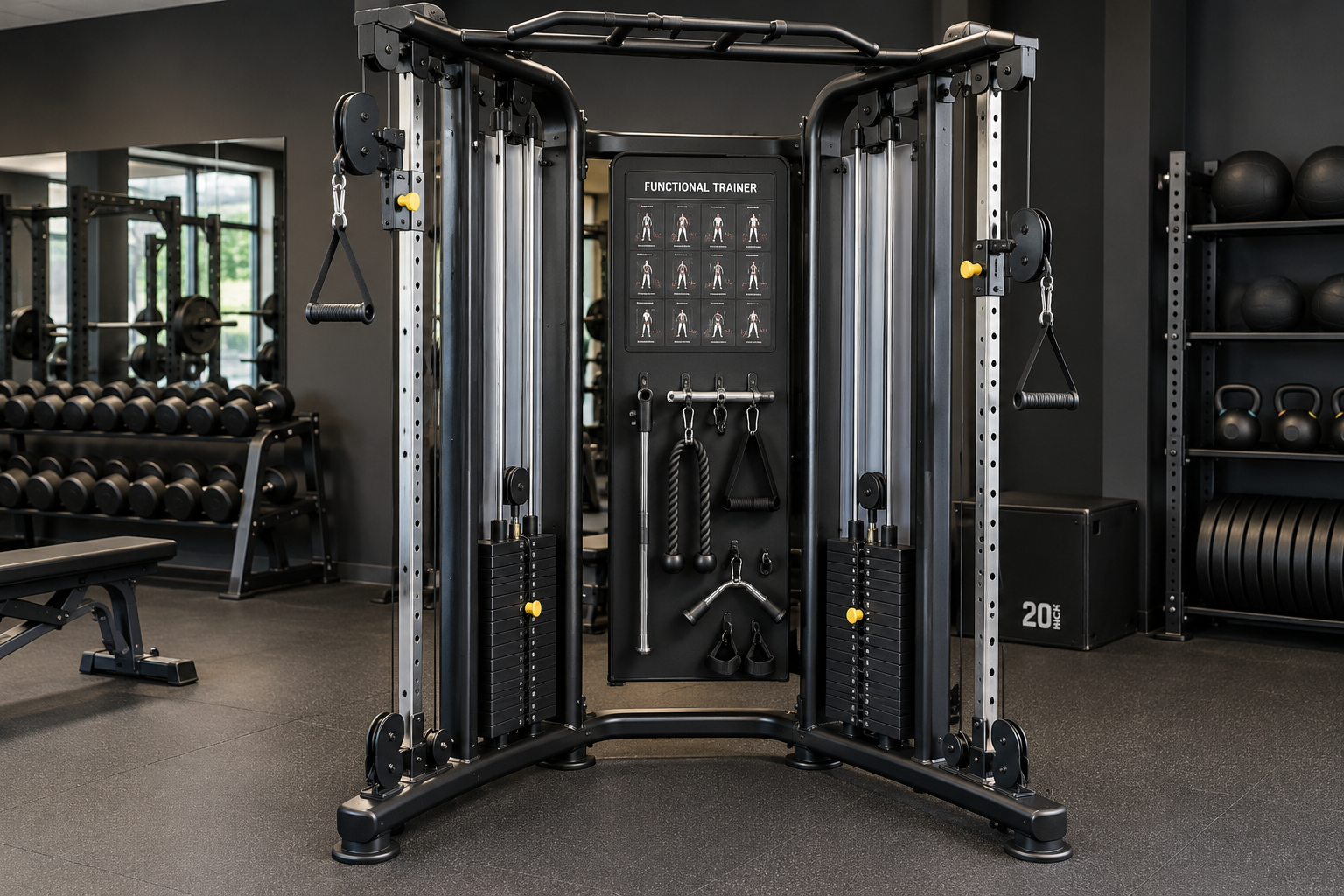
How to choose a functional trainer: buyer's guide
A functional trainer is a dual-pulley machine designed to perform a wide variety of exercises through adjustable cables and numerous accessories. To choose the most suitable model, it is necessary to evaluate construction features, adjustment system, pulley configuration, weight stack capacity, and compatibility with the available space.
Differences between various models do not only concern design or the number of included accessories. Material quality, pulley smoothness, adjustment possibilities, and structural sturdiness directly affect the user experience and equipment durability.
A choice based on verifiable technical criteria allows you to purchase a machine truly suited to the needs of a gym, a personal training studio, or an advanced home gym, avoiding oversized configurations or those inconsistent with training goals.
- Quick answer
- Which specifications really matter
- How to choose a functional trainer
- Space and usage compatibility
- Comparison table
- Buying mistakes to avoid
- How to evaluate the investment
How to choose a functional trainer
To choose a functional trainer, it is important to evaluate structure quality, pulley configuration, transmission ratios, weight stack capacity, available accessories, and the required operating space. The choice should be consistent with the number of users, the type of training planned, and the frequency of use of the machine.
Before purchasing, it is useful to define whether the machine will be primarily intended for individual workouts, personal training, or intensive use in a commercial gym.
Comparing multiple models using the same technical parameters allows for an objective evaluation.
Decision-making criteria
The main criteria concern number of pulleys, transmission ratios, weight stack capacity, guide quality, available adjustments, compatible accessories, and maintenance simplicity.
Technical references
Before purchasing, it is advisable to consult the manufacturer's technical documentation and verify that the machine is designed according to standards applicable to fitness equipment, such as the EN ISO 20957 series when relevant.
Which specifications really matter
Structural quality represents one of the most important aspects. A rigid frame contributes to stability during exercise execution and maintains constant performance even with frequent use.
Pulleys should ensure smooth sliding and simple adjustments. The load selection system must also be intuitive, fast, and reliable over time.
The availability of accessories broadens the machine's usage possibilities and allows you to adapt the functional trainer to different programs.
Pulley system
The quality of pulleys, guides, and the adjustment system affects movement smoothness and daily ease of use.
Weight stack and transmission
The capacity of the weight stack and the transmission ratio should be consistent with the users' level and the type of training planned.
How to choose based on usage
A personal training studio may favor a compact machine, easily adjustable and suitable for frequent exercise changes during the same session.
A commercial gym might instead lean towards a sturdier structure, designed for intensive use and equipped with numerous accessories.
For a home gym, it is useful to evaluate the ratio between footprint, versatility, and the ability to perform complete programs using a single machine.
Commercial gym
Sturdiness, reliability, and ease of adjustment represent particularly important features in facilities with high foot traffic.
Home gym and PT studio
In environments with limited space, a compact machine that is versatile enough to cover numerous training needs is often preferable.
Space and usage compatibility
Before installation, it is necessary to verify not only the dimensions of the machine but also the operating area required to fully use the cables and accessories.
Proper layout planning facilitates movement, improves workout supervision, and reduces interference with other equipment present.
An anti-shock flooring helps protect the floor and improve the stability of the training area. To learn more about available solutions, you can consult gym anti-shock flooring.
Space organization
A well-designed layout allows free use of the cables along their entire range of motion and facilitates access to accessories.
Accessory compatibility
Checking the availability and compatibility of accessories allows you to expand the machine's usage possibilities over time.
Comparison table
| Feature | What to check | Why it matters |
|---|---|---|
| Structure | Rigidity and build quality | Stability and durability |
| Pulleys | Sliding and adjustments | Movement smoothness |
| Weight stack | Capacity and increments | User compatibility |
| Transmission ratio | Manufacturer specifications | Load behavior |
| Accessories | Equipment and compatibility | Greater versatility |
| Maintenance | Ease of checks | Operational continuity |
How to interpret the comparison
Comparing machines using the same technical parameters allows for a more informed choice without focusing exclusively on price.
Defining priorities
Each facility should identify the most important features based on users and the business model.
Buying mistakes to avoid
One of the most frequent mistakes is choosing a functional trainer without evaluating the actual intended use or without checking compatibility with the available space.
It is also advisable to avoid exclusively comparing weight stack capacity while neglecting pulley quality, structural sturdiness, and adjustment simplicity.
Another critical issue concerns failing to verify the availability of spare parts and accessibility to components subject to maintenance.
Insufficient space
Considering only the machine's footprint without anticipating the operating area can compromise the functionality of the installation.
Evaluation based solely on cost
An effective choice considers build quality, reliability, maintenance, and versatility in addition to the initial investment.
How to evaluate the investment
The purchase of a functional trainer should be part of an overall evaluation that takes into account the facility's goals, the expected number of users, and the possibility of expanding the training area in the future.
A well-designed machine offers high versatility and allows you to perform numerous programs using a single station, optimizing available space.
Carefully analyzing technical specifications, comparing available models, and following the manufacturer's instructions for installation and maintenance allows you to make an informed choice consistent with the needs of a gym, a PT studio, or a home gym.
Comments (0)