
Trolley
You have no items in your shopping cart

 Budgets
 Dumbers
 Discs
Discs
 Benches
 Racks and Rigs
 Weights Holders
 Isotonic machines
 Calisthenics
 Cardio
 Kettlebells
 Flooring
 Gym Set
 Accessories
 Combat
 ARTI MARZIALI
 CONTAINER GYM
 Tug-Of-War
 Used Gym Equipment
 PILATES MACCHINARI
 GINNASTICA ARTISTICA
 CAMPI DA PADEL
 Prodotti in Pronta Consegna
 Informazioni
 IRONMAN
 Gift Card
- Donatif
- General information
- 0 I like it
- 9 Views
- 0 comments
- gym flooring, safety flooring, gym safety, shock-absorbing materials
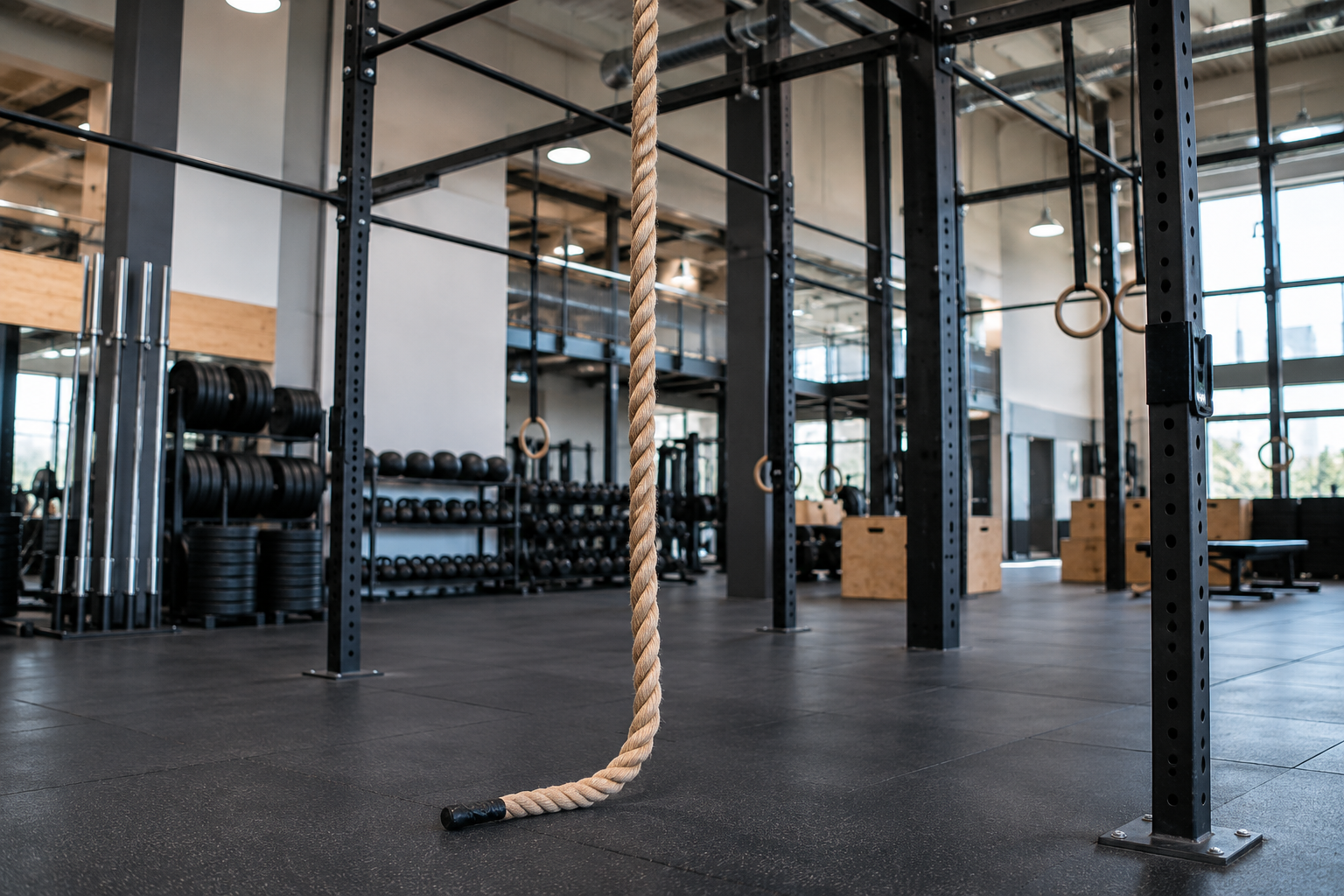
Climbing rope in a professional gym: anchor structure verification
A climbing rope is a specific rope for rope climbing used in functional training, athletic preparation, and military or sports courses. In a professional gym, the correct functioning of the equipment depends above all on the anchor structure, which must be designed and verified before the rope is installed.
Simply choosing the rope is not enough to guarantee safe use. The verification must involve the load-bearing structure, the fixing system, the available height, the flooring, safety distances, and the maintenance schedule. Each element contributes to user safety and the longevity of the facility.
This article outlines the main technical criteria to evaluate during the design of a professional rope climbing station without replacing the structural design or verification performed by qualified personnel. When applicable, the equipment manufacturer's instructions, the documentation of the hosting structure, and relevant technical standards must be followed.
- Quick answer
- Climbing rope: characteristics and use
- How to verify the anchor structure
- How much space is needed
- Station configuration
- Progressions to learn rope climbing
- Safety and maintenance
- FAQ
- Evaluating the investment
How to verify an anchor structure?
The verification consists of ensuring that the structure intended to support the rope is designed to withstand the loads expected during use, that the fixing point is compatible with the installed system, and that all elements comply with the manufacturer's instructions.
Before commissioning, it is necessary to check the technical documentation, inspect the integrity of the structure, and set up a schedule of periodic inspections.
Load-bearing capacities must not be empirically estimated but derived from design documentation or confirmed through technical verification of the existing structure.
Decision-making criteria
The choice of anchor must consider the material of the structure, the fixing method, the intended use, the frequency of use, and the possibility of carrying out periodic checks.
Technical sources
For professional facilities, it is appropriate to refer to the instructions of the climbing rope manufacturer, the manuals of the anchoring systems, and the technical standards applicable to sports structures and installed devices.
Climbing rope: characteristics and use
The climbing rope intended for fitness is designed to be climbed repeatedly during individual or group workouts. It can be made of natural or synthetic fibers depending on the environment of use and the required characteristics.
The choice of material influences grip, maintenance, moisture behavior, and long-term durability. The evaluation must be carried out considering the context of use and the manufacturer's instructions.
Among the aspects most requested by operators are useful length, rope diameter, surface finish, and compatibility with the anchoring system.
Rope diameter
The ideal diameter depends on the workout goals and the users' level. A larger diameter generally offers a different grip compared to thinner ropes. The choice must be consistent with the manufacturer's specifications and the type of intended use.
Climbing technique
Learning the foot grip helps reduce the load on the upper limbs, improving efficiency and safety during vertical progression.
How to verify the anchor structure
The verification must begin with the analysis of the load-bearing structure. Beams, metal frames, or dedicated structures must be designed to support the dynamic stresses generated during rope climbing.
The fixing point must be accessible for inspections and compatible with the connection elements provided by the manufacturer. Every component must be able to be checked without complex disassembly.
During the design phase, it is advisable to provide a system that allows the rope to be replaced without modifying the main structure.
Structure control
It is necessary to check the state of conservation, any corrosion, deformations, the integrity of the welds, and the presence of available technical documentation.
Fixing system
The fixing must use mutually compatible components, avoiding improvised solutions or adjustments not foreseen by the manufacturer.
How much space is needed for a climbing rope?
The available space must allow for climbing, descending, and the instructor's work while keeping the surrounding area clear.
The length of the rope must be chosen based on the actually available height and the configuration of the structure.
The presence of adequate impact-absorbing flooring contributes to risk management in the event of an uncontrolled descent or loss of grip.
Station layout
Multiple stations must maintain adequate separation to avoid interference between users during the workout.
Complementary accessories
Peg boards, pull-up bars, and functional stations can be integrated into the same area as long as they do not hinder rope climbing.
How to configure a professional station
An effective configuration includes orderly pathways, adequate lighting, and supervision capabilities for instructors.
The rope should be easily inspectable and replaceable when necessary without modifying the entire installation.
For greater integration with functional training, the rope can be paired with other functional training equipment.
Integration with other areas
The climbing rope can be included in functional circuits alongside rigs, bars, rings, and stations dedicated to athletic preparation.
User management
Scheduling turns and usage procedures helps maintain order and safety during group sessions.
How to learn rope climbing
Learning should be progressive, starting with preparatory exercises that develop grip strength and body control.
Progressions can include pull-ups, suspension exercises, the use of foot grips, and partial climbs before tackling the full climb.
Proper technique improves efficiency while reducing upper limb fatigue.
Initial progression
Beginners can gradually develop technique by working on hand-foot coordination.
Advanced training
Experienced athletes can introduce speed variations, climbs without foot support, and specific functional circuits.
Safety and maintenance
Before each use, it is advisable to check the condition of the rope and the anchor point, checking for any signs of wear.
Scheduled maintenance should follow the manufacturer's instructions, including visual checks, thorough inspections, and component replacement when necessary.
Verifications must be recorded according to the procedures adopted by the sports facility.
Design errors
Installing a rope on unverified elements, neglecting maintenance, or underestimating available space represent the most frequent errors.
Periodic checks
A scheduled inspection plan allows for the timely identification of any critical issues and keeps the station efficient.
FAQ
Can the climbing rope be attached to any beam?
No. Compatibility must be verified through technical documentation and structural assessment.
What is the best material?
It depends on the environment of use, the type of workout, and the manufacturer's instructions.
Is specific flooring needed?
Yes. The choice of surface must be consistent with the type of activity performed and the safety requirements of the facility.
Is there a single standard for length and diameter?
No. Length and diameter must be chosen considering the available height, workout goals, and the manufacturer's technical specifications. There is no universal value valid for all installations.
Evaluating the investment
A professional station dedicated to rope climbing represents an investment that requires attention both in the choice of the climbing rope and in the design of the anchor structure. Pre-emptively verifying the compatibility of the load-bearing structure, planning the available space, adopting scheduled maintenance, and following the manufacturers' instructions makes it possible to create a functional area, easily manageable and suitable for progressive training programs aimed at athletes and users of different levels.
Comments (0)