
Trolley
You have no items in your shopping cart

 Budgets
 Dumbers
 Discs
Discs
 Benches
 Racks and Rigs
 Weights Holders
 Isotonic machines
 Calisthenics
 Cardio
 Kettlebells
 Flooring
 Gym Set
 Accessories
 Combat
 ARTI MARZIALI
 CONTAINER GYM
 Tug-Of-War
 Used Gym Equipment
 PILATES MACCHINARI
 GINNASTICA ARTISTICA
 CAMPI DA PADEL
 Prodotti in Pronta Consegna
 Informazioni
 IRONMAN
 Gift Card
- Donatif
- General information
- 0 I like it
- 545 Views
- 0 comments
- gym flooring, safety flooring, gym safety, shock-absorbing materials
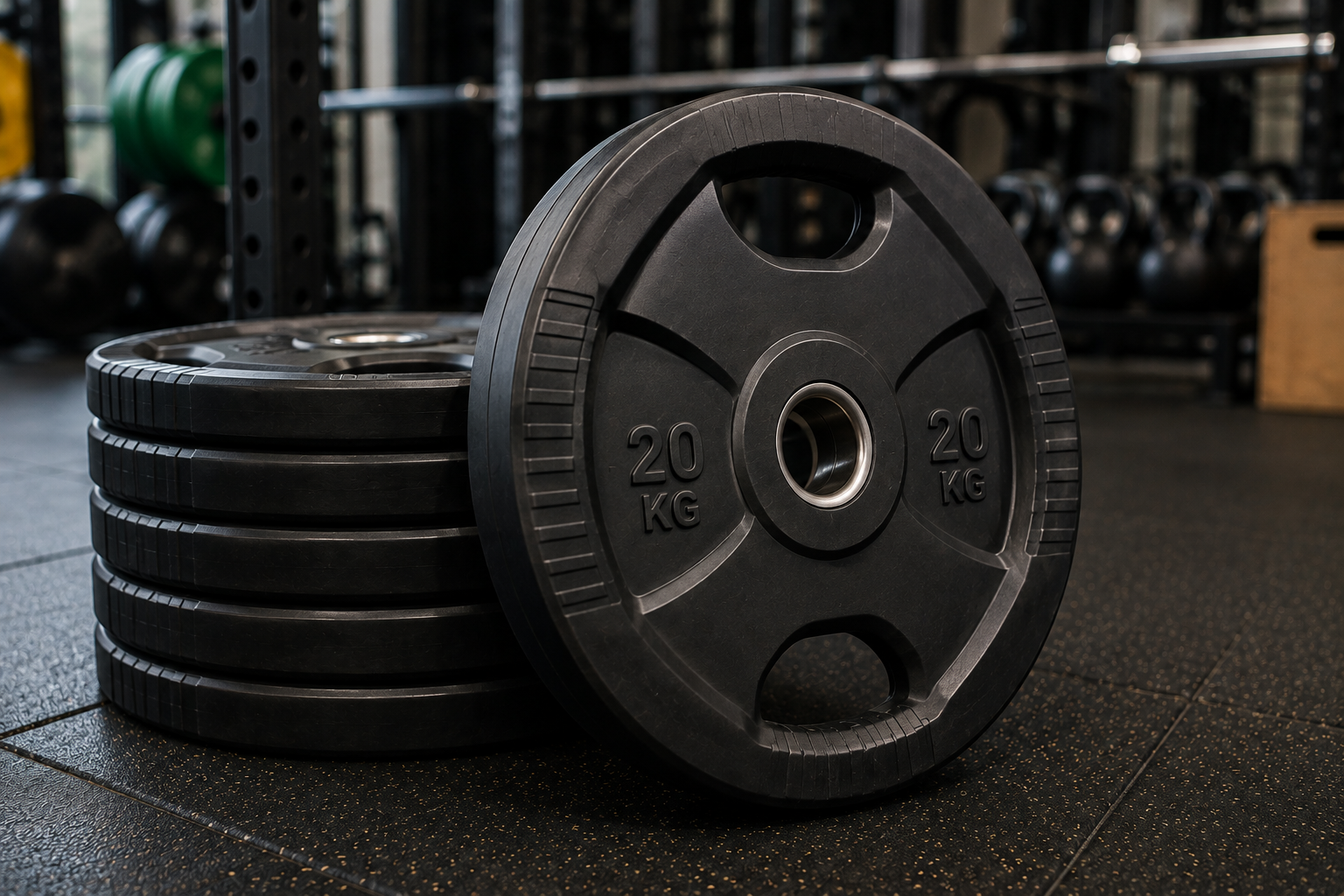
20 kg Gym Plates: Cast Iron, Rubber-Coated, or Bumper? The Right Choice
When building a home gym dedicated to strength, 20 kg plates often represent the heart of the equipment. They are among the first weights purchased because they allow for progressive load increases and are used in most fundamental exercises such as squats, deadlifts, and bench presses. However, choosing the correct model does not simply mean buying the weight available at the most convenient price.
The choice between 20 kg gym plates in cast iron, rubber-coated, or bumper depends on numerous factors: training environment, tolerable noise level, frequency of use, type of exercises performed, and the need to protect the floor. A private garage has different needs compared to an apartment in a condominium, just as a powerlifting athlete may have different priorities than someone who practices Cross Training.
Knowing the characteristics of the different materials allows you to avoid unsuitable purchases and build a more functional gym. A 20 kg plate is not just an element that adds weight to the barbell, but a component that influences the safety, comfort, and quality of the entire workout.
- Differences between cast iron, rubber-coated, and bumper plates
- 20 kg cast iron plates: advantages and limitations
- 20 kg rubber-coated plates: comfort and protection
- 20 kg bumper plates: when to choose them
- Noise, vibrations, and space management
- Which plate to choose based on training
- Common mistakes when choosing plates
- How to protect your investment
Differences between cast iron, rubber-coated, and bumper plates
20 kg plates may look very similar to each other because they perform the same main function: increasing the load on the barbell. However, the material and construction profoundly change the behavior of the plate during daily use.
Cast iron plates represent the most traditional solution and are appreciated for their compactness, robustness, and generally low price. Rubber-coated plates, on the other hand, add an external protective layer that improves comfort and surface protection. Bumper plates are specifically designed to withstand controlled drops and repeated impacts.
None of the three types is universally better. The correct choice depends on the environment and the type of training you want to practice.
Material and plate behavior
Cast iron is an extremely dense and rigid material, while rubber allows for the absorption of part of the energy generated during impact.
This difference directly influences noise, vibrations, and floor protection.
The context determines the choice
An athlete who mainly performs controlled exercises may prefer different characteristics compared to someone who practices explosive movements with frequent barbell drops.
Analyzing your actual usage is the first step to purchasing the most suitable plate.
20 kg cast iron plates: advantages and limitations
Cast iron plates have been present in traditional gyms for decades and continue to be a highly appreciated solution. Their main characteristic is construction simplicity: a solid, resistant structure capable of maintaining a small footprint on the barbell.
For those who practice classic strength training, they represent a reliable choice. They take up little space, allow you to load a lot of weight on the barbell, and generally have an accessible initial cost.
However, they also present some important limitations, especially in home gyms located in shared environments.
The advantages of 20 kg cast iron plates
Cast iron offers an excellent ratio between weight and dimensions. A 20 kg cast iron plate is generally more compact than many coated alternatives, a useful feature when you need to manage heavy loads.
The rigid structure also guarantees a long lifespan if the plate is used correctly.
Noise and impact
The main disadvantage concerns the noise produced during contact between plates, the barbell, and the floor. The classic metallic sound can become problematic in an apartment or condominium.
Furthermore, a direct impact can more easily damage delicate surfaces.
20 kg rubber-coated plates: comfort and protection
Rubber-coated plates represent an intermediate solution between traditional cast iron and bumper plates. The internal structure generally maintains a metal core, while the external rubber coating adds protection and comfort during use.
They are particularly appreciated in home gyms because they reduce noise, vibrations, and the risk of damaging the floor.
For many enthusiasts, they represent the best balance between performance, practicality, and price.
The advantages of tri-grip rubber-coated plates
Models with integrated handles facilitate transport and daily weight management. This feature is particularly useful in home gyms where spaces must be organized frequently.
The additional grip also makes some operations, such as moving and loading the barbell, easier.
Floor protection
The rubber coating reduces direct impact with the floor and limits the noise generated during training.
This makes them an interesting choice for those who train near other homes.
20 kg bumper plates: when to choose them
Bumper plates are designed for a specific function: to withstand the impacts generated during exercises in which the barbell is dropped or set down quickly. For this reason, they are the most widespread standard in Cross Training and Olympic lifting.
The high-density rubber absorbs part of the impact energy and protects both the floor and the barbell.
Although they are extremely versatile, they are not always the most efficient choice for every type of training.
Workouts with barbell drops
During Cleans, Snatches, and similar movements, controlling the barbell during the descent can be difficult or impossible with heavy loads. Bumpers are designed specifically to handle these situations.
Their ability to absorb shocks reduces the risk of damage to the equipment.
The choice for Cross Training
Those who practice high-intensity WODs and dynamic movements find bumper plates to be a particularly suitable solution.
Their construction allows you to train with greater freedom and safety.
Noise, vibrations, and space management
One of the most important aspects for those who train at home concerns noise control. The weight used is not the only element that influences acoustic impact: the plate material, flooring, and execution technique also play a fundamental role.
Cast iron plates produce the classic metallic noise, while rubber and bumpers significantly reduce vibrations and sounds.
In an apartment, this difference can determine the actual possibility of training without causing problems.
Training in a condominium
Those who live in an apartment should carefully consider the relationship between performance and environmental impact.
Using protective surfaces and suitable plates reduces the risk of disturbing neighbors.
Optimizing the home gym
Plates that are easy to move and organize allow you to make better use of available space.
A tidy gym also improves safety during workouts.
Which plate to choose based on training
The choice of the 20 kg plate should start from the discipline practiced. There is no single best material, but there is one that is most consistent with your program.
Evaluating exercises, frequency, and environment allows you to avoid unnecessary compromises.
A balanced configuration can also include the use of multiple types of plates.
Powerlifting and strength
For squats, bench presses, and traditional deadlifts, cast iron or rubber-coated plates can offer excellent performance.
The choice depends mainly on the desired comfort and the training environment.
Cross Training and Olympic lifting
For disciplines characterized by explosive movements and frequent drops, bumper plates generally represent the most recommended solution.
Their design is specific to this type of stress.
Common mistakes when choosing plates
One of the most frequent mistakes is buying plates only by considering the initial price. A cheap solution can turn out to be unsuitable if it generates excessive noise or is not compatible with the type of training practiced.
Another mistake is ignoring the quality of the material and focusing exclusively on the nominal weight.
A reasoned investment allows you to obtain greater satisfaction in the long term.
Ignoring the training location
A garage, a basement, and an apartment require different assessments.
The environment should always influence the choice of equipment.
Not considering evolution
The training level can change rapidly. Choosing products compatible with future goals avoids premature replacements.
Planning purchases makes the home gym more efficient.
How to protect your investment
Choosing between cast iron, rubber-coated, or bumper plates means carefully evaluating your way of training. 20 kg gym plates are fundamental elements of the gym and must be selected considering safety, durability, noise, and compatibility with personal goals.
To compare solutions designed for home gyms and professional training, you can consult the range of Donatif bumper plates, designed to offer construction quality and reliability in different contexts of use.
Correctly chosen equipment allows you to train better, protect your space, and build a gym destined to last over time.
Comments (0)