
Trolley
You have no items in your shopping cart

 Budgets
 Dumbers
 Discs
Discs
 Benches
 Racks and Rigs
 Weights Holders
 Isotonic machines
 Calisthenics
 Cardio
 Kettlebells
 Flooring
 Gym Set
 Accessories
 Combat
 ARTI MARZIALI
 CONTAINER GYM
 Tug-Of-War
 Used Gym Equipment
 PILATES MACCHINARI
 GINNASTICA ARTISTICA
 CAMPI DA PADEL
 Prodotti in Pronta Consegna
 Informazioni
 IRONMAN
 Gift Card
- Donatif
- General information
- 0 I like it
- 512 Views
- 0 comments
- gym flooring, safety flooring, gym safety, shock-absorbing materials
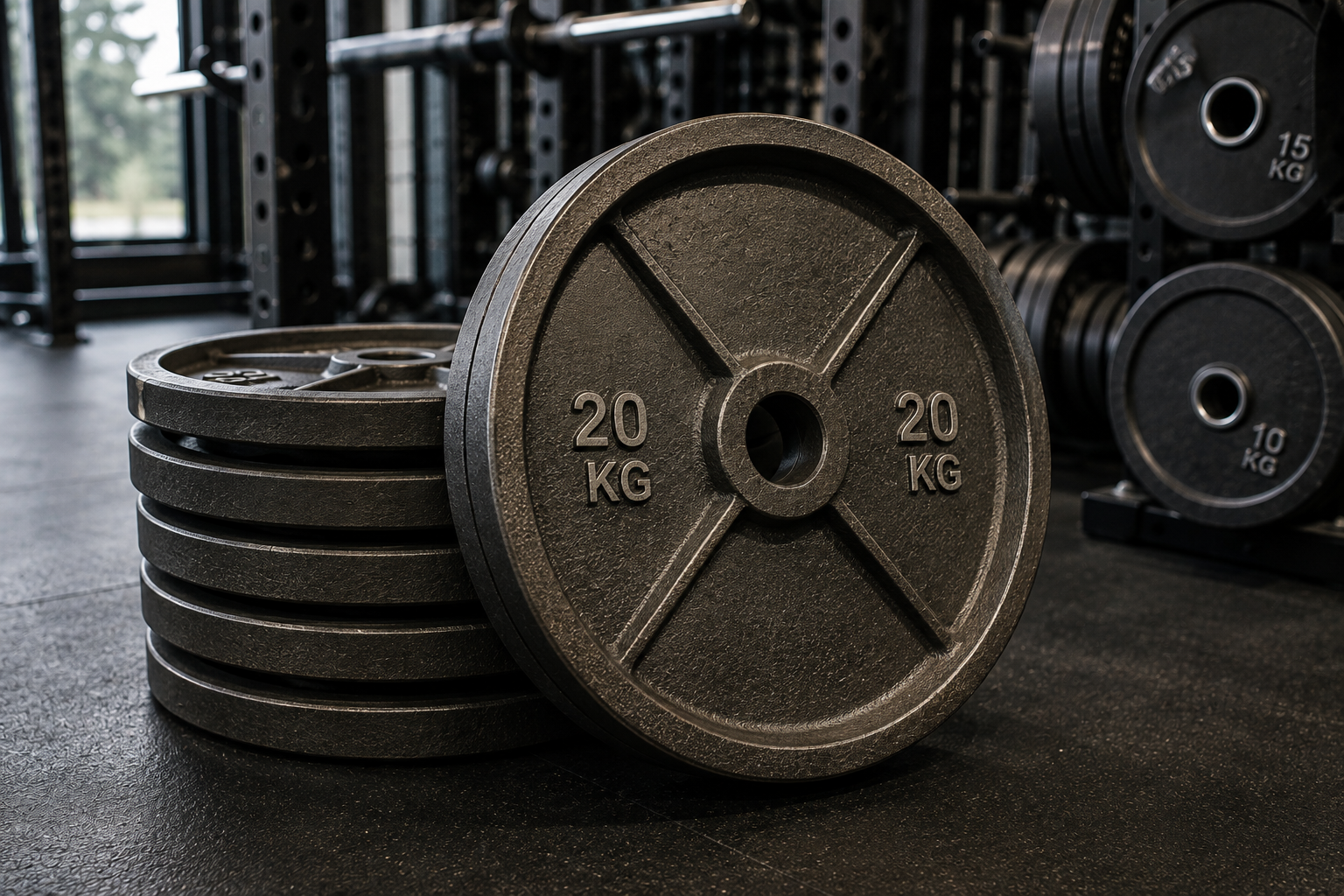
28mm Cast Iron vs. Rubber-Coated Gym Plates: A Buying Guide for Home Gyms
When setting up a home gym, one of the most common questions concerns the choice of plates to use on your 28mm barbell. At first glance, the differences between cast iron and rubber seem limited to aesthetics, but in reality, they directly affect training comfort, noise levels, equipment durability, and even floor protection.
The decision between 28mm cast iron or rubber-coated gym plates should therefore be made by carefully evaluating the context in which you train. An independent garage has very different needs compared to a room inside an apartment, just as a beginner has different requirements than someone training with heavy loads several times a week.
Understanding the advantages and limitations of both solutions allows you to avoid impulsive purchases and build a home gym designed to last over time. In this guide, we will analyze materials, noise, durability, maintenance, costs, and types of training to help you choose the most suitable solution.
- The main differences between cast iron and rubber
- Noise and comfort during training
- Durability and long-term resistance
- Cleaning and maintenance
- Which plates to choose based on training
- Price and long-term value
- The most common mistakes in choosing
- How to make the best investment
The main differences between cast iron and rubber
Cast iron plates represent the traditional solution used for decades in gyms and home gyms. They are compact, robust, andallow you to load a lot of weight on the barbell while taking up little space on the sleeves.
Rubber-coated plates, on the other hand, consist of a metal core covered by a protective layer of rubber that improves usage comfort and reduces the effects of impacts. This feature makes them particularly appreciated in home gyms where it is important to limit noise and vibrations.
Both solutions guarantee excellent performance if used in the correct context. The choice depends primarily on the training environment and your priorities.
Materials and construction
Cast iron offers high density and compactness, while the rubber coating protects the plate and improves resistance to accidental impacts.
The quality of the materials directly influences the durability of the equipment and the user experience.
Space on the barbell
Cast iron plates generally take up less space for the same weight, allowing you to load high amounts even on barbells with shorter sleeves.
Rubber-coated models are slightly thicker but offer significant advantages in other aspects.
Noise and comfort during training
One of the aspects that most differentiates the two types concerns the noise produced during exercises. Cast iron plates generate the classic metallic sound when they are set down, loaded, or bumped against each other.
For those training in an apartment or a garage connected to the house, this can be a problem, especially during workouts in the early morning or late evening.
Rubber-coated plates significantly reduce vibrations and noise, improving comfort both for the athlete and for those living nearby.
Training without disturbing
In shared environments, noise reduction is one of the main reasons that push many users toward rubber-coated plates.
A quieter gym makes workouts more pleasant and less invasive.
Floor protection
Rubber helps absorb part of the impact when the plate is set down or accidentally bumped.
This helps preserve both the floor and the surrounding equipment.
Durability and long-term resistance
Both types can offer long durability if used correctly. Cast iron plates are extremely robust but can be subject to scratches, oxidation, or chipping in case of violent impacts.
Rubber-coated models instead protect the metal core from daily impacts and maintain a well-kept aesthetic appearance for longer.
The choice should also consider the frequency of use and the environment in which they are stored.
28mm cast iron plate reviews highlight
Many users appreciate the solidity of cast iron plates and their ability to maintain their mechanical characteristics unchanged even after many years.
Proper storage in dry environments further contributes to their durability.
Rubber resistance
Quality coatings resist impacts and daily wear well, provided that aggressive detergents and prolonged exposure to the sun are avoided.
Regular maintenance preserves elasticity and surface finish.
Cleaning and maintenance
Maintenance of 28mm plates is generally simple, but there are some differences between the two types. Cast iron requires particular attention to humidity to prevent any oxidation phenomena.
Rubber-coated plates instead require delicate detergents that do not alter the protective coating.
Periodic cleaning improves both hygiene and the durability of the equipment.
How to maintain cast iron
Removing dust and moisture after workouts helps preserve the material over time.
Storing plates on dedicated racks also reduces the risk of accidental impacts.
How to clean 28mm rubber-coated weights
Warm water, neutral detergents, and microfiber cloths are the ideal solution to keep the coating clean without compromising its characteristics.
It is preferable to avoid aggressive solvents or abrasive products.
Which plates to choose based on training
The type of training is probably the most important criterion in the choice. Those who practice traditional bodybuilding or controlled strength training can use both solutions with satisfaction.
Those who perform more dynamic movements or wish to minimize noise and vibrations generally find greater advantages in rubber-coated plates.
The presence of technical flooring can also influence the final decision.
Strength training
For exercises like squats, bench press, rows, and military press, both systems guarantee excellent performance.
The choice depends mainly on the characteristics of the environment.
Home gym in an apartment
Those who train in shared spaces tend to favor the acoustic comfort and floor protection offered by rubber-coated plates.
This solution significantly improves the daily experience.
Price and long-term value
Cast iron plates generally have a lower initial cost than rubber-coated versions. However, price should not be the only evaluation criterion.
Noise reduction, floor protection, and better aesthetic preservation can justify the investment in rubber-coated models, especially in modern home gyms.
Analyzing the total cost of the entire life cycle allows you to make a more informed decision.
Purchase cost
Cast iron generally remains the most economical solution for those with a limited budget.
Rubber-coated plates require a higher initial investment but offer additional advantages in usage comfort.
Value over time
Equipment maintained correctly retains high performance and good resale value even after years of use.
Construction quality continues to be the most important factor.
The most common mistakes in choosing
Many users buy plates based solely on price or aesthetics, without considering the real context in which they train.
Another mistake is underestimating noise, which can become a daily problem, especially in apartments.
Carefully evaluating the environment, flooring, and goals allows you to avoid premature replacements.
Thinking only about savings
A lower initial cost can lead to compromises on usage comfort and space protection.
Considering long-term benefits makes the choice more rational.
Ignoring the type of training
Every discipline has different needs. Choosing plates based on the exercises actually performed improves both safety and satisfaction.
A complete assessment reduces the risk of unsuitable purchases.
How to make the best investment
The choice between 28mm cast iron or rubber-coated gym plates depends on numerous factors: training environment, budget, frequency of use, and sports goals. Cast iron represents a traditional, compact, and economical solution, while rubber-coated models offer greater comfort, noise reduction, and better surface protection.
To compare the different types available and identify the best plates for home, it is useful to carefully evaluate materials, construction quality, and compatibility with your barbell, so as to create an efficient home gym that is ready to grow over time.
Investing in the equipment most suitable for your needs means improving every workout, preserving the value of your home gym, and obtaining a quieter, safer, and more satisfying experience for many years.
Comments (0)