
Trolley
You have no items in your shopping cart

 Budgets
 Dumbers
 Discs
Discs
 Benches
 Racks and Rigs
 Weights Holders
 Isotonic machines
 Calisthenics
 Cardio
 Kettlebells
 Flooring
 Gym Set
 Accessories
 Combat
 ARTI MARZIALI
 CONTAINER GYM
 Tug-Of-War
 Used Gym Equipment
 PILATES MACCHINARI
 GINNASTICA ARTISTICA
 CAMPI DA PADEL
 Prodotti in Pronta Consegna
 Informazioni
 IRONMAN
 Gift Card
- Donatif
- General information
- 0 I like it
- 11 Views
- 0 comments
- gym flooring, safety flooring, gym safety, shock-absorbing materials
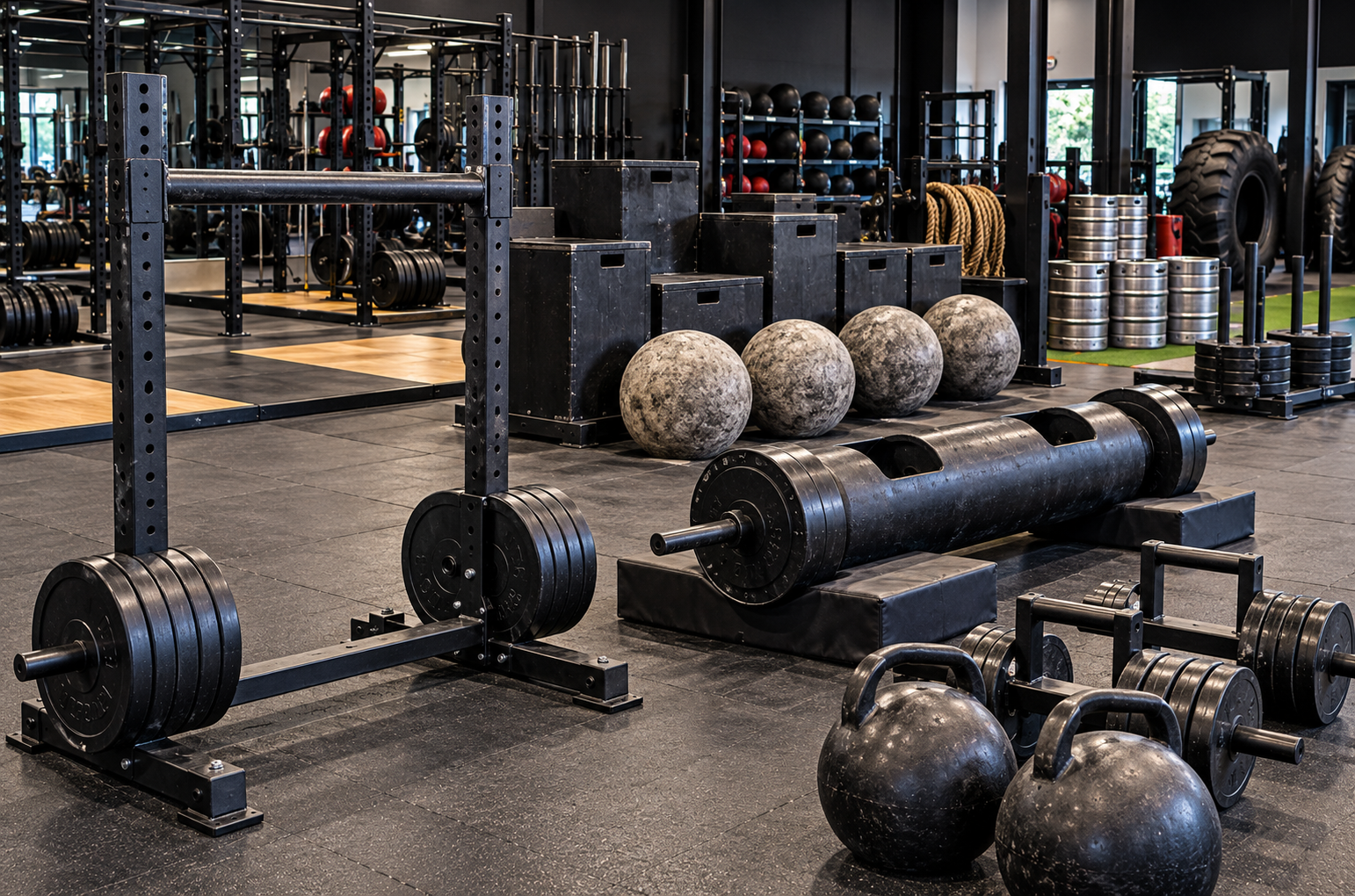
Strongman maintenance: equipment inspection and fasteners
Equipment dedicated to strongman training is designed to withstand intensive use and heavy loads, but it requires a regular maintenance program to maintain operational efficiency, reliability, and continuity of use over time. Proper periodic inspection allows for the timely identification of worn components, loose fasteners, and structural anomalies before they can affect the normal use of the equipment.
Maintenance is not exclusively about cleaning; it also includes documented checks, functional verifications, and the recording of interventions carried out. This approach facilitates the management of the strongman area and allows for the scheduling of replacements and preventive interventions following the manufacturer's instructions.
This guide offers practical criteria for organizing strongman equipment maintenance, focusing on inspections, fasteners, signs of wear, and preventive procedures without replacing the manufacturers' technical instructions.
- Quick answer
- What to check during the inspection?
- What frequencies to adopt?
- What signs of wear to monitor?
- Cleaning and routine maintenance
- Preventive actions
- FAQ
- Maintenance management over time
How to perform strongman equipment maintenance?
Maintenance of strongman equipment should include visual inspections, verification of fasteners, checking of parts subject to wear, cleaning according to the manufacturer's instructions, and recording of performed interventions. Operations must be planned according to the intensity of use and the characteristics of the individual pieces of equipment.
A documented procedure allows for the standardization of checks and simplifies maintenance management.
For specific operational procedures, it is always advisable to consult manuals, technical sheets, and manufacturer instructions.
Objective of maintenance
Keep equipment efficient, organize interventions, and schedule replacements when necessary.
Technical documentation
Manufacturer manuals represent the main reference for control frequencies and maintenance methods.
What to check during the inspection?
Each check should include the structure, fastening points, moving components, contact surfaces, and general state of the equipment.
Fasteners must be verified following exclusively the indications provided by the manufacturer, avoiding unforeseen modifications.
Yokes, supports, handles, and structural components should be checked to identify any visible anomalies.
Checking fasteners
Screws, bolts, and fastening systems should be inspected periodically according to the structure's maintenance plan.
Structure verification
The presence of deformations, abnormal play, or evident damage requires a technical assessment before use.
How often to perform checks?
The frequency of checks depends on the number of users, the intensity of workouts, and the type of equipment present in the area.
It is advisable to combine visual checks performed before each use with scheduled maintenance featuring more in-depth verifications.
Recording interventions facilitates monitoring the condition of the equipment over time.
Pre-use checks
A quick inspection allows for verifying general conditions and the absence of evident anomalies.
Scheduled maintenance
Periodic checks should be included in an internal calendar of the gym or sports center.
What signs of wear require attention?
Deformed components, fasteners requiring continuous adjustments, corrosion, wear of contact surfaces, or structural damage represent signs that require in-depth verification.
Intervening promptly allows for scheduling maintenance without unnecessarily interrupting activities.
Farmer's walks and frequently used equipment deserve constant checks based on the intensity of use.
Visual signs
Cracks, abrasions, deformations, or corrosion must be recorded and evaluated according to the manufacturer's instructions.
Functional signs
Instability, abnormal movements, or difficulty of use require verification before proceeding with the activity.
How to perform cleaning and routine maintenance?
Cleaning operations should be carried out using products compatible with the construction materials indicated by the manufacturer.
Routine maintenance also includes the removal of dust and residue, surface control, and verification of equipment integrity.
To complete a dedicated area, it is possible to integrate the project with strongman equipment designed for professional use.
Periodic cleaning
Before using detergents, it is advisable to check compatibility with the finishes and coatings present on the equipment.
Final verification
After each intervention, it is useful to perform a general check of the structure and the concerned components.
What preventive actions to adopt?
A preventive maintenance plan reduces the likelihood of extraordinary interventions and facilitates the scheduling of replacements.
Documented procedures, operator training, and recording of verifications improve the overall management of the area.
Flooring and contact surfaces should be included in periodic inspections to verify that they remain compatible with the intended use.
Maintenance log
Jotting down verifications, checks, and interventions allows for monitoring the evolution of the equipment's condition.
Staff training
Those managing the area should be familiar with the control procedures provided by the equipment manufacturers.
Frequently asked questions
How often to check fasteners?
It is advisable to perform a visual check before use and plan in-depth verifications according to the manufacturer's instructions and the intensity of use.
When to replace a component?
When it shows wear or damage incompatible with the instructions provided in the manufacturer's technical documentation.
Is it useful to document maintenance?
Yes. An intervention log facilitates the scheduling of verifications and the management of the equipment life cycle.
Maintenance management over time
Professional management of the strongman area includes preventive maintenance, availability of spare parts, technical documentation, and scheduling of periodic verifications. Evaluating these aspects right from the purchase phase allows for reduced downtime and maintains the high operational efficiency of the structure.
To compare different solutions, it is useful to prepare a technical specification that includes construction characteristics, maintenance plan, after-sales assistance, and availability of replaceable components. This approach allows for objective and verifiable evaluations without limiting oneself to the initial price alone.
Organized equipment maintenance in the strongman sector helps preserve functionality, order, and operational continuity, making the area ready to support specialized training programs over the long term.
Comments (0)