
Trolley
You have no items in your shopping cart

 Budgets
 Dumbers
 Discs
Discs
 Benches
 Racks and Rigs
 Weights Holders
 Isotonic machines
 Calisthenics
 Cardio
 Kettlebells
 Flooring
 Gym Set
 Accessories
 Combat
 ARTI MARZIALI
 CONTAINER GYM
 Tug-Of-War
 Used Gym Equipment
 PILATES MACCHINARI
 GINNASTICA ARTISTICA
 CAMPI DA PADEL
 Prodotti in Pronta Consegna
 Informazioni
 IRONMAN
 Gift Card
- Donatif
- General information
- 0 I like it
- 20 Views
- 0 comments
- gym flooring, safety flooring, gym safety, shock-absorbing materials
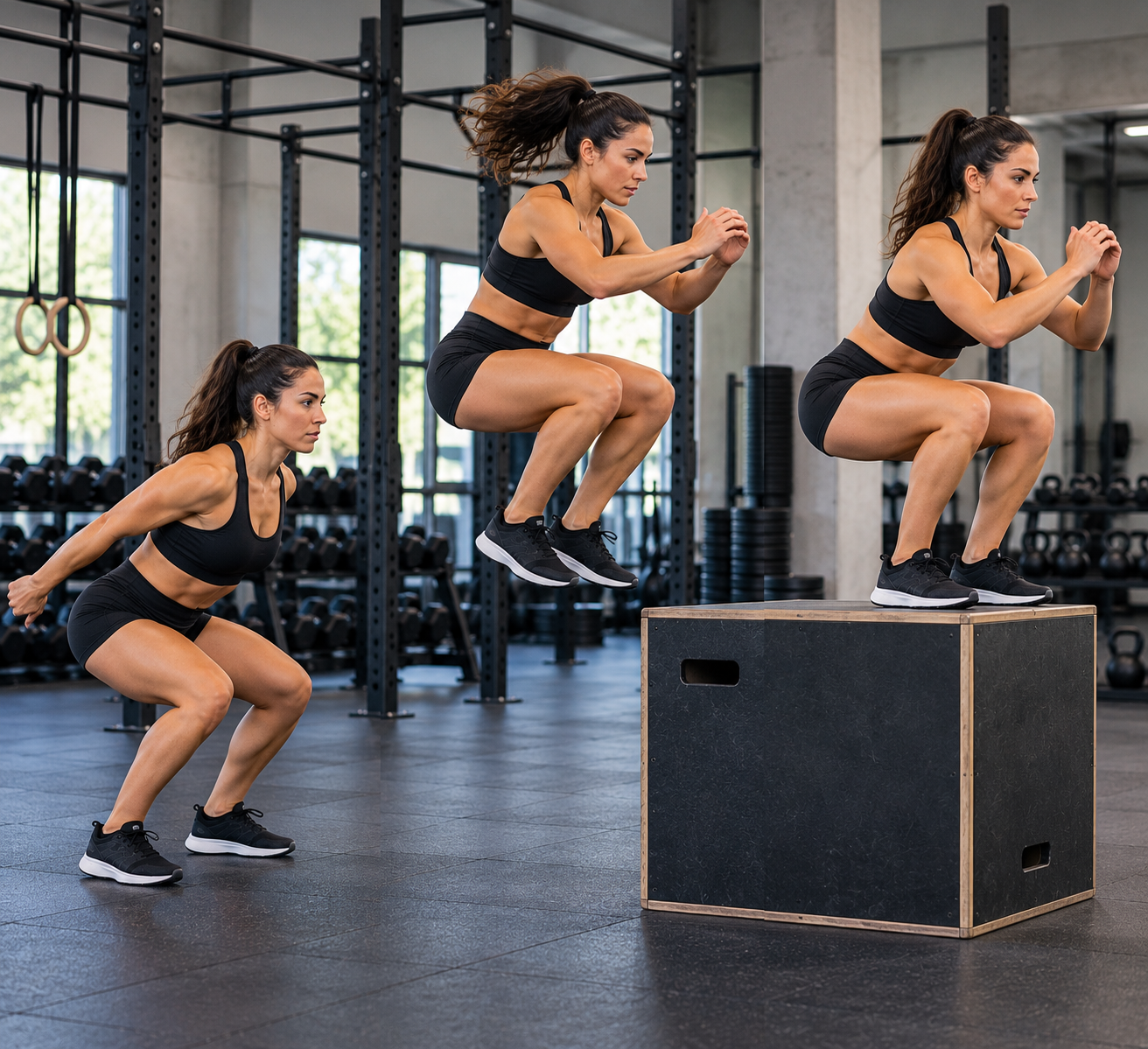
Common mistakes in the box jump: how to recognize and correct them
The box jump is one of the most widely used plyometric exercises for developing power, coordination, and explosive capacity. However, its effectiveness depends on the quality of movement rather than the height of the box or the number of repetitions performed. Seemingly small technical errors can actually reduce the benefit of the exercise and compromise the fluidity of the movement.
Recognizing the most frequent errors allows you to improve execution, organize a more effective progression, and maintain consistent technique throughout the session. The goal of the box jump is to develop an explosive and controlled jump, not simply to reach a higher surface.
This guide analyzes the most common mistakes in the box jump, illustrating practical criteria for correcting them, suggestions for proper use, and checks to perform before training.
- Quick answer
- How to perform the box jump correctly
- What are the most common mistakes
- How to correct mistakes
- Safety and checks before use
- How to improve over time
- FAQ
- Training with technical quality
What are the most common mistakes in the box jump?
The most frequent errors in the box jump involve choosing a box that is too high, an ineffective takeoff technique, an unstable landing, and progressing too quickly. To correct them, it is necessary to prioritize movement control and increase difficulty only when all repetitions are technically correct.
The quality of the movement represents the main evaluation criterion during each session.
Each modification of the program should be introduced gradually while maintaining consistency in technique.
What is the priority?
The priority is to perform controlled, repeatable jumps free of obvious compensations.
What should be observed?
It is useful to check the quality of the takeoff, the stability of the landing on the box, and the control of the descent at the end of each repetition.
How to perform the box jump correctly?
The movement begins with coordinated preparation, continues with an explosive push, and ends with a stable landing on the surface of the box.
The entire sequence should take place while maintaining continuity of the movement without sudden motions or compensations due to excessive height.
A stable technique allows you to repeat the movement while maintaining precision throughout the set.
Pay attention to the takeoff phase
The takeoff must be rapid and coordinated, exploiting an effective push without altering posture to reach the box.
Pay attention to the landing phase
The landing should be stable, quiet, and controlled before the subsequent descent.
What mistakes are observed most often?
Many mistakes stem from the desire to quickly increase the difficulty of the exercise while neglecting the quality of execution.
The most common signs include loss of balance, excessive tucking of the knees, unstable landing, differing repetitions from one another, and a reduction in precision as fatigue increases.
Identifying these aspects early allows you to modify the program before the mistake becomes habitual.
Choosing a box that is too high
Excessive height often induces technical compensations that make the jump less effective and harder to control.
Increasing difficulty too soon
Rapidly increasing height, volume, or intensity without consolidating technique is one of the most frequent errors in plyometric programs.
How to correct mistakes?
Correction should focus on the quality of the movement and not just the final result of the jump.
Temporarily reducing difficulty often allows for improved control, coordination, and precision of movement.
A well-planned progression facilitates technical learning and makes it easier to monitor improvements.
Use the step-up
The step-up represents a useful complementary exercise to improve landing control and balance before increasing the complexity of the box jump.
Integrate the jump squat
The jump squat can contribute to the development of explosive push-off, but it does not replace the technical work required by the box jump.
What checks to perform before training?
Proper preparation includes verifying the equipment, the environment, and the session programming.
The box must be stable, the surface free of obstacles, and the surrounding area adequate for the movements involved.
To set up a functional station, you can integrate dedicated tools by consulting the gym accessories section.
Check the space
It is important to have sufficient area for preparation, jumping, landing, and descent without interference.
Verify the flooring
The surface should be stable, clean, and maintained according to the manufacturer's instructions.
How to improve over time?
Progression should be built on the quality of execution rather than on increasing the height of the box.
It is advisable to modify only one parameter at a time while maintaining consistency in technique and verifying results during each session.
Recording the work done can facilitate the planning of subsequent progressions.
Evaluate every workout
Observing balance, control, and fluidity of movement allows you to understand if the difficulty level remains appropriate.
Respect recovery times
Adequate pauses help maintain technical precision and quality of execution even in the final sets.
FAQ on box jump mistakes
What is the most common mistake?
The most frequent one consists of choosing a box that is too high, sacrificing technical quality and landing control.
How to know if the technique is correct?
Good execution is characterized by a coordinated takeoff, stable landing, maintained balance, and homogeneous repetitions.
Are there technical references?
Execution methods can be explored in depth by consulting scientific literature dedicated to plyometrics, methodological manuals of sports federations, and technical documentation provided by equipment manufacturers when relevant.
Is it useful to frequently increase the box height?
No. Progression should depend on the quality of execution and not on the automatic increase of the height used.
Training with technical quality
Correcting the most common mistakes in the box jump allows you to build a more orderly, controllable, and coherent plyometric training session aligned with preparation goals.
Systematically monitoring technique, movement control, and progression allows you to make decisions based on observable criteria rather than solely on the perceived difficulty of the exercise.
An approach oriented toward execution quality facilitates technical improvement, makes planning future progressions simpler, and helps maintain high training effectiveness over the long term.
Comments (0)