
Trolley
You have no items in your shopping cart

 Budgets
 Dumbers
 Discs
Discs
 Benches
 Racks and Rigs
 Weights Holders
 Isotonic machines
 Calisthenics
 Cardio
 Kettlebells
 Flooring
 Gym Set
 Accessories
 Combat
 ARTI MARZIALI
 CONTAINER GYM
 Tug-Of-War
 Used Gym Equipment
 PILATES MACCHINARI
 GINNASTICA ARTISTICA
 CAMPI DA PADEL
 Prodotti in Pronta Consegna
 Informazioni
 IRONMAN
 Gift Card
- Donatif
- General information
- 0 I like it
- 698 Views
- 0 comments
- gym flooring, safety flooring, gym safety, shock-absorbing materials
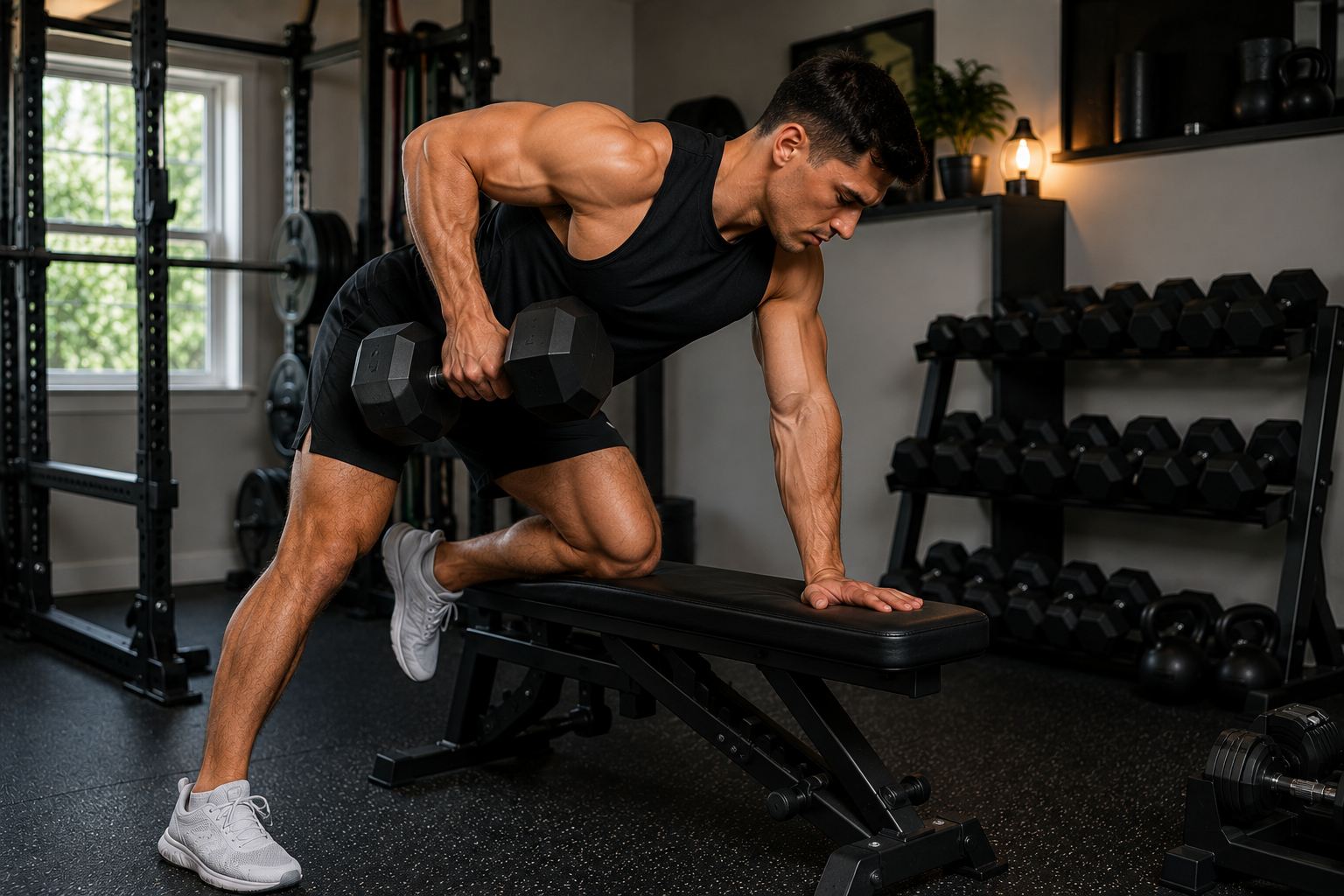
Dumbbell back exercises: build a V-taper back even in a home gym
Building a wide and strong back is one of the most ambitious goals for those who train, but it is often associated exclusively with the use of pull-up bars, lat machines, and specific equipment. In reality, a well-structured program with dumbbell back exercises allows you to develop the latissimus dorsi, trapezius, rhomboids, and stabilizer muscles even in a home gym without bulky equipment.
Dumbbells offer an important advantage: they allow you to work with greater freedom of movement and require active body control during every phase of the exercise. This means improving not only back strength but also coordination between muscles, joints, and posture.
To achieve a V-taper back, it is not enough to simply lift heavy weights. It is necessary to understand the role of the mind-muscle connection, control the movement of the scapula, and choose exercises capable of correctly stimulating the width and thickness of the back.
- Why train your back with dumbbells
- Back anatomy and muscles involved
- Principles for a V-taper back with dumbbells
- Dumbbell row: basic back exercise
- Dumbbell pullover for the latissimus dorsi
- Dumbbell deadlifts and the posterior chain
- Programming a dumbbell back workout
- Building a complete back in a home gym
Why train your back with dumbbells
The back is composed of numerous muscle groups that work together to stabilize the torso, move the arms, and maintain correct posture. An effective workout must therefore consider different functions: vertical pull, horizontal pull, hip extension, and scapular control.
Dumbbells allow you to train these patterns through free movements that require greater participation of stabilizer muscles compared to many guided machines. Each side of the body works independently, reducing the possibility of a dominant side compensating for the work of the other.
For those training at home, this versatility is particularly important because it allows you to achieve significant results with limited equipment.
Advantages over machines
Machines can be useful for isolating certain muscles, but they often limit the trajectory of the movement. Dumbbells leave more freedom and allow the body to naturally adapt the motion.
This promotes the development of coordination and improves the ability to control the load during the exercise.
Training the back without a bar
Not having a pull-up bar or a lat machine does not mean giving up on a complete back workout. With a correct selection of exercises, it is possible to effectively stimulate the main back muscles.
Dumbbells represent a practical solution for creating a complete routine even in small spaces.
Back anatomy and muscles involved
To effectively train your back, it is useful to understand which muscles participate in the different movements. The back is not a single muscle, but a set of structures that collaborate to produce strength and stability.
Knowing these functions allows you to choose more targeted exercises and improve the quality of your training.
A complete program must involve both the muscles responsible for width and those that contribute to thickness.
Latissimus dorsi and back width
The latissimus dorsi is primarily responsible for the wide shape of the back. Its function is mainly linked to the movements of adduction and extension of the arm.
Correctly stimulating this muscle allows you to develop the characteristic V-taper look of the physique.
Trapezius and rhomboids for thickness
The trapezius and rhomboids contribute to back density and scapular control. These muscles are fundamental for maintaining a stable posture during pulling movements.
A complete back therefore requires attention to both width and muscular depth.
Principles for a V-taper back with dumbbells
Achieving a V-taper back requires an approach based on progression, technique, and the ability to perceive muscular work. The weight used is important, but it is not the only determining factor.
Many errors stem from focusing exclusively on the load without controlling the movement and the position of the scapulae.
The quality of the contraction must remain at the center of the workout.
Mind-muscle connection in the back
The mind-muscle connection indicates the ability to perceive the muscle that is working during the exercise. In the case of the back, this aspect is particularly important because many movements can be compensated for by the biceps.
Focusing on the contraction of the back helps to transfer more of the work to the target muscles.
Scapular control
The scapula plays a fundamental role in the movements of the upper body. Correct management of the scapular position improves the efficiency and safety of the exercises.
Training the back therefore also means learning to control the movement of the involved joints.
Dumbbell row: basic back exercise
The dumbbell row is one of the most effective exercises for developing back thickness. The movement consists of bringing the dumbbell toward the torso through a controlled pull, involving the latissimus dorsi, rhomboids, and trapezius.
The ability to work one arm at a time allows you to focus more on the quality of the contraction and correct any differences between the sides.
It is a fundamental exercise for those who want to build a strong back using only dumbbells.
Dumbbell row technique
During execution, it is important to keep the torso stable and lead the movement with the elbow, avoiding the use of momentum. The dumbbell must follow a controlled trajectory.
Correct technique increases the stimulus on the back and reduces excessive involvement of the arms.
Row progression
Progression can occur by gradually increasing the load, the number of repetitions, or by improving the control of the movement.
The goal should be to increase the stimulus while always maintaining good execution.
Dumbbell pullover for the latissimus dorsi
The dumbbell pullover is a very interesting exercise for involving the latissimus dorsi through a shoulder extension movement. It is often used to complete work on back width.
Its peculiarity is the feeling of stretching that allows you to perceive muscular work in a different way compared to classic pulls.
To be effective, it requires control and correct management of the range of motion.
Importance of muscle stretching
The stretching phase under control creates an important stimulus for the muscle. In the pullover, it is essential to avoid movements that are too rapid, which reduce tension.
Correct execution allows you to better exploit the potential of the exercise.
Integrating the pullover into the program
The pullover can be inserted after heavier pulling exercises or used as a complementary movement.
The choice depends on the goals and the general structure of the workout.
Dumbbell deadlifts and the posterior chain
Dumbbell deadlifts allow you to train not only the back but the entire posterior chain. Glutes, hamstrings, spinal erectors, and stabilizer muscles work together to control the movement.
They are particularly useful in a home gym because they allow you to develop general strength without the need for barbells or specific machines.
Technique remains fundamental to exploit the benefit of the exercise.
Role of the posterior chain
The posterior chain is responsible for many fundamental actions such as lifting, pushing, and stabilizing the body. Strengthening it improves both athletic performance and daily movement capacity.
Dumbbell deadlifts represent an effective tool for this goal.
Movement control and safety
During deadlifts, it is important to maintain a stable position of the spine and control the descent of the weight.
Correct execution allows you to progressively increase the load while reducing the risk of technical errors.
Programming a dumbbell back workout
An effective program for the back must combine different movement patterns. A single exercise is not enough to stimulate all the functions of the back musculature.
The combination of rows, extension movements, and work for the posterior chain allows you to create a complete stimulus.
Frequency and volume must be adapted to the athlete's level.
Choosing sets, repetitions, and load
The number of sets and repetitions depends on the training goal. To increase muscle mass, it is necessary to create sufficient tension while maintaining precise technique.
The load must always be compatible with the control of the movement.
Progression over time
To continue improving, it is necessary to gradually increase the stimulus. This can happen through heavier loads, more repetitions, or better technical quality.
Consistency remains the main factor in back development.
Building a complete back in a home gym
Training the back with dumbbells proves that a home gym can offer significant results even without a pull-up bar or lat machine. Through targeted exercises, it is possible to develop width, thickness, and muscle control using compact and versatile tools.
The difference between an effective workout and an unproductive one does not depend only on the available equipment, but on the ability to choose the correct movements and apply precise technique. The mind-muscle connection and scapular control become fundamental elements to truly stimulate the back.
Choosing reliable equipment like adjustable dumbbells allows you to build a flexible home gym capable of supporting constant progression and complete programs for strength development.
Comments (0)