
Trolley
You have no items in your shopping cart

 Budgets
 Dumbers
 Discs
Discs
 Benches
 Racks and Rigs
 Weights Holders
 Isotonic machines
 Calisthenics
 Cardio
 Kettlebells
 Flooring
 Gym Set
 Accessories
 Combat
 ARTI MARZIALI
 CONTAINER GYM
 Tug-Of-War
 Used Gym Equipment
 PILATES MACCHINARI
 GINNASTICA ARTISTICA
 CAMPI DA PADEL
 Prodotti in Pronta Consegna
 Informazioni
 IRONMAN
 Gift Card
- Donatif
- General information
- 0 I like it
- 361 Views
- 0 comments
- gym flooring, safety flooring, gym safety, shock-absorbing materials
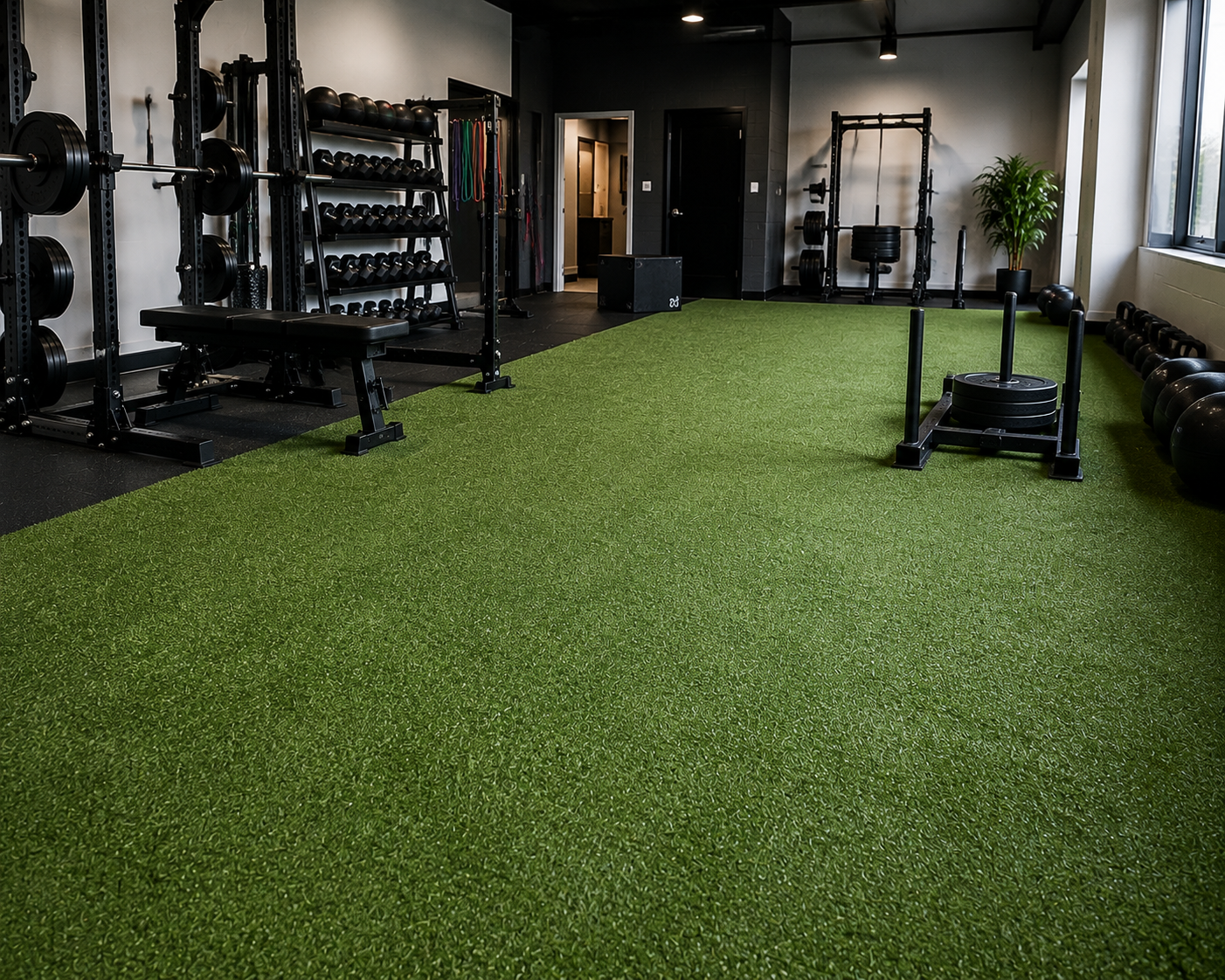
Synthetic Turf for Indoor Gyms: When and Why to Install It
In recent years, the design of fitness spaces has evolved rapidly. Modern gyms are no longer just places dedicated to training, but environments designed to offer an engaging, functional, and highly recognizable experience. In this context, indoor gym synthetic turf has become one of the most appreciated solutions for enhancing areas dedicated to functional training, sled training, and high-intensity exercises.
Beyond the aesthetic impact, synthetic turf represents a technical choice capable of improving the usability of spaces. Its characteristics allow for the creation of lanes dedicated to sled pulling, zones for sprints, agility exercises, and athletic tracks without compromising the durability of the flooring or the comfort of the users.
For owners of fitness centers, personal training studios, and functional boxes, investing in a solution of this type means differentiating themselves from the competition, increasing the perceived value of the facility, and offering a professional environment capable of communicating innovation at first glance.
- Why choose synthetic turf
- Functional advantages
- Gym design and image
- How to install it correctly
- How to choose the best product
- Errors to avoid
- Evaluating the investment
- Why it represents a strategic choice
Why choose synthetic turf
The introduction of synthetic turf in training areas stems from the need to create surfaces dedicated to dynamic exercises that require high resistance to wear. In particular, sled workouts, sprints, and changes of direction put any traditional covering under stress.
A specific surface allows for improving the quality of training by offering greater grip, a more natural sensation during pushing, and better perception of the spaces dedicated to athletic activities.
From a commercial point of view, the presence of a green lane also represents a distinctive element that contributes to enhancing photographs, promotional videos, and social media content of the gym.
An ideal solution for functional training
Functional areas require materials designed to withstand continuous use, multi-directional movements, and heavy equipment. A modern functional training floor with the insertion of synthetic turf allows for clearly separating different operational zones, increasing safety and organization.
The perfect lane for the sled
The creation of a gym sled lane allows for performing pushing and pulling exercises while reducing the wear of traditional flooring and improving the fluidity of movement.
Functional advantages
One of the main benefits of synthetic turf consists of its ability to withstand intensive use while maintaining a professional appearance over time. High-density fibers are designed to withstand the continuous passage of users and equipment.
The surface guarantees a good balance between friction and smoothness, a fundamental characteristic during exercises with sleds and weighted sleds.
Furthermore, it facilitates the subdivision of spaces, allowing for the creation of dedicated paths without complex structural interventions.
Greater safety
A uniform surface helps to reduce the risk of tripping and improves stability during explosive exercises.
Resistance over time
Professional products maintain color and technical characteristics even after years of intense use, reducing replacement interventions.
Gym design and image
Today, design represents an important competitive factor. A modern gym must be immediately recognizable and convey professionalism from the very first entrance.
Synthetic turf creates a strong chromatic contrast with rubber flooring, enhancing the entire functional area and making it the protagonist of the facility.
Many centers also use this solution to integrate logos, numbered lanes, and custom graphics capable of strengthening the brand.
Customization
Colors, markings, and logos allow for transforming a simple lane into an element of visual communication consistent with the gym's identity.
Value for marketing
An aesthetically curated environment improves the perception of the service and favors the production of high-impact photographic and video content.
How to install it correctly
Correct installation starts with the preparation of the subfloor. The surface must be perfectly leveled and clean to ensure uniform adhesion.
It is important to use specific glues and professional products capable of withstanding strong mechanical stresses.
The positioning must also consider the maneuvering spaces for equipment and the flow of users within the gym.
Sizing
The length of the lane generally varies between 10 and 20 meters depending on the available space and the planned activities.
Maintenance
Simple periodic cleaning allows for maintaining high aesthetic and functional performance without particular operating costs.
How to choose the best product
Not all synthetic surfaces are the same. Professional solutions use high-resistance fibers, reinforced backings, and adhesives designed for intensive use.
It is important to evaluate density, fiber height, elastic recovery capacity, and compatibility with the planned exercises.
Relying on suppliers specialized in the fitness sector allows for obtaining a solution truly designed for the needs of gyms.
Professional materials
Higher construction quality guarantees superior durability and better performance in the long term.
The right partner
To obtain a professional result, it is advisable to choose companies with specific experience in the creation of functional areas. A solution like indoor gym synthetic turf designed by specialists allows for maximizing the return on investment.
Errors to avoid
One of the most frequent errors consists of purchasing products intended for residential use. These materials are not designed to support continuous loads and tend to deteriorate rapidly.
Even an improvised installation can compromise the durability of the surface, causing detachment or deformations.
Finally, it is fundamental to carefully evaluate the position of the lane to avoid interference with other training areas.
Saving on material
A choice exclusively oriented towards price often entails higher costs in the medium term due to early replacements.
Neglecting design
Accurate planning improves the user experience and optimizes the use of available spaces.
Evaluating the investment
The introduction of synthetic turf represents an investment that produces both operational and commercial benefits. A more modern gym increases the perceived value of the service and contributes to customer loyalty.
Functional areas are often among the most photographed and used, making this solution particularly effective also from a marketing point of view.
Over time, the long durability of professional materials allows for easily amortizing the initial cost thanks to reduced maintenance.
Economic return
A more captivating environment favors the acquisition of new members and improves the competitive positioning of the fitness center.
Perceived value
A well-maintained facility communicates attention to detail, innovation, and quality of service, elements increasingly sought after by users.
Why it represents a strategic choice
For gym owners and personal training studios, investing in synthetic turf means going beyond simple aesthetic improvement. It is a solution capable of increasing functionality, space organization, and the quality of the training experience.
Modern functional areas require materials designed to support intensive use and at the same time enhance the image of the facility. Accurate design allows for creating distinctive, efficient environments ready to welcome new training methodologies.
Carefully evaluating materials, installation, and technology partners allows for obtaining a durable solution that improves the competitive positioning of the gym and contributes to differentiating oneself in a market increasingly oriented towards quality, innovation, and customization of spaces.
Comments (0)