
Trolley
You have no items in your shopping cart

 Budgets
 Dumbers
 Discs
 Benches
 Racks and Rigs
 Weights Holders
 Isotonic machines
 Calisthenics
 Cardio
 Kettlebells
 Flooring
 Gym Set
 Accessories
 Combat
 ARTI MARZIALI
 CONTAINER GYM
 Tug-Of-War
 Used Gym Equipment
 PILATES MACCHINARI
 GINNASTICA ARTISTICA
 CAMPI DA PADEL
 Prodotti in Pronta Consegna
 Informazioni
 IRONMAN
 Gift Card
- Donatif
- General information
- 0 I like it
- 148 Views
- 0 comments
- gym flooring, safety flooring, gym safety, shock-absorbing materials
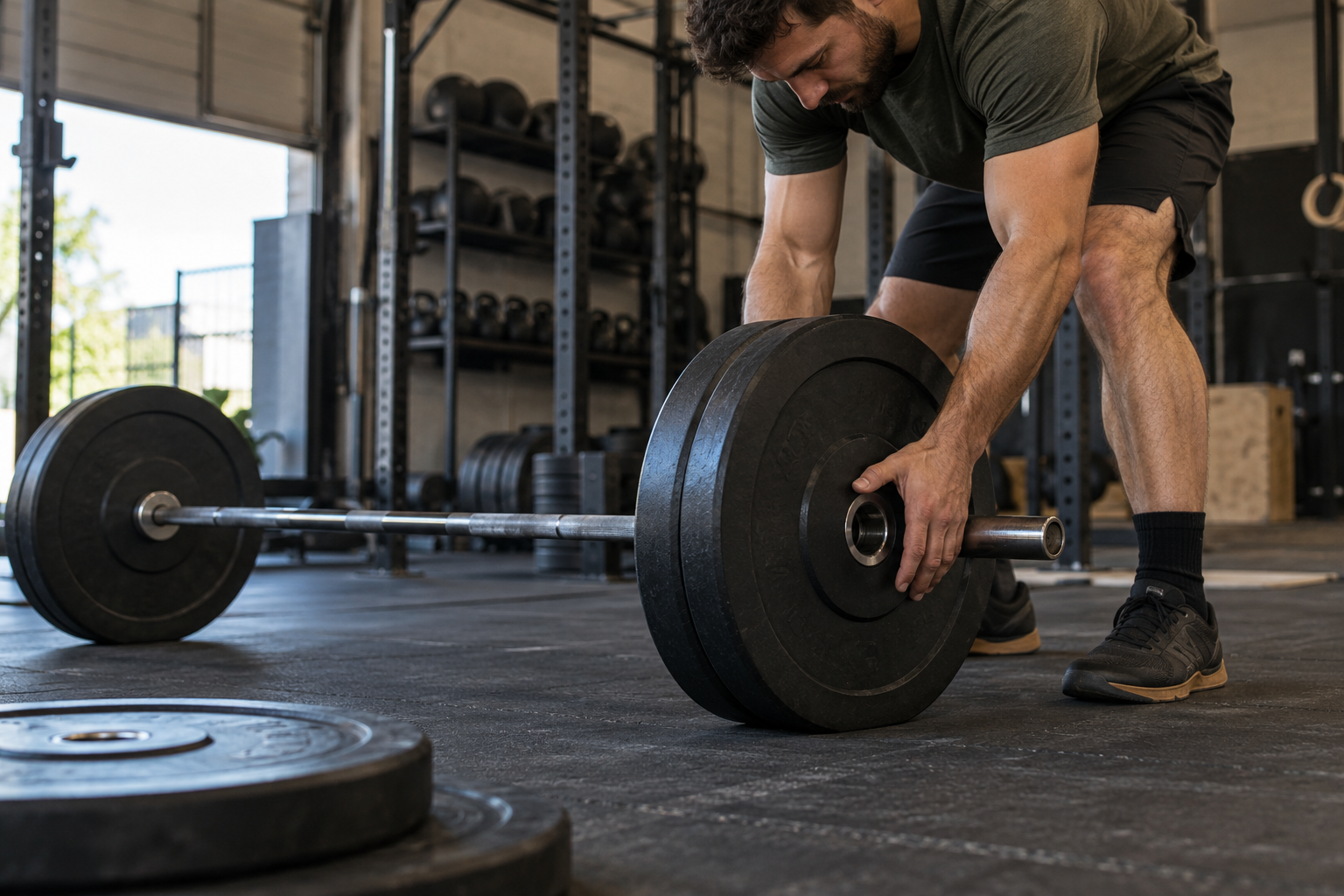
What are CrossFit bumper plates and how are they used
In an area dedicated to barbell exercises, weight plates are not all interchangeable. Shape, materials, and intended usage methods affect the preparation of the workstation and load management. Bumper plates are a specific category to understand before using them, especially when traditional plates and products intended for different activities are present in the same room.
Understanding what CrossFit bumper plates are means distinguishing product characteristics and training conditions. The coated appearance does not automatically authorize any dropping of the barbell, while a compatible size does not clarify all methods of use. Manufacturer instructions and area organization remain essential references for using the intended system.
This guide explains how to recognize plates, read useful information, and prepare them for the session. It does not present a universal drop technique nor does it replace the teaching of exercises. For gym staff, the goal is to make products, placement, and procedures recognizable, so that users can prepare and reset the workstation without confusing different families of equipment.
- Recognize construction and function of the bumper plate
- Read weight and barbell compatibility
- Distinguish bumpers and other plate families
- Prepare the barbell before the set
- Understand the limits of dropping and stress
- Organize surface, space, and nearby people
- Store plates and monitor their condition over time
Recognize construction and function of the bumper plate
Bumper plates are barbell plates characterized by a construction in which the outer body and the central part perform different functions.
Materials and construction solutions may vary between models. To recognize the product, it is necessary to consult the relevant information, avoiding identifying it solely by color or the presence of a coating.
The construction of bumper plates must be read together with the declared conditions of use. One plate may look similar to another and differ in characteristics relevant to its use. Comparison must therefore refer to the model and documentation, especially when preparing a room with products purchased at different times or coming from different suppliers.
Distinguish coating and central part
The visible coating alone does not describe the behavior of the plate or the conditions in which it can be used. The central part must also be consistent with the barbell and with what is provided by the product. An anomaly observed in this area must be reported without deducing that the machine remains usable simply because the plate can be slipped on.
Read the plate as a complete product
The complete product includes markings and references useful for identifying it. The manager should keep this information recognizable and distinguish any different series. A room with visually similar plates but different intended uses requires clear organization, so that the user does not choose the material solely based on its position on the rack.
Read weight and barbell compatibility
Weight must be recognized through product markings and not deduced from color.
If different identification systems are present in the room, they must be made understandable to users. The goal is to prepare a load consistent with the program, avoiding errors due to visual similarity between plates or their usual position on the rack.
Barbell compatibility must be verified on the relevant information of both products. The simple possibility of bringing the plate close to the sleeve does not replace a check of the references. Staff must be able to clarify which combinations are intended, without letting the user reconstruct the configuration through trial and error or comparisons with similar equipment.
Verify the indications on the plates
Markings must remain legible and attached to the product. If a plate cannot be identified with certainty, the situation must be handled according to the facility's organization before inserting it into the load. It is useless to attribute a weight based on habit or visual estimation when the necessary information to correctly prepare the workstation is missing.
Consider the space occupied on the sleeve
The thickness of the plates influences the available space on the sleeve. The configuration must respect the conditions established by the barbell and the elements used. It is not enough to add up the desired weights: you must verify that the preparation is compatible with the system and that the relevant closing elements can be handled according to their respective instructions.
Distinguish bumpers and other plate families
Traditional plates, coated products, and bumpers may share some characteristics without having the same intended use.
Staff should know the actual equipment and make relevant references available. The user must not assume that any colored plate belongs to the same category or that all combinations are suitable for the same activities.
Barbell plates can be explored further through data of individual models. The commercial category offers alternatives, while use must remain linked to the product present. A general description of the bumper does not automatically confirm the conditions of use of all plates available in the room or shown on the same catalog page.
Avoid equivalences based on appearance
Appearance can help initial recognition, but it must not be the final criterion. If a series presents different characteristics, the information must be verified and communicated. Even a new product must be integrated into the room's organization, preventing it from being mixed with existing equipment without clarifying any differences in intended usage methods.
Keep room equipment recognizable
An orderly storage area can separate the relevant families and keep weights legible. This facilitates preparation and return, especially when multiple users share the area. The arrangement criterion must be consistent with actual products: a generic bumper label is not enough if the rack contains different elements that require different instructions.
Prepare the barbell before the set
Preparation must start from the load planned for the person and the exercise, according to the agreed program.
The total weight includes the elements actually used, not just the plates just added. When there is a doubt about counting or configuration, staff can help clarify it before starting the movement.
Barbell loading must follow the conditions relevant to the products and the activity. The presence of bumpers does not automatically modify every procedure of the workstation. Barbell, plates, and collars must be considered together, avoiding improvised configurations to reach a desired weight without verifying the compatibility of the prepared system.
Connect the load to the individual program
The individual program must remain the reference for the work request. Copying another user's load does not clarify whether it is appropriate for your session. Even when the weight is noted, the person must check which elements are present, especially if they change barbells or use a different series of plates than usual.
Check the complete configuration
Before the set, the workstation must be organized for the intended exercise and nearby people. Unused plates and accessories must have a placement that does not interfere with the activity. If the configuration requires further instructions, it must be prepared with the support of the staff instead of being corrected during execution.
Understand the limits of dropping and stress
The bumper must not be interpreted as authorization to drop any barbell at any point in the room.
Methods of use, combinations, and surface conditions must be verified through relevant references. The construction of the plate is part of the system and does not alone describe the behavior of the entire workstation during activity.
Barbell exercise technique requires instruction related to movement and the individual. A guide on plates cannot prescribe a universal method of dropping or recovering the barbell. The instructor must be able to explain the relevant sequence, keeping product instructions and individual training progression distinct.
Follow what is intended for the product
The conditions declared by the manufacturer must be applied to the model present, without transferring them from a different series. If staff do not have the necessary information, they must retrieve it through appropriate channels. Familiarity with other bumpers does not replace the relevant reference, especially when equipment is expanded or modified.
Address technique with an instructor
Technique must also consider the end of the repetition and management of the workstation, according to the program and area conditions. The user should not learn these steps by imitating another person from a distance. Any doubt should be addressed with the instructor before introducing a request that cannot be handled in a comprehensible way.
Organize surface, space, and nearby people
The area must be organized for the intended activity, with attention to walkways and nearby workstations.
The manager should define where exercises take place and how accessories and waiting areas are managed. The presence of a floor coating does not automatically make every point in the room equivalent for all barbell activities.
The surface must be evaluated together with the building's conditions and intended use, through relevant expertise when necessary. Floor protection, noise, and vibration are different issues. The bumper does not automatically guarantee isolation toward nearby rooms, just as the simple thickness of a coating alone does not confirm the compatibility of the entire configuration.
Evaluate the area intended for the barbell
The area must remain recognizable even when the room is busy. If a pathway crosses the area where loads are prepared, the layout requires attention before attributing the problem solely to user behavior. Organization can be observed in ordinary conditions, looking for recurring interference and relevant changes to space distribution.
Distinguish building protection and compatibility
Building assessments remain separate from plate instructions. The manufacturer can provide product data, while the context requires additional information. The manager must keep these levels visible, avoiding that a commercial label or experience in another gym is used as general confirmation of their own room's conditions.
Store plates and monitor their condition over time
The end of the session includes returning the plates to their intended position.
Storage consistent with the equipment facilitates counting and allows subsequent users to recognize what they are looking for. The procedure must be understandable and compatible with the racks used, without turning tidying up into a step left to each person's interpretation.
The condition of the plates must be monitored through relevant instructions and a reporting procedure. Coating, central part, or other elements showing anomalies must be described and identified. The decision on use must not be based solely on the fact that the product continues to be recognizable or can still be put on the barbell.
Keep storage legible after the session
Storage must make retrieval and return possible without creating predictable interference with those training. If equipment increases, the arrangement must be updated rather than adding plates in provisional positions. Staff can observe recurring difficulties and make the organization clearer, linking quantities, types, and rack positions to actual activities.
Report anomalies without improvised interventions
An anomaly requires concrete information and appropriate follow-up, avoiding improvised repairs or product modifications to keep it available. Reference to the series or the single element helps track the report. Bumper management thus remains part of normal room organization: preparing, using, storing, and checking products according to relevant conditions.
Comments (0)