
Trolley
You have no items in your shopping cart

 Budgets
 Dumbers
 Discs
 Benches
 Racks and Rigs
 Weights Holders
 Isotonic machines
 Calisthenics
 Cardio
 Kettlebells
 Flooring
 Gym Set
 Accessories
 Combat
 ARTI MARZIALI
 CONTAINER GYM
 Tug-Of-War
 Used Gym Equipment
 PILATES MACCHINARI
 GINNASTICA ARTISTICA
 CAMPI DA PADEL
 Prodotti in Pronta Consegna
 Informazioni
 IRONMAN
 Gift Card
- Donatif
- General information
- 0 I like it
- 146 Views
- 0 comments
- gym flooring, safety flooring, gym safety, shock-absorbing materials
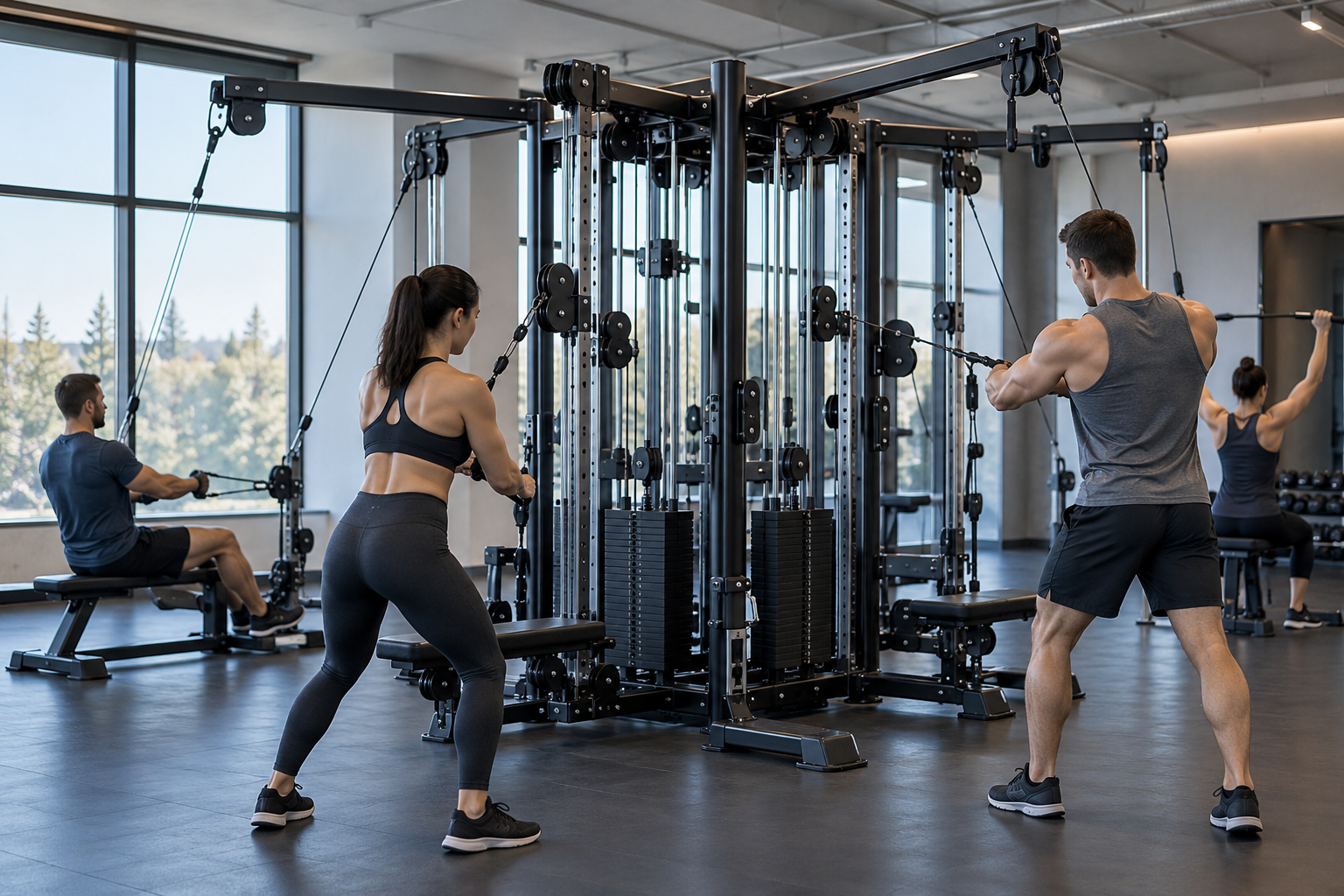
What an eight-cable pulley station is: operation and benefits for the gym
Understanding what an eight-cable pulley station is is useful for gym managers and purchasing officers who want to organize a versatile training area capable of accommodating different exercises and multiple users. Cable stations represent an important category of professional fitness equipment, but the available configurations can vary significantly in structure, number of stations, resistance systems, and adjustment possibilities.
The expression eight-cable pulley station does not necessarily identify a standardized type of machine. In a commercial setting, it can be used to describe a multi-function structure equipped with multiple traction lines or cable stations. To understand the actual operation of a model, it is necessary to check the technical sheet, distinguishing the number of cables present, that of usable outlets, and the number of people who can train simultaneously.
For a professional gym, the value of such a station does not depend solely on the quantity of theoretically performable exercises. Overall dimensions, ergonomics, station availability, characteristics of weight stacks, ease of maintenance, and compatibility with the training program also matter. This guide delves into the main evaluation criteria, with application examples and useful indications to avoid purchases based exclusively on commercial descriptions.
- What an eight-cable pulley station is
- How the cable and pulley system works
- Configurations and number of usable stations
- What exercises can be performed
- Technical features to verify
- Dimensions, installation, and space organization
- Safety, checks, and maintenance
- Comparison with other cable equipment
- Purchase and operational management costs
- How to evaluate the investment for a professional gym
What an eight-cable pulley station is
A pulley station is equipment that uses cables, pulleys, and resistance systems to allow pulling movements and other guided-load exercises. In multi-function configurations, multiple work points can be integrated into a common structure. This allows concentrating different training possibilities in a single area, provided the stations are designed for the intended use.
When talking about eight cables, it is necessary to clarify the meaning attributed by the manufacturer to this feature. Eight cable segments do not automatically equal eight independent outlets, just as eight outlets do not guarantee that eight people can use them simultaneously. Some stations may share weight stacks, mechanical paths, or operating spaces.
The correct interpretation of the configuration therefore requires an examination of the technical drawing and model specifications. For the purchasing officer, this check is fundamental because it allows distinguishing a construction feature from an actual operational advantage. The commercial designation constitutes a starting point, not sufficient proof of the machine's capacity.
What the presence of eight cables really indicates
In a multi-function structure, the number of cables can refer to different elements of the transmission system. Some connect the weight stack to the pulleys, while others constitute parts of the path necessary to obtain certain pulling directions.
Before comparing two models, it is advisable to ask how many exit points are actually available, which ones can be used together, and whether they share the same resistance. Without this information, the simple number of cables does not allow a reliable technical comparison.
Difference between traditional pulley and multi-function station
The term pulley is often associated with the classic low-cable seated row exercise. A multi-function station can instead also include lat pulldowns, movements with adjustable cables, and stations dedicated to different exercises.
The presence of multiple functions does not automatically make the machine superior to a specialized station. A dedicated structure can offer ergonomic characteristics particularly suited to an exercise, while a multi-function solution prioritizes variety and space sharing.
How the cable and pulley system works
Operation is based on the transmission of force through a cable that runs over one or more pulleys. When the user pulls a handle, the movement is transferred to the resistance system, which can include a selectable weight stack. The arrangement of the pulleys changes the direction of the force and can influence the ratio between the handle displacement and that of the load.
An important aspect is the transmission ratio. In some machines, the handle displacement is different from that of the weight stack and the perceived resistance does not directly coincide with the selected nominal value. For this reason, two stations with apparently identical weight stacks can offer different load sensations.
The actual behavior also depends on friction, pulley geometry, cable conditions, and structure characteristics. It is not correct to deduce the available resistance solely from the total mass of the installed weights. For an accurate evaluation, it is necessary to consult the information provided by the manufacturer and verify the declared conditions of use.
Transmission ratio and effective resistance
A system with a different transmission ratio may require a greater displacement of the handle to lift the weight stack by a certain distance. This characteristic influences both the available range of motion and the theoretical resistance transmitted to the user.
When comparing professional models, it is useful to request the declared ratio for each station. The indications must be interpreted also considering friction and other mechanical characteristics, avoiding simplified equivalences between selected kilograms and applied force.
Cable sliding and movement quality
The fluidity of sliding contributes to the perceived quality during the exercise. Pulleys, guides, and connections must work correctly to allow regular movements within the expected range.
Abnormal noises, sticking, or sudden variations in resistance may indicate the need for checks. These signals must not be ignored, especially in structures subject to frequent use by numerous users.
Configurations and number of usable stations
Multi-function cable stations can be organized through different modules, each intended for specific training modalities. A configuration can include high and low traction points, adjustable cables, and stations with dedicated seats. The actual combinations depend on the model and must not be assumed based on the designation.
For a gym, the number of independent stations represents a more useful data point than the total number of cables. A machine that allows multiple people to train simultaneously can help manage customer flow, but only when movement spaces do not overlap and resistance systems are usable in the declared modes.
It is therefore advisable to request a representation of operating areas and verify any restrictions on simultaneous use. Even a structure with many outlets can be inefficient if users have to wait for a nearby station to be freed before performing their exercise.
Independent stations and shared weight stacks
Two cable outlets can be connected to the same weight stack or to separate resistance systems. The difference is relevant because it determines which exercises can be performed simultaneously.
The purchasing officer should check the number of weight stacks, the outlets associated with each, and any restrictions. A structure with multiple cables but shared resistances can offer versatility without guaranteeing an equivalent number of independent users.
Height adjustments and pulling directions
Adjustable outlets allow modifying the point of application of the resistance based on the exercise and the user's characteristics. The availability of adjustments can expand working possibilities, especially for unilateral movements and pushing or pulling variants.
It is necessary to check the actual adjustment range, the simplicity of the mechanisms, and the stability of the selected positions. An adjustable system must be used exclusively according to the procedures provided by the manufacturer.
What exercises can be performed
A cable station can allow exercises for the back, arms, shoulders, and other muscle regions, depending on the available outlets and compatible accessories. Pulldowns and rows represent frequent applications, while adjustable cables can allow complementary movements for the upper limbs and trunk.
The theoretical possibility of performing an exercise does not mean every model is designed to do so. It is necessary to verify the pulling direction, cable travel, available resistance, and required space. Some movements may require specific handles or configurations not included in the standard equipment.
For a professional fitness center, it is useful to build a matrix of the actually proposed exercises, associating the necessary station with each. This allows identifying overlaps and deficiencies before purchase, avoiding choosing a highly articulated structure that does not meet user needs.
Exercises for the back and pulling muscles
High cable pulls can be used for lat machine variants when the structure has a suitable station. Low outlets can allow seated rows or other pulling movements, provided appropriate supports and usage conditions are provided.
The quality of the exercise also depends on body position and the ability to stabilize correctly. A station with a suitable pulling direction but without adequate supports might not offer the same experience as a specific machine.
Exercises for arms, shoulders, and complementary work
Adjustable outlets can be used for curls, triceps extensions, and shoulder movement variants when allowed by the configuration. Using different handles modifies grip modes and can make the execution of certain exercises more comfortable.
Selection must still respect user capabilities and the technician's instructions. It is not appropriate to use a station for movements not foreseen by the manufacturer or introduce improvised connections to obtain different pulling directions.
Technical features to verify
Choosing a professional pulley station requires the analysis of verifiable characteristics. These include dimensions, structure mass, type of resistance systems, transmission ratios, cable travel, and number of actually independent stations. The availability of a complete technical sheet facilitates comparison between alternatives.
It is also important to evaluate adjustments, accessory compatibility, and installation instructions. The presence of numerous functions can increase versatility, but introduces components that must be used and maintained correctly. A more complex machine is not necessarily more suitable for every gym.
Declared load capacities must be interpreted in their context. The capacity of a component does not automatically demonstrate the capacity of the entire structure, just as the weight stack mass does not alone describe the effective resistance. When data is ambiguous, it is preferable to request clarifications from the manufacturer before proceeding.
Structure, materials, and stability
The frame must be designed to support the stresses expected during use. Materials, connections, and geometry contribute to overall stability, but cannot be correctly evaluated through the apparent thickness of the profiles alone.
The purchasing officer should check the intended use, installation requirements, and manufacturer documentation. In the presence of mandatory fastening systems, installation must comply with the expected instructions and building structure characteristics.
Weight stacks, increments, and load adjustment
The overall mass of the weight stack is an element to consider together with the transmission ratio and available increments. A system with small increments can facilitate progression for some exercises, while other activities require greater resistance availability.
It is useful to verify that selectors are easily accessible and that the system prevents improper uses according to the design. Adjustments must be performed respecting instructions and without intervening on components while they are under load.
Dimensions, installation, and space organization
A multi-function station can concentrate various activities in a relatively defined surface, but its operational footprint is greater than just the frame dimensions. Handle travel, user position, any mobile accessories, and access paths must be considered. Design must therefore start from an accurate floor plan.
Placement must avoid interference with nearby machines, passages, and exits. If the structure allows the simultaneous use of multiple stations, spaces must be evaluated considering all activities provided at the same time. The presence of numerous work points can increase the need for free surface area around the machine.
Before installation, it is necessary to verify assembly requirements, floor characteristics, and indications regarding any anchoring. Structural assessments must be entrusted to competent professionals when required by room conditions or product specifications.
Difference between nominal dimensions and operational space
The dimensions reported in the technical sheet generally describe the structure in a certain configuration. They do not always represent the entire space needed to perform exercises safely.
For example, an adjustable cable station may require lateral space for arm movements or body shifts. It is therefore useful to represent also the usage areas on the floor plan, not just the machine perimeter.
Installation, flooring, and accessibility
Flooring must be compatible with the weight of the structure and expected stresses. It is not correct to assume that any technical gym surface is automatically suitable for all machines.
It is also necessary to check access modes to the stations, the space needed for adjustments, and the possibility of performing maintenance. A machine installed too close to a wall can make interventions requiring access to rear components difficult.
Safety, checks, and maintenance
Cable stations include components subject to movement and wear. Cables, pulleys, guides, selectors, and connections must be checked according to the manufacturer's instructions. The frequency of checks depends on machine characteristics and intensity of use, especially in gyms with high user turnover.
Maintenance of cable machines must provide attention to signs of deterioration, irregular sliding, abnormal noises, and adjustment operation. A cable showing visible damage or a component not operating correctly requires evaluation before continuing use. Repairs must comply with procedures provided by the manufacturer.
It is useful to set up an intervention log and assign clear responsibilities to staff for routine checks. Users must receive instructions on correct adjustment methods and handle usage. The presence of a professional machine does not eliminate the need for supervision when appropriate.
Checking cables, pulleys, and connections
Cables must be examined according to the methods indicated by the manufacturer, paying attention to any coating anomalies, deformations, or sliding problems. Pulleys and connections must also maintain design conditions.
It is not prudent to replace a cable with a generically similar component without verifying its compatibility. Materials, dimensions, and terminal characteristics can influence system operation.
Usage procedures and staff training
Staff should know permitted adjustments, load limitations, and methods to recognize evident anomalies. An internal procedure can provide for checking general conditions before opening and immediate reporting of problems.
In the presence of a defect potentially relevant to safety, the station must be taken out of use until appropriate verification. Continuing to use a malfunctioning machine to avoid service disruptions can increase the risk of more serious consequences.
Comparison with other cable equipment
An eight-cable pulley station must be compared with alternatives that perform similar functions but have different operational characteristics. These include traditional pulley stations, lat machines, adjustable crossover pulleys, and multi-function structures with multiple modules. The choice depends on the variety of exercises required and the number of users.
A specialized machine can be easier to use for a specific exercise and offer a particularly defined position. A multi-function station can instead concentrate different activities, reducing the need to purchase multiple separate structures. However, the space advantage must be verified considering actual operational areas.
To understand the different solutions available in the guided machine sector, you can consult the category of professional isotonic machines, subsequently comparing the characteristics of individual models. The connection between a commercial category and a specific eight-cable configuration must not be taken for granted: technical sheets must always be verified.
Multi-function station and adjustable crossover pulley
An adjustable crossover pulley can offer different pulling directions through one or more outlets, proving useful for complementary exercises and unilateral movements. Its operational capacity depends on configuration and available spaces.
A structure with multiple modules can allow greater variety of simultaneous activities, but generally requires a more articulated evaluation of layout and usage procedures. Convenience depends on the frequency with which the various stations are actually employed.
Cable station and dedicated machines
A lat machine or specific pulley station can offer an ergonomic configuration designed around a main movement. This can be useful in gyms with high demand for certain exercises.
A multi-function structure may be preferable when wishing to expand training variety without introducing many separate machines. Before choosing, it is advisable to compare adjustment quality, station availability, and overall costs.
Purchase and operational management costs
The initial price represents only part of the cost of a professional station. Transport, installation, any anchoring, maintenance, and replacement of wear components can impact the overall budget. Individual items depend on the model and commercial conditions, and must therefore be verified through detailed quotes.
A structure with numerous stations may appear economically attractive when compared to purchasing multiple separate machines. However, the comparison must consider actual simultaneous usage capacity. If multiple work points share the same weight stack or interfere with each other, the number of available exercises does not necessarily correspond to the number of users served.
Spare parts availability represents another important factor. Cables, pulleys, and other components may require replacements during the operational life of the machine. Before purchase, it is useful to clarify assistance methods and conditions provided for interventions, avoiding basing the decision exclusively on list price.
Evaluating total cost of ownership
The total cost of ownership includes the initial investment and predictable expenses during the period of use. It can be useful to build a prospectus distinguishing purchase, installation, maintenance, and possible costs related to temporary machine unavailability.
It is not possible to indicate a universal cost for all eight-cable stations, because configurations, dimensions, and services can vary significantly. Economic comparison must therefore use offers referring to homogeneous characteristics and conditions.
Ratio between investment and actual use
A station can offer many training possibilities, but its operational value depends on the frequency with which they are used. If some stations remain constantly unused, the configuration might be oversized compared to gym needs.
It is useful to estimate the number of users per time slot and identify the most requested exercises. This information allows evaluating whether a multi-function structure is preferable compared to two or more specialized machines.
How to evaluate the investment for a professional gym
The decision to purchase an eight-cable pulley station should start by defining the activities the gym intends to offer. A center oriented toward general training may attribute particular importance to exercise variety and adjustment ease. A structure dedicated to athletic preparation might instead prioritize specific pulling directions, resistance characteristics, and the possibility of integrating work with other equipment.
The purchasing officer should prepare a list of necessary exercises, associating the foreseen station with each. This analysis allows distinguishing essential functions from occasional ones and verifying whether the declared number of cables corresponds to a concrete advantage. It is particularly important to ascertain how many users can train simultaneously without incompatibly sharing the same resistance systems.
The second check concerns space. Machine dimensions must be compared with actually available surface area, including user movements, accesses, and maintenance areas. An apparently compact structure can require wide free spaces around stations, especially when using handles with extended trajectories.
The third criterion concerns technical documentation. Before requesting a definitive quote, it is advisable to obtain information on cable configuration, weight stacks, transmission ratios, adjustments, installation requirements, and intended use. When specifications are not clear, requesting clarifications from the manufacturer represents a necessary phase of the decision-making process.
It is also important to evaluate management over time. A machine used intensively must be able to be controlled and maintained according to procedures accessible to staff. Spare parts availability, maintenance instructions, and assistance impact service continuity and can make an initially less economical solution more convenient.
A practical example concerns a gym with an isotonic zone already equipped with lat machines and low pulleys, but with few possibilities for adjustable cable work. In this scenario, it might be more useful to integrate a structure dedicated to adjustable pulls rather than immediately replacing existing machines with a large multi-function station. The choice depends on the usage of already available stations and expansion objectives.
In a newly opened center, however, a station with multiple modules could represent an option to compare with purchasing separate machines. The comparison must include overall cost, simultaneous capacity, operational footprint, and maintenance. It is not sufficient to sum the number of exercises declared in catalogs, because real availability also depends on usage modes.
To make the decision verifiable, it is useful to prepare a matrix with explicit criteria: required functions, independent stations, necessary space, resistance characteristics, safety requirements, and expected total cost. Assigning priority to these elements allows comparing different proposals without confusing technical performance and commercial arguments.
A choice consistent with the gym project thus arises from analyzing actual needs, not from seeking the highest possible number of cables. Understanding the mechanical configuration, verifying usage conditions, and evaluating costs over time allows identifying a solution proportioned to the structure's spaces, users, and operational objectives.
Comments (0)