
Trolley
You have no items in your shopping cart

 Budgets
 Dumbers
 Discs
 Benches
 Racks and Rigs
 Weights Holders
 Isotonic machines
 Calisthenics
 Cardio
 Kettlebells
 Flooring
 Gym Set
 Accessories
 Combat
 ARTI MARZIALI
 CONTAINER GYM
 Tug-Of-War
 Used Gym Equipment
 PILATES MACCHINARI
 GINNASTICA ARTISTICA
 CAMPI DA PADEL
 Prodotti in Pronta Consegna
 Informazioni
 IRONMAN
 Gift Card
- Donatif
- General information
- 0 I like it
- 118 Views
- 0 comments
- gym flooring, safety flooring, gym safety, shock-absorbing materials
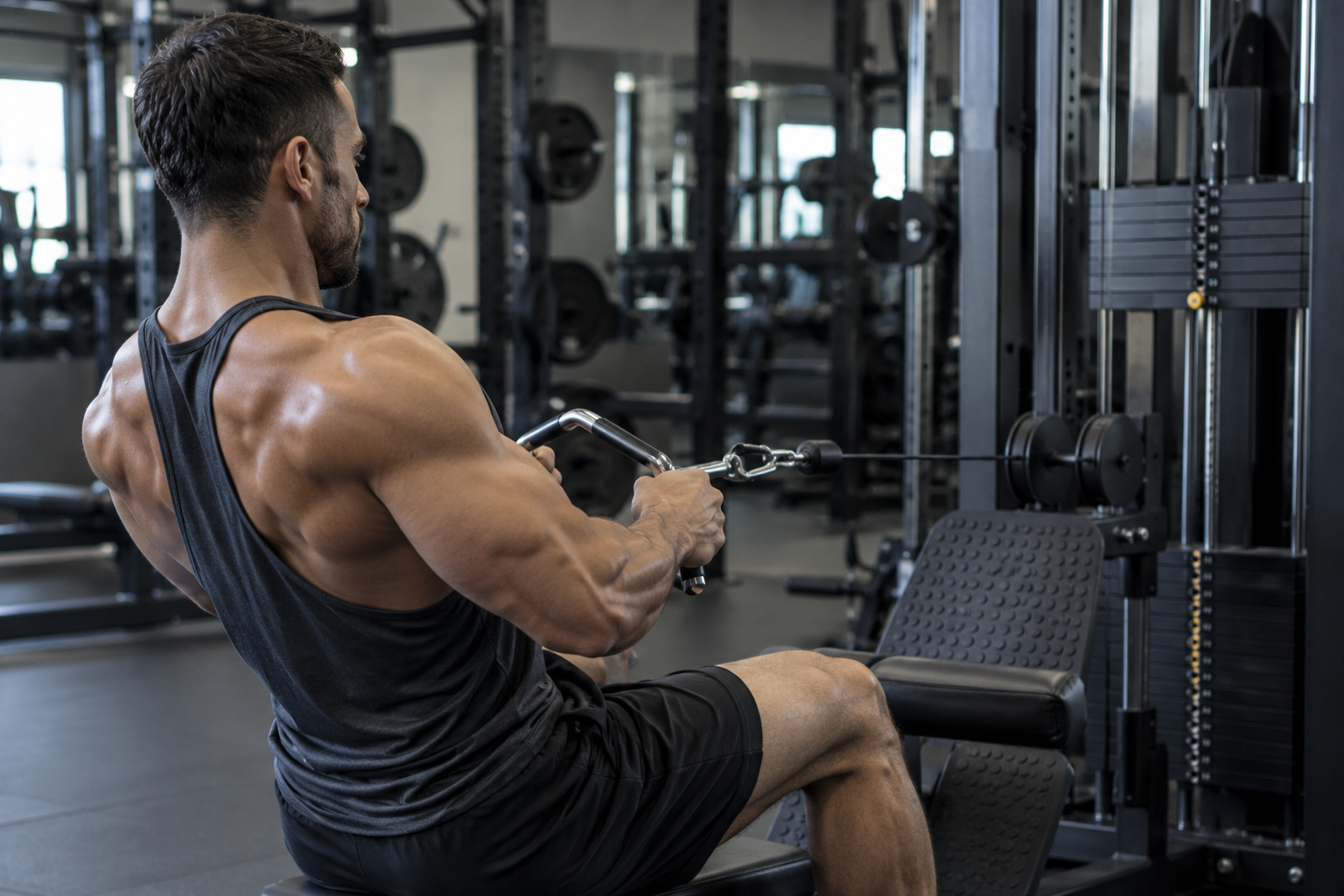
Cable pulley machine for training back and arms: exercises, adjustments and professional choice
Using a cable pulley machine to train back and arms allows you to organize pulling, flexing and extension exercises through an adjustable cable and resistance system. In professional gyms, this equipment is appreciated for the possibility of adapting the pulley height, modifying the direction of the pull and using different grips. For a manager or a purchasing manager, however, versatility is not enough to justify the investment: you need to understand which movements can actually be performed, what adjustments are needed and how to evaluate the technical characteristics of the machine.
The term cable pulley machine generally identifies a cable station with an adjustable pulley, although configuration, range of motion and resistance systems can vary among manufacturers. Some models feature a single column with a weight stack, others use two independent columns or weight plate loading systems. These differences affect the available exercises, the space required and the practicality of use during training sessions.
A correct choice must start from the operational needs of the facility. A gym oriented towards general fitness can prioritize ease of adjustment and accessibility, while a center dedicated to athletic preparation may require greater freedom of movement and a wider resistance range. This guide explores how to set up exercises for back and arms, what mistakes to avoid and what criteria to use to compare alternatives without confusing declared performance, costs and real needs.
- How a professional cable pulley machine works
- How to correctly adjust the cable pulley machine
- Exercises to train the back with the cable pulley machine
- How to train biceps with the cable pulley machine
- How to train triceps with the cable pulley machine
- How to organize a back and arm session
- Technical characteristics to evaluate before purchase
- Safety, maintenance and daily management
- Costs and comparison with other equipment
- How to plan the investment in a professional cable pulley machine
How a professional cable pulley machine works
The cable pulley machine uses a system of cables, pulleys and resistances to transfer the load to the grip used by the athlete. Resistance can be generated by a selectable weight stack or by weight plates loaded on a special support. During the exercise, the movement of the grip causes the cable to slide and the load to be lifted through the transmission system.
The main functional advantage consists in the possibility of modifying the direction of the applied force. By adjusting the pulley height and body position, it is possible to perform different movements without replacing the entire machine. This feature makes the cable pulley machine interesting for workouts involving multiple muscle groups and for facilities that must use space efficiently.
The mechanical configuration, however, affects the resistance actually perceived. In some systems, the ratio between cable movement and weight stack displacement is different from one to one. Consequently, the selected value does not necessarily coincide with the force required at the grip. To correctly interpret the loads, it is essential to consult the manufacturer's specifications.
The main components of the machine
A professional cable pulley machine generally includes a supporting frame, a pulley system, a transmission cable, a height adjustment device and a resistance system. Versions with a weight stack also include guides, plates and a load selector. Each component contributes to the fluidity of movement and operational continuity.
The quality of the pulleys and the sliding system is particularly important during exercises that require control along the entire range of motion. Irregular friction or poorly fluid movements can make it difficult to maintain predictable resistance.
Single and double column cable pulley machine
A single column station can be suitable for unilateral exercises and movements performed with a single grip. A double column configuration instead allows the use of two independent cables, expanding the possibilities for bilateral work and adjustment of the distance between the pulling points.
The choice depends on the available space and the programmed exercises. A double column is not automatically necessary to train back and arms, but can offer greater versatility in facilities offering personalized training.
How to correctly adjust the cable pulley machine
Before starting an exercise, it is necessary to set the pulley height, load and grip. These three elements determine the direction of the pull and influence the ability to perform the movement with control. An adjustment that is inconsistent with the exercise can modify the required work and make the athlete's position less stable.
The first check concerns the correct locking of the pulley in the selected position. The adjustment device must be inserted completely according to the manufacturer's instructions. Subsequently, it is necessary to check the connection of the grip and select a resistance compatible with the user's experience.
It is useful to start with a few repetitions at a reduced load to check the available range of motion. During this test, the cable should not reach the mechanical limit before the completion of the movement. The body position must also allow maintaining balance and control without resorting to excessive compensations.
How to choose the pulley height
For exercises such as triceps pushdowns, a high pulley is generally used. For many variants of biceps curls, a low position can be useful, while for rows, the height depends on the desired trajectory and the athlete's position.
Adjustment should not be chosen solely based on the name of the exercise. It is important to observe the direction of the cable relative to the intended movement, verifying that the grip can travel the entire trajectory without interference.
Load and grip selection
The adjustment of the cable pulley machine also includes the choice of single handles, straight bars, ropes or other compatible accessories. Each grip modifies the gripping possibilities and can make a given exercise more practical.
The initial load should allow controlled repetitions, without abrupt movements of the trunk or loss of position. When changing machines, it is advisable to check the resistance again, because different transmission ratios can make the values indicated on the weight stacks incomparable.
Exercises to train the back with the cable pulley machine
The cable pulley machine allows performing various pulling movements involving the back muscles. Among the most common applications are rows, single-arm pulls and cable pullover variants. The choice of exercise depends on the objective, the available height and the possibility of correctly stabilizing the body.
To train the back effectively, it is important to distinguish horizontal pulling movements from those with a predominantly vertical or diagonal trajectory. The different directions modify the relative contribution of the muscles involved, but do not allow completely isolating a single anatomical region. Programming should therefore include complementary exercises and not rely on a single variant.
The quality of execution depends on scapular control, trunk position and elbow management. Using excessive loads can favor oscillations and compensations that reduce movement precision. For this reason, especially in the first sessions, it is preferable to favor a repeatable trajectory.
Cable row for back musculature
The cable pulley row can be performed with a single handle and a pulley positioned at a height consistent with the chosen trajectory. The athlete assumes a stable position, grasps the handle and brings the elbow towards the trunk while keeping the movement controlled.
During the return phase, it is important to prevent the load from pulling the body forward. The position of the scapulae must adapt naturally to the movement without resorting to excessive stiffening. For unilateral variants, the trainer can observe any differences in control between the two sides.
Cable pullover with arms almost extended
The cable pullover is generally performed with a high pulley and an adequate grip. The athlete brings the arms downward through a movement predominantly handled by the shoulder, keeping the elbows slightly bent and the trunk in a stable position.
This variant can be included as a complement to rows, but requires attention to individual mobility and the range of motion used. It is not necessary to force the movement beyond available control. A moderate load facilitates the perception of the trajectory and tension continuity.
How to train biceps with the cable pulley machine
Cable biceps exercises are mainly based on elbow flexion against external resistance. The cable pulley machine allows modifying the initial hand position and pull direction, offering different curl variants. The possibility of using single handles or bars allows adapting the exercise to the user's preferences.
During the curl, it is important to prevent the movement from being produced mainly by trunk oscillation. The elbow must follow a trajectory consistent with the chosen variant, and the load must allow controlling both the lifting and return phases. Resistance that is too high can make it difficult to maintain these conditions.
For a professional gym, cable curls represent an additional possibility compared to dumbbell and barbell exercises. It does not necessarily replace other tools, but expands the ways in which the trainer can organize the work. The choice between alternatives should depend on the training goal and the athlete's characteristics.
Low cable curl
The low cable curl is performed by connecting a bar or handle to the lower pulley. The athlete assumes a stable position, maintains control of the trunk and flexes the elbows bringing the grip upward. The distance from the machine must allow the cable to move without interference.
During descent, it is advisable to maintain control of the resistance, avoiding letting the weight stack drop rapidly. The trajectory can be adapted to individual characteristics without imposing a rigid or uncomfortable joint position.
Unilateral curl and movement control
The unilateral curl allows training one arm at a time and observing any differences in the ability to control movement. Using a single handle, the trainer can adjust the athlete's position according to the cable direction.
This variant is useful when you want to pay closer attention to individual technique. However, every difference between sides should not be interpreted as a clinical problem: any symptoms or significant limitations require appropriate evaluation.
How to train triceps with the cable pulley machine
The cable pulley machine is frequently used for elbow extension exercises intended for the triceps musculature. The most common variants include bar pushdowns, rope extensions and overhead exercises. By changing the pulley position and grip, the movement configuration can be modified.
The main technical criterion concerns the control of the elbow joint and the ability to maintain a stable position. During the pushdown, for example, the movement should be produced predominantly by elbow extension, avoiding using body weight to push the grip downward.
Overhead variants require a different shoulder position and may not be equally comfortable for all users. The trainer should adapt range of motion and resistance to individual capacities, avoiding forcing positions that cause pain or evident limitations.
Bar or rope pushdown
The cable triceps pushdown is generally performed with a high pulley. The athlete grasps the handle, maintains a stable position and extends the elbows against resistance. The return must be controlled, without allowing the load to rapidly pull the arms upward.
The choice between bar and rope modifies the gripping possibilities and the freedom of hand movement. There is no universally better grip: comfort, control and compatibility with the athlete's structure are more useful criteria than commercial preferences.
Overhead triceps extensions
Overhead extensions can be performed using a rope and a pulley configuration that allows a controlled trajectory. The body position must guarantee balance and allow the elbows to move without interference.
This variant involves the triceps in a different position compared to the pushdown. It is advisable to start with moderate resistance and verify that shoulder mobility allows the exercise without discomfort. The goal is not necessarily to reach the maximum possible range of motion, but to maintain an appropriate movement.
How to organize a back and arm session
A session with the cable pulley machine should be organized considering goals, the athlete's level and overall workload. For a beginner user, a limited selection of exercises may be sufficient, while an experienced athlete could integrate different variants within a broader program. The availability of numerous adjustments does not imply that it is necessary to use them all in the same session.
A practical criterion consists of starting with a pulling movement for the back and adding specific exercises for biceps and triceps. The number of sets and reps must be adapted to individual programming. For those learning technique, the quality of repetitions represents a priority compared to the immediate increase in resistance.
In professional gyms, it is also important to consider station management. If the cable pulley machine is used by multiple people, programs requiring continuous pulley modifications can increase waiting times. Orderly planning can improve session fluidity without reducing training quality.
Operational training example
For an adult already accustomed to strength training, a possible demonstration session includes cable rows, pullovers, low cable curls and pushdowns. As an initial example, the trainer could schedule two to three sets per exercise with an indicative interval of eight to fifteen repetitions, adapting load, recovery and volume to individual capabilities.
This sequence does not represent a universal prescription. It must be modified in relation to other exercises performed during the week, recovery capacity and specific goals. Progression can concern resistance, repetitions or execution quality, avoiding unjustified increases.
How to manage load progression
Effective progression requires the athlete to maintain adequate technique while gradually increasing the training stimulus. Before selecting a higher resistance, it is useful to verify trunk stability, control of the return phase and the ability to complete the expected range of motion.
When switching to a different cable pulley machine, the indicated load should not be transferred automatically. Transmission ratios, friction and mechanical configurations can modify perceived resistance. It is preferable to perform a new initial adjustment.
Technical characteristics to evaluate before purchase
The selection of a professional cable pulley machine must consider transmission system quality, frame stability, adjustment range and available resistance. A machine with a high weight stack is not necessarily more suitable for every gym. The ability to offer fluid movements and easily repeatable adjustments can be equally important.
The purchasing manager should check the overall dimensions of the machine, the required operating space and any installation conditions. A compact station may still require significant free area to allow exercises with the body distant from the column. The necessary space must be evaluated considering users and transit paths.
Among professional isotonic machines, the cable pulley machine occupies a particular position because it allows performing different movements through a single structure. To compare configurations and characteristics of available equipment, it is useful to consult the category of isotonic gym machines, always verifying the specifications of individual models and compatibility with planned exercises.
Pulleys, cables and transmission ratio
The transmission ratio determines the relationship between grip displacement and load displacement. A system with a two-to-one ratio, in an ideal configuration, requires force at the grip lower than the selected nominal weight, while allowing greater cable excursion. Friction and actual construction can modify real behavior.
For this reason, it is important to request information on the mechanical configuration and verify that the available excursion is sufficient for programmed exercises. Fluidity should be evaluated through a practical test, when possible.
Adjustments, accessories and adaptability
An adjustment system must be intuitive, stable and compatible with users of different heights. It is useful to verify the number of available positions and the ease with which the pulley can be moved without complex operations.
Compatibility with different grips expands the machine's applications. However, accessories must be suitable for expected loads and connected through appropriate systems. It is not advisable to use components lacking sufficient information regarding their intended use.
Safety, maintenance and daily management
A professional cable pulley machine must be used respecting the manufacturer's instructions, with particular attention to adjustment devices and components subjected to tension. Before exercising, it is advisable to verify that the load selector is correctly inserted, that the pulley is locked and that the grip is connected securely.
Maintenance represents an important operational requirement because the system includes moving parts subject to wear. Cables, pulleys, guides and connections must be checked according to the manufacturer's directions. Abnormal noises, irregular movements or visible deterioration require attention and may make it necessary to suspend use until technical verification.
For a gym with high traffic, it is useful to define clear responsibilities for routine checks. Users must receive instructions on permitted adjustments and correct grip usage. Interventions on mechanical components and replacements must be carried out according to procedures provided by the manufacturer and by competent personnel.
Cable and pulley inspection
The cable represents a fundamental component of the transmission system. Signs of deterioration, deformations, coating damage or anomalies in sliding must be evaluated with care. The frequency of checks depends on the intensity of use and the technical instructions of the machine.
Pulleys must rotate correctly and maintain the cable in the intended position. It is not advisable to improvise repairs or use incompatible replacement parts. The availability of adequate spare parts should be verified already during the purchase phase.
### Cleaning and scheduled checks
Contact surfaces and grips must be cleaned with products compatible with the materials. It is important to prevent inappropriate detergents from damaging coatings, plastic components or mechanical parts.
A verification log can help the manager document checks, anomalies and interventions. This approach facilitates equipment management and allows identifying recurring problems before they compromise service continuity.
Costs and comparison with other equipment
The price of a cable pulley machine depends on configuration, resistance system, manufacturing quality, dimensions and included accessories. A single-column station and a double-column machine should not be compared solely through initial cost, because they can offer different operational possibilities. The choice must start from the exercises the gym actually intends to offer.
The overall cost also includes installation, any additional accessories, maintenance and replacement of components subject to wear. For a professional facility, the availability of assistance and spare parts can significantly affect convenience over time. A cheaper machine to purchase might prove less advantageous if it requires frequent interventions or presents operational limitations.
It is useful to compare the cable pulley machine with other back and arm training solutions, such as lat machines, pulley rows, dumbbells and guided movement machines. This equipment is not perfectly interchangeable: each offers different characteristics in terms of trajectory, stabilization and adjustment possibilities. The evaluation should consider the overall room composition.
Initial cost and total cost of ownership
The total cost of ownership can be estimated by summing purchase price, installation, maintenance and spare parts over the considered time horizon. For example, a machine purchased at 2,000 euros with 300 euros of total additional expenses in five years presents a hypothetical cost of 2,300 euros, without including any other charges.
These amounts are exclusively illustrative and do not represent market quotes. Their purpose is to show why two offers must be compared considering complete economic conditions and not just the displayed price.
Cable pulley machine, lat machine and free weights
The lat machine is primarily designed for vertical pulling movements, while the low row offers a configuration dedicated to horizontal pulling. The cable pulley machine allows greater trajectory variability, but may require greater stabilization capacity from the user.
Free weights allow additional training modalities and can integrate cable work. For a gym with limited space, a versatile station can be interesting, but does not automatically replace all dedicated machines. The choice depends on the training offering and user characteristics.
How to plan the investment in a professional cable pulley machine
Before purchasing a cable pulley machine, the manager should define which exercises will actually be performed and how many users will access the station during peak hours. This analysis helps understand whether a single column is sufficient or if a more articulated configuration can offer operational advantages. The choice must be proportioned to the planned service, avoiding purchasing functions that would remain unused.
The second step concerns technical verification. Resistance interval, transmission ratio, adjustable height, cable excursion and frame stability must be compatible with programmed exercises. It is advisable to request complete technical data sheets and clarifications on installation conditions. When possible, a practical test allows evaluating fluidity, ergonomics and simplicity of adjustments.
Planning must also include operational space. It is not enough to verify the machine's footprint: one must consider the positions assumed by athletes during rows, curls, pushdowns and exercises with the body distant from the column. Correct arrangement facilitates trainers' work and reduces interference with neighboring stations.
From an economic point of view, it is preferable to compare alternatives meeting the same essential requirements. Price, warranty, spare parts availability and assistance conditions can be evaluated after verifying technical suitability. This method reduces the risk of choosing an apparently convenient machine but poorly suited to the gym.
For facilities wishing to progressively expand their offering, the cable pulley machine can represent an interesting solution thanks to the variety of available exercises. The value of the investment, however, depends on usage frequency, programming quality and the ability to keep equipment efficient over time. Selection based on documentable requirements allows allocating the budget to a machine consistent with operational needs, facilitating a conscious and sustainable commercial choice.
Comments (0)