
Trolley
You have no items in your shopping cart

 Budgets
 Dumbers
 Discs
 Benches
 Racks and Rigs
 Weights Holders
 Isotonic machines
 Calisthenics
 Cardio
 Kettlebells
 Flooring
 Gym Set
 Accessories
 Combat
 ARTI MARZIALI
 CONTAINER GYM
 Tug-Of-War
 Used Gym Equipment
 PILATES MACCHINARI
 GINNASTICA ARTISTICA
 CAMPI DA PADEL
 Prodotti in Pronta Consegna
 Informazioni
 IRONMAN
 Gift Card
- Donatif
- General information
- 0 I like it
- 111 Views
- 0 comments
- gym flooring, safety flooring, gym safety, shock-absorbing materials
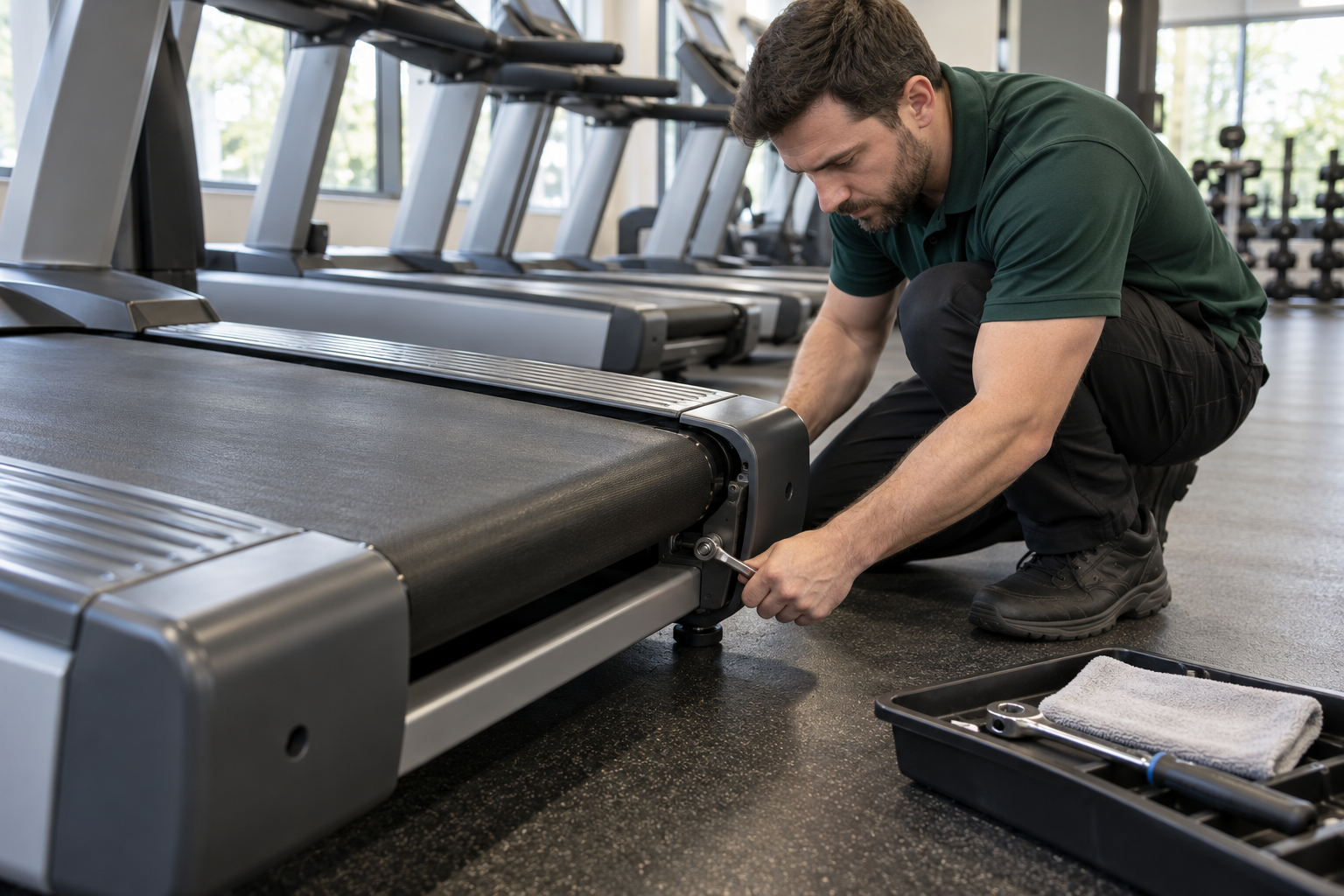
Scheduled maintenance checklist in a combat gym
A combat training room changes layout multiple times throughout the day. Technical classes, partner drills, and athletic preparation use surfaces and equipment in different ways, while accessories and protections may be moved between one group and another. Maintenance must therefore consider not only the individual product, but also how the area is prepared, used, and handed back for the next activity.
This gym scheduled maintenance checklist is dedicated to the combat context, with a focus on MMA cages, tatami mats, and protections. It does not establish universal frequencies or replace the manuals of the structures present. It helps the manager gather relevant indications, distribute activities, and verify that an anomaly receives follow-up before fading back into the routine of classes.
An effective program distinguishes between observation, cleaning, and technical intervention. An instructor may notice a displaced protection, but the evaluation of a structural element requires different skills and references. Making this distinction explicit prevents familiarity with the area from being mistaken for authorization to perform any repair. The expected result is orderly management, with recognizable conditions of use and responsibilities.
- Map the areas and assign a reference to each structure
- Prepare the area check before classes
- Monitor MMA cage conditions without improvised interventions
- Manage tatami and surfaces as complete systems
- Include protections and accessories in the ordinary schedule
- Log anomalies, interventions, and area availability
- Plan assistance and spending based on real conditions
Map the areas and assign a reference to each structure
The initial map should identify the cage, tatami areas, and accessory equipment without grouping them under the generic heading of MMA room.
Different products may require different cleaning and maintenance. A legible inventory allows documents and reports to be linked to the correct structure, even when multiple rooms or similar configurations are present.
For each element, it is necessary to collect the model, available documentation, and supplier references. Identifiers must be kept stable when the room is reorganized. If information on the installed configuration is missing, the request for clarification must be logged: a list compiled with uncertain data does not solve the traceability problem.
Record cage, surfaces, and protections
The cage can be described through the elements identified in the relevant documentation, including access and expected protections. Training surfaces must be distinguishable by zone or type. This level of detail allows anyone reporting a defect to locate it without resorting to vague indications such as near the wall.
Link checks to installed products
Each activity must be linked to the instructions of the product actually present. It is not advisable to transfer a procedure between different materials or systems simply because they have a similar appearance. The manager should be able to identify the reference document and the competent person to ask for clarifications before including an intervention in the program.
Prepare the area check before classes
Room preparation includes a survey of observable conditions relevant to the planned activity.
Misplaced accessories, shifted protections, or surface anomalies must be reported through an understandable procedure. The organizational check does not certify the technical suitability of the entire structure: it serves to catch obvious problems and manage them according to applicable instructions.
Combat room management requires special attention to configuration changes. A space that is orderly in the morning may look different after a class that uses additional accessories. It is useful to assign the task of verifying restoration, preventing each group from assuming that the previous one has already checked everything.
Observe conditions after each layout change
The survey must reflect what will happen in the next class. An accessory placed at the margins may be irrelevant for a demonstration and interfere with drills that use the entire area. Instructors and the operational contact person should share this information, keeping lesson organization separate from technical evaluations of the structures.
Manage elements that obstruct activity
A temporary obstacle should not be normalized just because it has been present for some time. The program must establish where to store accessories and how to manage unavailable zones, without relying solely on the memory of regular users. When a condition requires the exclusion of an area, the measure must be understandable even to occasional visitors.
Monitor MMA cage conditions without improvised interventions
MMA cage maintenance must refer to the installed system and available instructions.
Moving parts, access elements, and protections must be considered according to their function. An anomaly observed during training requires a precise report, without attempting to determine the reliability of the structure through improvised tests or additional loads.
The commercial documentation of combat equipment can help identify products and contacts to reach out to. However, intervention methods remain tied to the specific configuration present. It is not correct to deduce component compatibility or maintenance procedures solely from belonging to the same catalog category.
Describe observed movements and damage
The report should state the affected point, the time of appearance, and observed circumstances, possibly accompanied by useful photographs. Phrases like it moves more than usual become more informative when linked to an identifiable position. The instructor describes the detected behavior; the evaluation of causes and necessary actions is up to the appropriate person.
Entrust technical checks to designated personnel
Tightenings, modifications, or replacements must follow relevant procedures and required skills. The availability of tools on-site does not automatically authorize an intervention. If the condition raises doubts about use, the management of the area must follow applicable instructions and internal procedures without waiting for the next scheduled maintenance.
Manage tatami and surfaces as complete systems
Cleaning and condition checks are related activities, but not equivalent.
A freshly sanitized surface may feature a raised edge or a deteriorated element. The program should therefore include observations relevant to the system used and record anomalies without considering the completion of cleaning as a positive outcome for every other check.
Gym tatami mats may differ in materials, connections, and laying methods. Products and cleaning methods must be compatible with available instructions. When modifying an element of the surface, the consistency of the whole must be evaluated, avoiding temporary solutions that introduce different characteristics into the same activity area.
Distinguish hygiene and surface integrity
The hygiene plan must describe activities, relevant products, and methods for preparing the area before reuse. Instructions cannot be transferred indiscriminately between different surfaces. Staff must know how to find instructions and how to report observed undesirable effects, such as alterations to the covering or difficulties in restoring expected conditions.
Check edges, joints, and layout
Edges, joints, and transition points deserve attention during organizational surveys. A misalignment must be located and monitored, without assuming that simply moving elements will solve the cause. If the room is periodically reconfigured, the documentation must make it possible to verify what layout is planned and what checks accompany the restoration.
Include protections and accessories in the ordinary schedule
Removable protections may change position or be replaced during normal activity.
For this reason, they must be included in the inventory and relocation procedure. A component present in the room is not necessarily installed correctly: instructions relevant to the product must be followed, and conditions requiring a check must be made visible.
The manager must avoid judgments based solely on external appearance. A marked covering and an element that no longer performs its function correctly require different evaluations. Observations must be transmitted to the competent contact person, keeping the description of the defect, operational decision, and any intervention performed separate.
Identify removable elements
A simple system can identify accessories by type and intended zone, without creating unnecessarily complex codes. The goal is to prevent an object reported as problematic from being put back into circulation because it was moved elsewhere. The procedure must be recognizable by instructors and tidying staff.
Separate aesthetic wear and functional anomalies
Crafted modifications should not replace clarification on component functionality. Adding material or changing a fastening can alter the conditions established by the system. When a replacement is needed, compatibility and procedures must be confirmed through relevant references, keeping useful documentation in the area's file.
Log anomalies, interventions, and area availability
The logbook must make it possible to track a report through to its outcome.
Date, affected element, and initial observation form the basis, but a contact person and an indication of actions taken are also needed. A note left without follow-up does not help the manager distinguish a pending problem from one that has already been verified.
Area availability must be updated when the situation changes. If a zone or piece of equipment is unusable, instructors must receive consistent information to organize classes. The commercial schedule should not anticipate reopening ahead of the conditions established by the intervention and checks relevant to the case.
Open an actionable report
A brief but precise report is preferable to a form that no one fills out. Staff can describe the symptom and location, leaving specialized details to the technical report. The two documents must be linkable so that what was observed, which intervention followed, and what instructions were received can be reconstructed.
Document the reopening decision
Reopening must be based on the outcomes required for the specific situation and the facility's procedures. Whoever updates the logbook must be able to identify the reference supporting the decision. The mere disappearance of the symptom or the fact that a class is imminent does not alone constitute a sufficient criterion.
Plan assistance and spending based on real conditions
The financial program should distinguish recurring activities, open interventions, and potential replacements.
These items respond to different decisions and should not be lumped together into a generic maintenance fund without detail. The information gathered makes it possible to request more precise proposals and identify which services still need to be defined.
Date selection must consider staff availability and the conditions required to work in the area. Moving an intervention outside of class hours can help organization, but does not justify postponing a problem that requires a different response. The program remains a management tool subordinate to relevant technical conditions.
Coordinate interventions with classes
To coordinate classes, it is useful to know which areas will be affected and which activities can continue according to defined conditions. Generic communication about gym maintenance offers little information. Instead, the manager should link the schedule to an identifiable work perimeter, updating it when times or availability change.
Evaluate repair and replacement
Repair and replacement require a comparison of documented conditions, proposed interventions, and operational consequences. There is no universal economic rule valid for all protections or structures. The updated file makes it possible to justify spending based on the real area, keeping confirmed data, quotes, and still-open evaluations recognizable.
Comments (0)