
Trolley
You have no items in your shopping cart

 Budgets
 Dumbers
 Discs
 Benches
 Racks and Rigs
 Weights Holders
 Isotonic machines
 Calisthenics
 Cardio
 Kettlebells
 Flooring
 Gym Set
 Accessories
 Combat
 ARTI MARZIALI
 CONTAINER GYM
 Tug-Of-War
 Used Gym Equipment
 PILATES MACCHINARI
 GINNASTICA ARTISTICA
 CAMPI DA PADEL
 Prodotti in Pronta Consegna
 Informazioni
 IRONMAN
 Gift Card
- Donatif
- General information
- 0 I like it
- 99 Views
- 0 comments
- gym flooring, safety flooring, gym safety, shock-absorbing materials
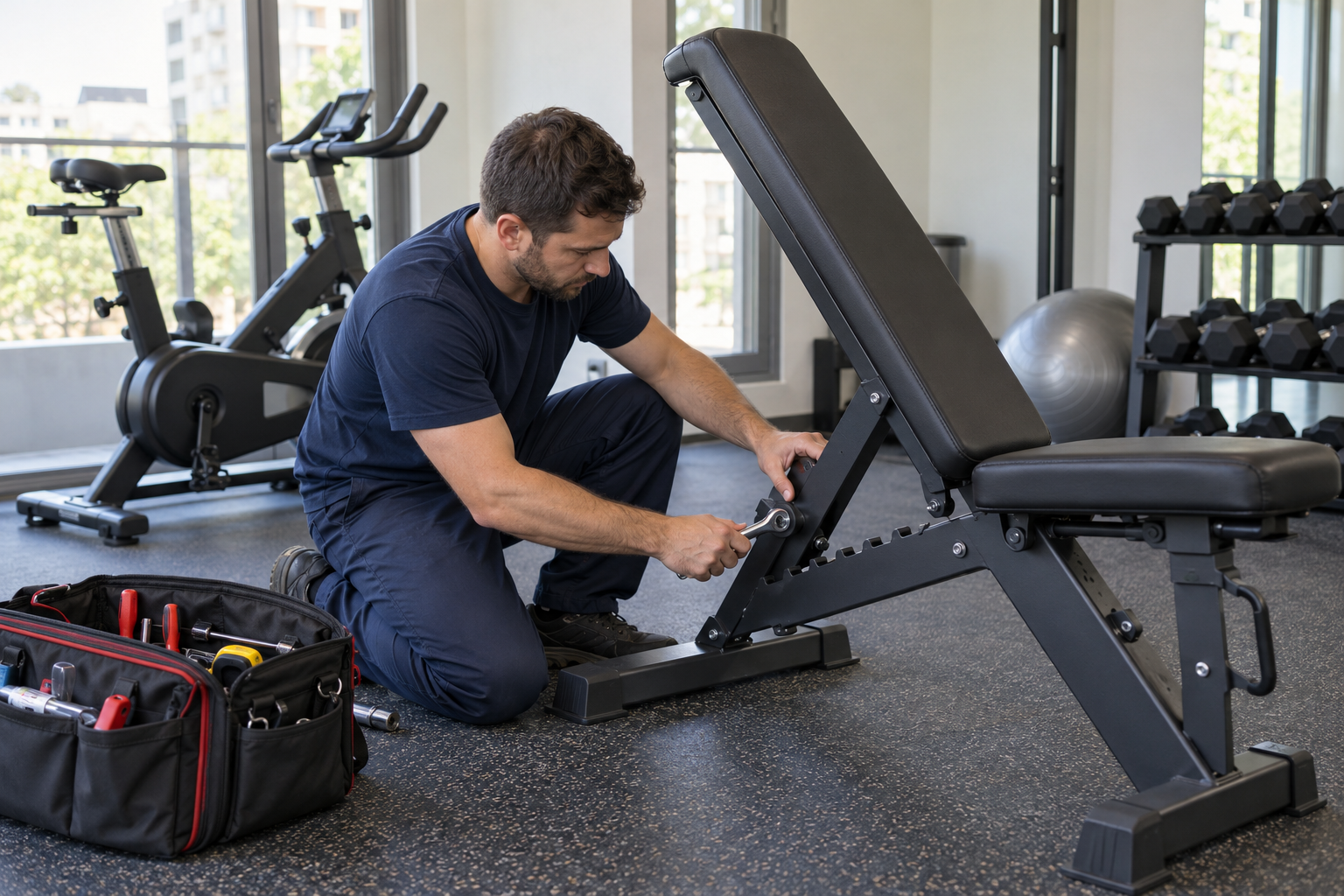
Condominium gym quotation with weekend assembly: costs and checks
For a condominium looking to set up a fitness room, scheduling delivery and assembly over the weekend may seem like the most practical solution. In reality, availability on Saturday or Sunday is just one of the variables to evaluate. The intervention may involve shared access, elevators, noise, installation personnel, and responsibilities that must be defined before placing the order.
A condominium gym quotation with weekend assembly is useful when it makes all activities included in the price legible, rather than merely reporting a final figure. For the building manager, the document must make it clear to residents what will be built, which areas of the building will be affected, and what conditions could lead to an additional cost. Transparency protects both the condominium and the supplier.
This guide proposes a method for reading offers and planning the intervention, without inventing rates or conditions that apply to every company. Solutions depend on the delivery location, the products chosen, applicable regulations, and the commercial agreement. The objective is to transform a generic request for weekend assembly into a comparable specifications document and a sequence of practical checks.
- Define what the quotation actually includes
- Inspect the room with a targeted site visit
- Plan the assembly during the weekend
- Manage transport and handling within the building
- Define assembly, inspection, and operational handover
- Read economic conditions and support clauses
- Compare comparable offers and document the choice
- Choose a sustainable investment even after the weekend
Define what the quotation actually includes
The first check concerns the structure of the offer. Machine supply, transport, floor delivery, and assembly are different services and should not be considered included by implication. A legible quotation allows for the reconstruction of the complete journey from the order to the room ready for use, indicating the duties of each party involved.
It is useful to request a breakdown distinguishing between products, logistics services, installation labor, any accessory materials, and verification operations. Each item should be accompanied by a description precise enough to recognize what is being offered. Formulas like full service or standard assembly have little value if they do not explain limits, exclusions, and necessary conditions.
When the condominium presents multiple equipment alternatives, each configuration must have an explicit perimeter. Otherwise, two offers with similar amounts may conceal different quantities, services, and responsibilities. A purchasing manager should be able to indicate which elements are mandatory, which are optional, and which require an evaluation after a site visit.
Distinguish product price from accessory services
The price of a machine does not necessarily coincide with the cost of having it installed in the room. Any handling, special access, packaging disposal, or area preparation can affect the total.
Indicate inclusions and exclusions in writing
Exclusions make it possible to identify the work that remains the responsibility of the condominium. If the quotation does not include electrical upgrades, floor protection, or special handling, the matter must be explicit.
Inspect the room with a targeted site visit
A technical site visit is often the step that makes the service estimate reliable. The dimensions of the room are not enough: it is necessary to examine the transport route, passage clearances, potential use of elevators, and obstacles preventing access to the stations.
The condominium should prepare updated photographs, a floor plan, and indications regarding usable common spaces. Information should include schedule constraints and potential limitations for the entry of vehicles, materials, and operators.
The check must not be limited to the room door. The positioning of the products, planned electrical connections, and the condition of the floor and walls can also influence the required work.
Measure doorways, routes, and unloading points
The measurements to be taken depend on the packaging and handling methods. It is useful to note the usable width of passages, any tight curves, steps, and permanent obstacles.
Identify preparations to be completed
Before delivery, it should be checked whether sockets, anchor points, local protections, or other preliminary work are necessary. Indications must come from product instructions and relevant technical checks.
Plan the assembly during the weekend
Weekend assembly is not automatically simpler than on weekdays. It can facilitate the presence of a contact person, but in residential buildings, it may encounter limitations regarding noisy activities, access, and the use of common spaces.
The schedule should include a delivery window, an assembly window, and a final inspection window, distinguishing estimated times from confirmed commitments. The administrator must know the expected number of operators and the potential presence of specialized technicians.
The weekend assembly planning should also include the management of adverse events, such as transport delays or room unavailability. If multiple accesses are needed to complete the work, it must be clarified in advance how they will be organized.
Coordinate condominium contact persons
The supplier should know who to speak with for opening accesses, managing common spaces, and confirming activities. In parallel, residents and the caretaker should receive essential information regarding dates, routes, and potential inconveniences.
Provide a plan in case of delays
The contract or order confirmation can describe how postponements, operator unavailability, and uncompleted activities are handled. It is unwise to assume that a postponed intervention will automatically remain at the same price.
Manage transport and handling within the building
The logistics of a condominium gym can impact overall work more than expected. Even bulky equipment can have heavy components or shapes that are difficult to handle.
The cost of floor delivery should be explicitly verified and not deduced from the phrase transport included. If special vehicles or additional workers are needed, the supplier must evaluate the conditions before making commitments.
Before the arrival of the materials, it is necessary to establish where packaging will be temporarily stored and how shared surfaces will be protected. If the project includes anti-shock gym flooring, it is useful to coordinate the installation with the positioning of the equipment, respecting technical requirements, processing times, and manufacturer instructions. Correct sequencing of activities avoids repeated handling.
Protect common areas and existing surfaces
Elevators, doors, and floors may be affected by the passage of packages. The intervention plan should provide for protections compatible with the context and a check of the condition of the affected areas before and after the work.
Manage packaging and waste materials
After assembly, cardboard, protective elements, and other materials to be sent to appropriate disposal channels often remain. Disposal must not be considered included unless it appears in the offer.
Define assembly, inspection, and operational handover
Assembly must be carried out in compliance with the instructions of the individual equipment and any installation requirements. The condominium should know what activities are performed and what final checks are planned.
A handover report can list products, identification codes, documents received, and anomalies found. It is useful to report any open items and assign a person in charge, with shared methods and closing times.
When specific technical checks are necessary, they must be entrusted to competent parties. The administrator should not turn a simple visual inspection into a general declaration of conformity.
Gather instructions and data for each piece of equipment
Manuals, serial numbers, maintenance instructions, and support contact details should be available at the time of delivery. An orderly archive facilitates the work of future administrators and assigned personnel.
Close open points before use
If a piece of equipment presents a defect or requires uncompleted work, it should be identified and the resolution path defined. The fact that assembly is scheduled for a weekend does not justify the early opening of a problematic station.
Read economic conditions and support clauses
The total price is only part of the comparison. Applicable taxes, payment methods, offer validity, and conditions allowing for variations must be checked.
The proposal should indicate how any additional hours, unforeseen access, or technical services requested during the work will be handled. For the condominium, it is essential to know who can authorize these interventions, because an unapproved expense can complicate bookkeeping.
Warranties and support also deserve a reading separate from installation. Conditions on products, installation services, and subsequent support must be distinguished, clarifying times and methods for requesting interventions.
Analyze exclusions and possible extras
Frequent exclusions depend on the context and cannot be deduced from a standard list. For this reason, it is advisable to explicitly ask whether internal transport, any special vehicles, flooring installation, and packaging removal are included.
Clarify support and spare parts after installation
Before accepting, the condominium should know the fault reporting channel, the necessary documentation, and the conditions applicable to technical call-outs. Reliable after-sales service requires understandable procedures, not just promises of availability.
Compare comparable offers and document the choice
The comparison should start with a uniform request for a quote. Each supplier receives the same list of products or equivalent services, the same route information, and the same weekend assembly requirement.
An evaluation table can place service completeness, schedule clarity, available documents, and support conditions alongside the final figure. It is important not to assign arbitrary mathematical weights to criteria: the administrator should first define which requirements are essential and which represent preferences.
Decisions will be more defensible if the report or internal documentation explains why a solution was preferred. This is not about justifying the highest or lowest price overall, but about showing the relationship between the condominium's needs, building constraints, and services actually offered. The quality of the decision trail reduces future ambiguities.
Prepare a single matrix for proposals
The matrix should contain at least products, assembly, transport, excluded works, requested date, weekend conditions, support, and final documents. If an item is not available, it must be indicated as to be clarified rather than interpreted as included.
Establish conditions before order confirmation
Confirmation should reference the chosen configuration, offer versions, and subsequent agreements. It is useful to attach floor plans and logistical information that influenced the price, to prevent them from being considered simple informal notes.
Choose a sustainable investment even after the weekend
A good quotation makes it possible to organize the intervention, but it must also prepare for the subsequent management of the room. When evaluating alternatives, the condominium should take into account maintenance, component accessibility, consumption, and possible replacements.
The final decision should rest on three coordinated checks: the room is actually prepared, the supplier has described the included services, and responsibilities after delivery are defined. If any of these elements are missing, the project can be postponed for a targeted check without losing the work already done.
For the administrator, the goal is to present an understandable proposal with trackable costs and sustainable operating conditions. A qualified partner can help translate the specifications into practical solutions and documented checks.
Transfer information to the management supervisor
At the end of the work, manuals, reports, support contact details, and the schedule of planned interventions should be handed over. This step prevents important documents from getting lost in purchasing communications.
Evaluate the decision with verifiable criteria
The final comparison should answer concrete questions: have accesses been verified, is weekend assembly confirmed, are exclusions understood, and can the room be used according to instructions? Answers must derive from documents and assessments, not commercial formulas.
Comments (0)