
Trolley
You have no items in your shopping cart

 Budgets
 Dumbers
 Discs
 Benches
 Racks and Rigs
 Weights Holders
 Isotonic machines
 Calisthenics
 Cardio
 Kettlebells
 Flooring
 Gym Set
 Accessories
 Combat
 ARTI MARZIALI
 CONTAINER GYM
 Tug-Of-War
 Used Gym Equipment
 PILATES MACCHINARI
 GINNASTICA ARTISTICA
 CAMPI DA PADEL
 Prodotti in Pronta Consegna
 Informazioni
 IRONMAN
 Gift Card
- Donatif
- General information
- 0 I like it
- 121 Views
- 0 comments
- gym flooring, safety flooring, gym safety, shock-absorbing materials
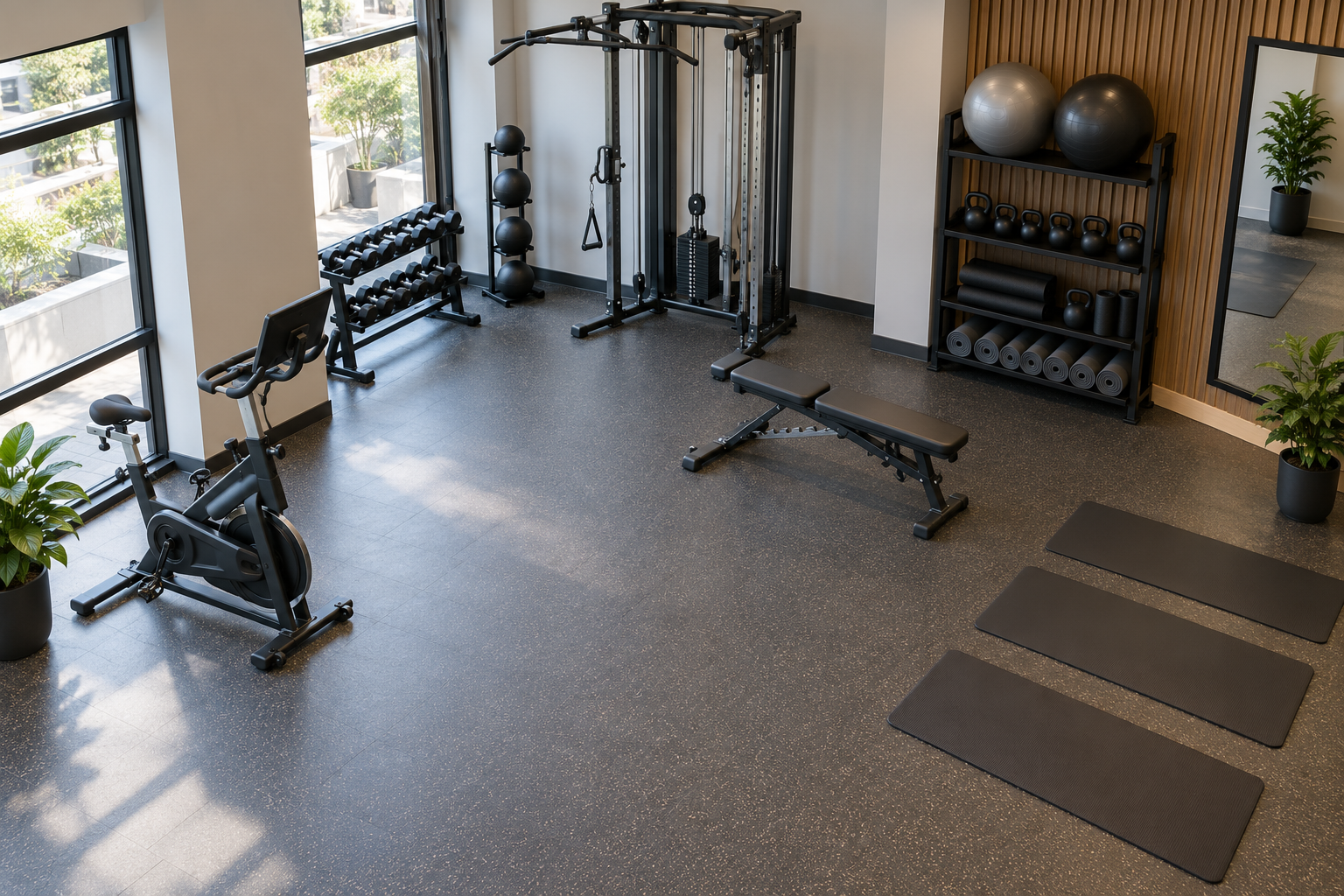
Condominium gym case study: download and evaluation sheet
Anyone looking for a condominium gym case study to download often wants a document to bring to a meeting, share with a designer, or use to formulate a quote request. Its usefulness depends on the information contained: a list of products and a few photographs only tell part of the project. To apply the example to one's own building, it is necessary to know the assumptions, checks, and operating conditions.
A condominium gym case study should distinguish between the documented intervention and the illustrative scenario. In the first case, it is necessary to understand what data are available and to which context they refer; in the second, the assumptions must be explicit. This guide offers a textual sheet to be copied and adapted to read a received document or prepare a request, without presenting an external download as already available.
The sheet serves to identify differences and questions before using an example as a decision-making basis. It does not constitute a technical project, a quote, or a building inspection. The property manager can use it to gather information, assign in-depth analyses, and make the comparison between residents and professionals clearer, keeping visible what is confirmed and what still requires evaluation.
- Identify the document and the type of example
- Compare the described room with the available one
- Read the configuration through permitted activities
- Examine how noise and surfaces are handled
- Reconstruct the financial framework without copying the total
- Verify organization after opening
- Transform the sheet into a concrete request for further analysis
Identify the document and the type of example
The first part of the sheet should report the document title, source, date, and version when available.
This allows knowing what material has been shared and avoiding comparisons between different drafts. If the case study has been updated, it is necessary to understand which information has changed compared to the copy already circulated among residents.
A condominium project document can contain photographs, floor plans, descriptions, and tables with different levels of detail. It is useful to note what is actually present and which references allow for further study. Graphical completeness alone does not prove that all necessary evaluations have been carried out or that the data are transferable.
Record source, date, and version
The sheet can begin with these fields: title, author or entity providing the document, date, version, and intended destination. When a piece of data is missing, it should be marked as to be clarified. An initial section composed this way helps retrieve the context even months later, without having to reconstruct the conversation through which the material arrived.
Distinguish between recorded data and illustrative hypotheses
For each reported result, it is advisable to ask whether it derives from a measurement, a quote, or an assumption. The document should make it possible to recognize the difference. An illustrative example can be useful for reasoning about choices, as long as it is not presented in a meeting as proof of performance obtained in a real building.
Compare the described room with the available one
The second part concerns the physical context.
Surface area, room shape, access points, and relationship with residential units must be described when relevant. An example referring to a room separated from residential floors offers different conditions than a room adjacent to bedrooms or living rooms, even if the proposed equipment seems similar.
The feasibility sheet should distinguish observed characteristics from technical evaluations. The manager can collect measurements and photographs, while structural suitability, systems, and other pertinent aspects require competent professionals. The document to be downloaded or requested should indicate which checks support the represented choices, avoiding generic confirmations based solely on space availability.
Collect dimensions and observed constraints
Useful fields include available dimensions, openings, floor level, entrance path, and adjoining rooms. Next to each data point, one can note the source and whether it has been verified. This organization makes it quick to identify what needs to be updated when comparing the case study with your condominium's room.
Open a list of missing checks
The list of open checks should report the question, the subject to involve, and the decision that depends on the answer. For example, the placement of a station may remain provisional until further relevant analysis is done. Recording this dependency helps prevent a preliminary drawing from being treated as an already approved configuration for purchase.
Read the configuration through permitted activities
A list of equipment becomes useful if it explains what activities it responds to and how it occupies space.
The case study should describe functions, users, and expected modes of use. When these elements are missing, it is difficult to understand whether the configuration is suitable for the new context or merely represents a commercial choice among many possible ones.
The cardio solutions can be explored through the documentation of the relevant products. The comparison must still refer to individual models and room conditions. Reusing a category present in a case study does not automatically confirm the compatibility of the available machines with any condominium gym.
Verify operational footprints and adjustments
For each station, the sheet can report the intended function, model when indicated, and available information on the operating space. Access, adjustments, and movement during exercise must be considered. The simple outline of the machine on the drawing does not allow evaluating interaction with users and room pathways.
Recognize differences between models
A different model can change footprints, installation conditions, and management. If a received document is adapted, every replacement must be recognized and verified against the project. Even a seemingly equivalent product may require additional data: the sheet serves precisely to collect these differences before they disappear behind a financial total.
Examine how noise and surfaces are handled
The expressions silent and noise-dampening require attention in a residential context.
The document should explain which sources and conditions they refer to, especially when attributing a result to flooring. A generic description does not allow predicting behavior in the reader's building, which may have different characteristics and adjoining rooms.
Acoustic evaluations, when relevant, must be traceable to appropriate data and expertise. The sheet can record which in-depth analyses were carried out and which remain necessary for one's own room. This prevents turning commercial material or a design example into an indistinct guarantee against disturbance toward residential units.
Ask what elements the judgment is based on
For every statement regarding noise, it is advisable to note the source, considered activity, and described conditions. If these elements are missing, the point remains a question to submit to the competent contact person. There is no need to invent an alternative evaluation: the value of the sheet also lies in making the inadequacy of available data recognizable.
Record conditions and limits of solutions
The section on surfaces can report the planned material, laying system when indicated, and declared functions. Floor protection and acoustic performance must not be confused. Transferring the solution to another building requires considering the support and actual activities, asking for necessary in-depth analyses before confirming the setup.
Reconstruct the financial framework without copying the total
An amount reported in a case study is useful only if the scope it refers to is known.
Equipment, room preparation, transport, and assembly can be handled in different ways. The sheet should identify these items and flag what is not indicated, avoiding presenting the total as an applicable budget for one's own building.
Quote comparison requires homogeneous content. If the document shows a supply without internal handling, the cost must be interpreted accordingly. Dates, conditions, and configuration influence amounts: using an example to organize questions is more useful than transferring figures devoid of the context in which they were formulated.
Separate equipment, works, and services
Financial fields can distinguish goods, room interventions, and delivery or installation services. For each item, the amount when available, source, and known inclusions must be indicated. Blank boxes must remain recognizable as missing information, so the schedule does not produce an appearance of completeness not supported by the document.
Recognize recurring costs and excluded conditions
Future management may include cleaning, utilities, checks, and maintenance according to the configuration. The case study should clarify whether such items are considered and under what assumptions. Estimates must be kept separate from contractual amounts, especially when the document is used to discuss economic sustainability and gym organization over time.
Verify organization after opening
A useful case study also describes how the gym will be managed.
Access, tidying up, and reporting affect the usability of stations just as much as the initial configuration. The document can offer organizational examples, but the condominium must evaluate them against its own decisions and relevant conditions, involving necessary professionals for specific aspects.
The sheet should distinguish what is proposed from what was observed after opening. A hypothetical reservation model and documented usage data have different meanings. Recording this distinction helps discuss the service without attributing results to a new project that were not actually observed.
Gather rules and operational responsibilities
Operational fields can include access methods, contact person for anomalies, available documentation, and organization of checks. When a task is assigned to an entity, what it consists of must be clear. Coordinating a report does not mean performing a technical intervention or automatically making decisions on the availability of a machine.
Read results without generalizations
Any results must be read alongside the period and method of collection. A number of accesses without a temporal reference offers limited indications, as does a satisfaction rating without context. The sheet can gather available information and open questions, avoiding converting them into promises about the future behavior of residents.
Transform the sheet into a concrete request for further analysis
The document prepared by the manager should contain a summary of the examined case and the differences compared to the building of interest.
This format helps the designer or supplier understand the request without reconstructing all previous conversations. The sheet does not replace technical drawings: it organizes the material from which to start pertinent in-depth analyses.
Before using a downloaded copy, it is advisable to verify that the version is correct and that the context of the information is preserved. Extracting only a table or a photograph can eliminate important assumptions and limitations. The file should allow tracing back to the original document and the questions that guided the evaluation.
Prepare the material to be shared
Shared material can include a sheet of one's own room, a reference to the case study, and a short list of differences to be examined. Questions must be linked to decisions: what check is needed to confirm the layout, which services are missing from the cost, and which conditions influence delivery. This makes comparison with interlocutors more precise.
Define what answers are needed before the investment
The investment can be discussed when the condominium has sufficient answers regarding the conditions that determine it. The sheet helps make this passage visible, keeping confirmed data and still open points distinct. The value of the downloaded case study thus emerges from the ability to support pertinent questions, rather than from superficial similarity with a gym already represented.
Comments (0)