
Trolley
You have no items in your shopping cart

 Budgets
 Dumbers
 Discs
 Benches
 Racks and Rigs
 Weights Holders
 Isotonic machines
 Calisthenics
 Cardio
 Kettlebells
 Flooring
 Gym Set
 Accessories
 Combat
 ARTI MARZIALI
 CONTAINER GYM
 Tug-Of-War
 Used Gym Equipment
 PILATES MACCHINARI
 GINNASTICA ARTISTICA
 CAMPI DA PADEL
 Prodotti in Pronta Consegna
 Informazioni
 IRONMAN
 Gift Card
- Donatif
- General information
- 0 I like it
- 147 Views
- 0 comments
- gym flooring, safety flooring, gym safety, shock-absorbing materials
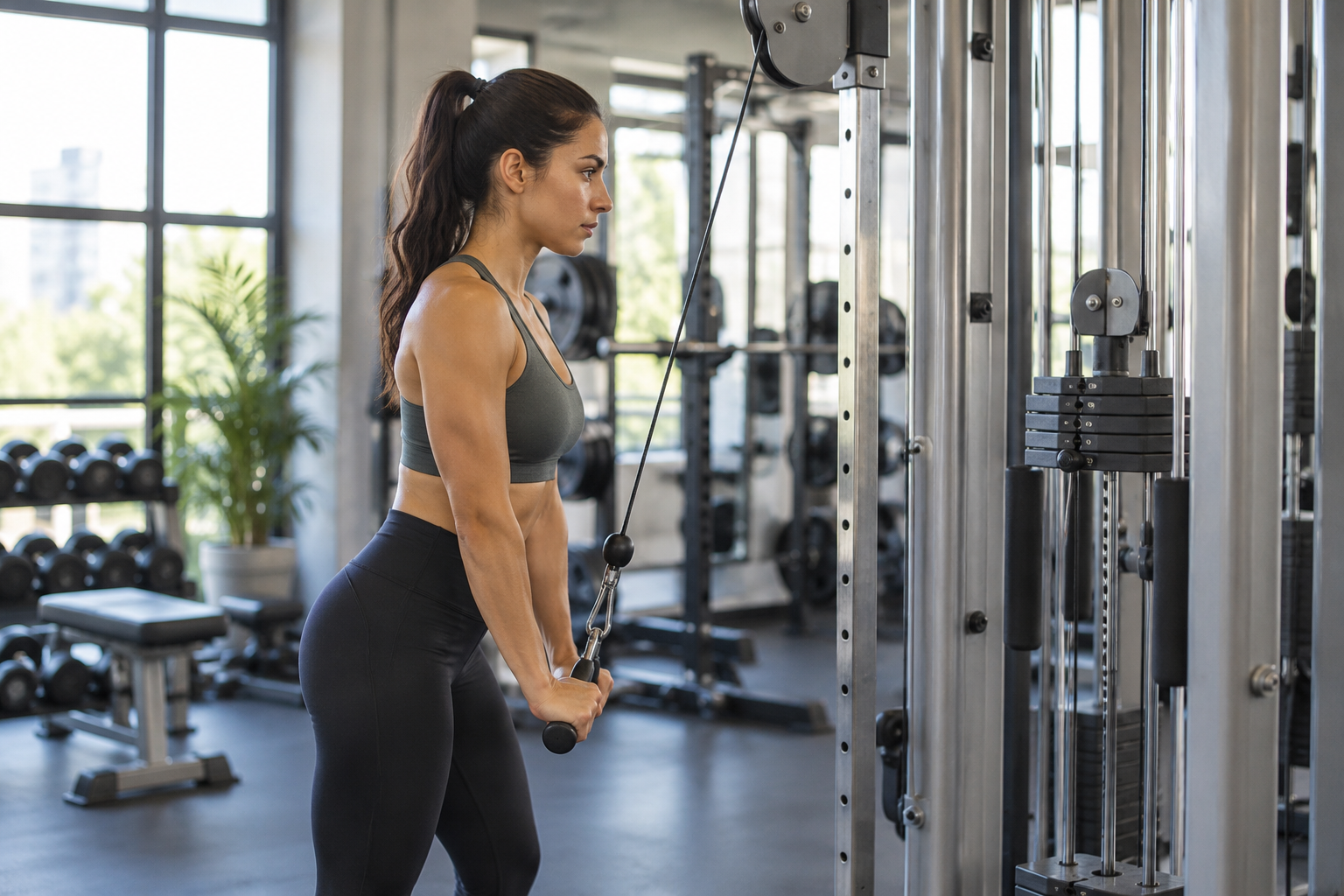
High cable pulley exercises
A high cable station allows different exercises by changing the attachment, body position and movement path. The pulley guides the cable, while the machine's resistance system determines the applied load. Movements at the same station do not all train the same muscles: pulling towards the chest, extending the elbow and working the trunk have different objectives.
The word pulley is often used for a cable machine, but it can also refer to a seated low-cable row. This guide concerns a configuration with a high cable outlet. Before selecting exercises, check which uses and attachments the manufacturer permits for the actual station.
The following sections explain common variations and criteria for adjusting difficulty and space. They do not replace individual assessment or the equipment manual. The aim is to select understandable, controllable movements instead of turning every set into a pull performed with the entire body.
- How do you prepare a high-cable station?
- How do you perform a pulldown?
- What is a straight-arm pulldown?
- How do you use a high cable for triceps?
- How should a face pull be set up?
- How does a cable crunch differ from an arm pull?
- How do you choose resistance and exercise order?
- What checks matter when selecting a station?
How do you prepare a high-cable station?
Check that the pulley is in its intended position and that the attachment is connected correctly. The connector must suit the system and close as the manufacturer specifies. If the station is adjustable, make changes while the mechanism is unloaded. Choose space that allows the cable to move without rubbing against people, benches or other objects. Your starting position should allow you to take and return the handle without losing balance. If reaching it requires climbing or a sudden pull, review the setup before beginning. Preparing the station is part of the exercise rather than something to improvise once the resistance is moving.
Grip and line of pull
A bar, rope and single handle are not equivalent accessories for every exercise. They change the available grip, hand spacing and wrist freedom. Start with the movement you intend to perform and choose a compatible attachment rather than adapting the task to whatever is already connected. Observe the line between your hands and the cable outlet. If it interferes with the body or equipment, change position. Check the setup using manageable resistance before selecting your working load.
How do you perform a pulldown?
A pulldown combines shoulder and elbow movement to bring the attachment towards the body. On dedicated stations, adjust the seat and thigh support according to the model to maintain stable contact. The bar is generally brought in front of the body through a path compatible with mobility and machine design. Avoid turning the repetition into a large torso swing. If resistance lifts your body from the seat, you are not simply making the same action harder. Review adjustment and loading so the intended movement becomes controllable again. A stable starting position should remain recognisable throughout the set.
How this differs from a row
A low-cable row uses another direction of pull and a specific position. Both may involve the back, but that does not make them interchangeable in every programme. For pulldowns, select a grip that permits a controlled path instead of choosing extreme width to imitate another user. Guide the return rather than letting the weight stack take over. The end of the repetition depends on maintained position and available range, not an obligation to touch an exact point on the chest regardless of individual movement.
What is a straight-arm pulldown?
In a straight-arm pulldown, the elbow remains at a relatively stable angle while the arms move relative to the trunk. This differs from a pull involving substantial elbow bending. The variation requires control of the torso without using leg drive to drag the attachment downwards. Begin with resistance that makes shoulder movement clear. If the set becomes elbow extension or continuous bending of the whole body, its character has changed from the selected variation. Establish what should move before deciding how much resistance belongs on the station.
Range and trunk position
A slight forward inclination may form part of the setup, but it should remain consistent through the repetition. Do not seek extra range by arching the back or pushing the attachment beyond a controllable path. Keep foot contact and knees stable and guide the return. Your distance from the pulley should provide cable clearance without requiring you to move progressively farther away during the set. An instructor can help distinguish the intended action from compensations, particularly when the exercise is unfamiliar and the sensation of effort is difficult to interpret.
How do you use a high cable for triceps?
In a triceps pushdown, elbow extension is the main action. The shoulder and trunk should not become the engine driving the attachment. Stand with stable feet and choose a grip that does not force the wrists into an uncomfortable position. Extend the elbow through a manageable range, then control the return. Throwing body weight onto the attachment is not needed to finish each repetition. If the torso moves progressively more, reduce resistance and check whether the original path can be restored. A set should remain recognisably the exercise you intended, even as effort increases.
Rope or bar?
A rope can offer different freedom of grip from a rigid bar, but it does not automatically improve every set. Choose an attachment that permits controlled hands and wrists and a secure machine connection. Do not force the rope ends apart if doing so changes body position or causes discomfort. Also distinguish a pushdown from an overhead extension: the upper arm's orientation relative to the trunk changes and requires another setup. Learn each variation separately before comparing loads or sensations. A shared station does not imply identical technique.
How should a face pull be set up?
A face pull draws the attachment towards the facial area while combining shoulder and elbow movement. The precise configuration depends on the variation, pulley and attachment. Select resistance that allows control without pushing the head forwards or leaning progressively farther back to compensate. High loading is not necessary to make a coordination-demanding exercise challenging. Before beginning, ensure that the cable path cannot interfere with your face and that connections are intact. The starting distance needs to allow the intended movement without forcing a last-moment adjustment as the attachment approaches.
Control without forcing position
Do not pull a rope into the face or move the neck to chase the attachment. Adapt hand position and arm movement to the chosen path and your ability to maintain it. Avoid absolute instructions demanding identical elbow height from everyone regardless of mobility. If shoulder discomfort appears, increasing speed is not a solution. Stop the variation and seek appropriate guidance. Quality is visible in a repeatable movement rather than only a strong contraction sensation or a completed repetition count. Keep the task clear enough to tell whether the attachment or body has changed direction.
How does a cable crunch differ from an arm pull?
In a cable crunch, the cable provides resistance to the trunk movement intended by the variation. The hands hold the attachment in position, but should not turn the exercise into a downward pull performed only by the arms. If kneeling, arrange stable support and enough room to enter and leave the position. Start with manageable loading to understand what actually moves. Large attachment travel does not by itself show that the trunk is performing the intended task. Observe the body action instead of judging the exercise only by how far the stack rises.
Choose a suitable variation
Trunk training has different objectives and does not necessarily require this exercise. Avoid adding resistance to a variation you cannot yet control or that causes discomfort. Do not use rapid hip rocking simply to move the stack. Clarify the start, intended action and return first. If the station does not provide suitable space, choose another approach instead of kneeling in a walkway. Cable availability alone is not a sufficient reason to include the exercise. Its purpose should fit the programme and the person using the station.
How do you choose resistance and exercise order?
Establish the session's aim and select variations accordingly. A back pulldown and triceps pushdown can share the machine without sharing an appropriate load. Numbers on different stations may also be incomparable because of their levers and transmission systems. Use resistance to adjust the task while preserving a recognisable path. Record attachment, position and loading to compare similar sessions. If grip and configuration change every time, it becomes difficult to tell whether capacity improved or the exercise simply changed. Include repetition and rest choices in the same practical record.
Make progression understandable
Increase difficulty when the planned work can be repeated with consistent contacts and movement. Change resistance or work quantity without altering every parameter simultaneously. Account for exercises already present: more pulls are not always necessary if the back has already received substantial work. Recovery should allow the movement to resume under control. If completing a repetition requires jerking or different supports, use that signal to reassess the set instead of accelerating just to reach a predetermined number. Progress should preserve the task rather than disguise a different movement under a heavier load.
What checks matter when selecting a station?
Before use, observe accessible cable sections, coverings, pulleys, attachments and connections. Do not use visibly damaged components or improvise repairs merely to finish training. Report unusual noises, irregular movement or loose parts to the person responsible. Keep the weight-stack area clear and guide the return without dropping resistance. User checks do not replace manufacturer-prescribed maintenance, but help prevent obvious faults being ignored. Also consider whether the path remains clear when neighbouring stations are in use. Space that is adequate for a stationary person may not accommodate several moving cable attachments.
Connect equipment choice to the programme
The gym equipment category offers a starting point for exploring configurations. Compare adjustment range, permitted attachments, supports and operating space rather than only the advertised exercise count. A useful choice makes relevant movements straightforward for actual users. The programme should explain why each variation is included and how it is adapted, instead of putting every possible cable exercise into one workout. Knowing the differences between pulling, elbow extension and trunk work makes the station easier to use purposefully and allows progress to be compared on a meaningful basis.
Comments (0)