
Trolley
You have no items in your shopping cart

 Budgets
 Dumbers
 Discs
 Benches
 Racks and Rigs
 Weights Holders
 Isotonic machines
 Calisthenics
 Cardio
 Kettlebells
 Flooring
 Gym Set
 Accessories
 Combat
 ARTI MARZIALI
 CONTAINER GYM
 Tug-Of-War
 Used Gym Equipment
 PILATES MACCHINARI
 GINNASTICA ARTISTICA
 CAMPI DA PADEL
 Prodotti in Pronta Consegna
 Informazioni
 IRONMAN
 Gift Card
- Donatif
- General information
- 0 I like it
- 98 Views
- 0 comments
- gym flooring, safety flooring, gym safety, shock-absorbing materials
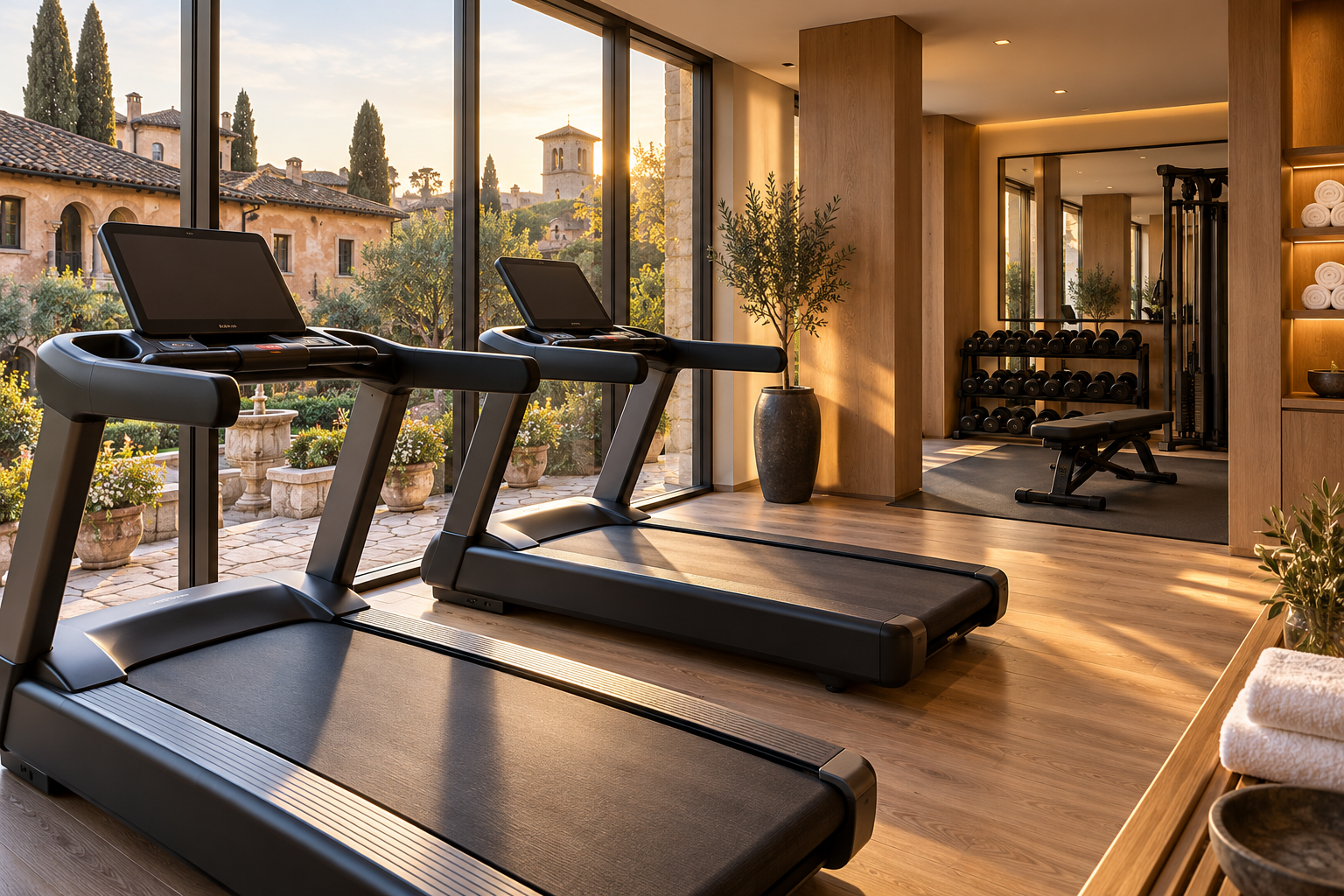
Criteria for choosing a hotel gym supplier
A guest enters the fitness room between a meeting and breakfast. They do not know the machines, have little time, and expect a legible space. Meanwhile, the hotel staff must manage cleaning and reports without interrupting other services. The quality of the supply therefore depends on the ability to respond to this context, as well as the appearance of the equipment.
The criteria for choosing a hotel gym supplier must start from the operation of the accommodation facility. Room dimensions, guest paths, access methods, and staff availability condition the project. An offer designed for a fitness center with continuous assistance cannot be automatically transferred to an environment used in different ways.
The director and facility manager need a proposal that connects the guest experience and internal organization. This means clarifying equipment, included services, installation conditions, and assistance. Useful questions do not just concern how many products enter the room, but how they will be used, kept available, and integrated into the daily life of the hotel.
- Describe the fitness experience the hotel wants to offer
- Evaluate the position of the gym in the building
- Compare equipment through functions and ease of use
- Integrate cleaning, information, and reporting into the project
- Read logistics in the hotel calendar
- Check assistance and documentation of the supply
- Choose the proposal consistent with investment and service
Describe the fitness experience the hotel wants to offer
The brief should explain the role of the gym in the hotel's offering.
An essential service for business travelers has different needs from a central space in the stay experience. The difference influences functions, equipment, and organization: before choosing machines, it is necessary to decide which activities to actually make available to guests.
Hotel fitness rooms must respond to users who may know little about the facility and its equipment. Accessibility of information, comprehensibility of adjustments, and room order affect usage. The supplier should know how access will be managed, without assuming the continuous presence of an instructor when not planned.
Identify users and occasions of use
Usage forecasting can start from available customer data and observations on recurring requests. Assumptions must remain recognizable, especially when the gym is a new service. The project can provide a consistent initial equipment supply and leave open the possibility for developments, without presenting as certain a demand still to be verified.
Define a promise compatible with the space
The commercial promise must match the actual room. If the space allows for a few well-organized activities, it is better to design those clearly rather than chasing apparent completeness. The request to the supplier should distinguish between essential requirements and preferences, making motivated compromises possible when surface or management limits emerge.
Evaluate the position of the gym in the building
The position influences the relationship with other services.
The path from the room to the gym, the proximity of rest areas, and staff access are elements to be described in the brief. A room that is hard to reach or difficult to clean may be less functional even if the setup looks neat and the machines are suitable.
Noise, vibrations, and environmental conditions must be addressed in relation to the building and planned activities. The choice of a compact machine or flooring does not automatically prove compatibility with neighboring rooms. The supplier can contribute with product data, while building inspections require appropriate professionals when relevant.
Consider paths and nearby environments
The inspection should consider the guest path and the operator path. The two needs may only partially coincide, especially during deliveries and maintenance. Knowing these paths helps plan access without treating the gym as a room isolated from the hotel's operation and other customer service environments.
Check the room through relevant expertise
The project must distinguish commercial survey from technical evaluations. Systems, surfaces, and installation conditions must be examined through references applicable to the case. If the room has points still to be clarified, the proposal should record them and indicate which decisions depend on them, avoiding consolidating the configuration before necessary in-depth studies.
Compare equipment through functions and ease of use
The equipment must respond to the guests' time and usage methods.
It is not enough to reduce a traditional gym to the size of the room. Each station must have a recognizable function and consistent operational spaces, while adjustments and information must be compatible with the hotel's planned service organization.
Cardio equipment for hotels can be explored through individual model data. Dimensions, access, and intended use must be compared with the actual conditions of the fitness room. The commercial category helps the search, but configuration requires specific checks and cannot rely on design alone.
Select cardio for the intended use
For cardio, it is useful to distinguish requested activities, adjustments, and placement conditions. The visibility of instructions and the management of a report also count in the guest experience. The proposal must make clear why each model was selected, especially if the number of stations is limited and every choice reduces space for other functions.
Examine strength and accessories without overloading the room
Strength equipment and accessories must be evaluated together with tidying up and cleaning. A wide assortment can make a small room more complex, while a few relevant solutions can be managed with greater clarity. The comparison must consider use and overall organization, without assigning automatic value to the number of pieces included.
Integrate cleaning, information, and reporting into the project
The staff in charge of cleaning should know the planned equipment before opening.
Compatible products, surface accessibility, and tidying methods can affect daily work. The supplier must make relevant instructions available so that the service can be organized without transferring procedures designed for other materials or components.
Operational management of the gym must clarify who checks reports and who coordinates assistance. A guest may report a problem to the reception without correctly identifying the machine. Recognizable codes and clear references help staff gather useful information, preventing the anomaly from remaining in an informal handover between departments.
Involve those who will manage the room every day
Housekeeping, reception, and internal maintenance have different tasks. The project should recognize these differences and provide for an orderly handover of information. A simple procedure, connected to the actual room, is more usable than a generic document that indiscriminately assigns equipment management and technical decisions to everyone.
Prepare a channel for anomalies
The reporting channel should allow indicating the station, symptom, and time of appearance. If the situation requires suspending use, staff must know how to apply the planned procedure and inform guests. Technical evaluation remains entrusted to competent personnel, without inviting users to perform further tests to confirm the defect.
Read logistics in the hotel calendar
The installation calendar must be coordinated with the occupancy and activities of the facility.
Delivery, handling, and assembly may require different appointments. The supplier should describe the phases and prerequisites so that the hotel can organize access, room availability, and communications without relying on a single date generically indicated as delivery.
Fitness equipment installation includes services to be defined precisely. Unloading, internal transfer, and assembly are not automatically the same service. The proposal must clarify where the material will be left, who will receive it, and which path conditions were considered before confirming appointments and amounts.
Confirm delivery and installation separately
A date compatible with the commercial calendar still requires the actual availability of products and operators. Confirmations must concern the chosen configuration, avoiding treating the availability of a category like that of all included models. Any partial deliveries must be evaluated in relation to work organization and the future usability of the room.
Prepare paths and work areas
Passage measurements and package dimensions help verify handling and access. If certain areas must remain available to guests, the work plan must take this into account. Path protections and packaging management must be agreed upon so as not to leave the hotel with activities it assumed were already included in the supply.
Check assistance and documentation of the supply
The quality of assistance is evaluated through understandable conditions and procedures.
The hotel should know who to contact, what data to provide, and how requests will be handled. A generic indication of available support does not clarify what will happen when a machine becomes unusable during a busy period or in the absence of the usual contact person.
Instructions and reports related to equipment must be linked to the inventory. This allows designated staff to quickly retrieve the model and documentation without depending on the memory of the person who followed the purchase. Delivery should make expected documents and channels explicit to obtain any clarifications on management conditions.
Clarify the process after a report
The process should distinguish between report collection, technical evaluation, and intervention. The hotel can organize internal communication and room access, while specialized activities require appropriate personnel. Clarifying these steps before ordering helps assess the operational commitment the supply will entail over time, in addition to its initial cost.
Distinguish warranty and recurring activities
The commercial warranty does not automatically replace cleaning, checks, and relevant maintenance. Applicable conditions must be read in their actual wording, distinguishing inclusions and exclusions. The supplier should explain what information is needed to schedule recurring activities and which services can be agreed upon separately for the proposed equipment.
Choose the proposal consistent with investment and service
The economic comparison must include equipment and services necessary to reach the agreed room.
A lower offer may exclude handling or other activities present in a competing proposal. To decide, the director must see the differences and link them to the hotel's organization, without resorting to assumptions of economic return not supported by data.
A useful comparison distinguishes satisfied requirements, limits, and still open conditions. Design can be a relevant criterion for the property's identity, but it must be read together with usability and management. The choice becomes more defensible when each preference is linked to a service need and each cost to the corresponding performance.
Compare offers with the same scope
Proposals must be compared on the same functional basis, recording differences in models, accessories, and installation level. Less extensive equipment may be appropriate if it meets the brief, while a richer one still requires verification of space and procedures. The total becomes meaningful only when the content of the offer is legible.
Define the operational handover of the fitness room
Before opening, the delivered configuration, availability of instructions, and references for assistance and reports must be confirmed. Involved staff must know the procedures relevant to their role. The project thus translates into a concrete service, whose organization can be observed and improved through the actual use of the fitness room.
Comments (0)