
Trolley
You have no items in your shopping cart

 Budgets
 Dumbers
 Discs
 Benches
 Racks and Rigs
 Weights Holders
 Isotonic machines
 Calisthenics
 Cardio
 Kettlebells
 Flooring
 Gym Set
 Accessories
 Combat
 ARTI MARZIALI
 CONTAINER GYM
 Tug-Of-War
 Used Gym Equipment
 PILATES MACCHINARI
 GINNASTICA ARTISTICA
 CAMPI DA PADEL
 Prodotti in Pronta Consegna
 Informazioni
 IRONMAN
 Gift Card
- Donatif
- General information
- 0 I like it
- 206 Views
- 0 comments
- gym flooring, safety flooring, gym safety, shock-absorbing materials
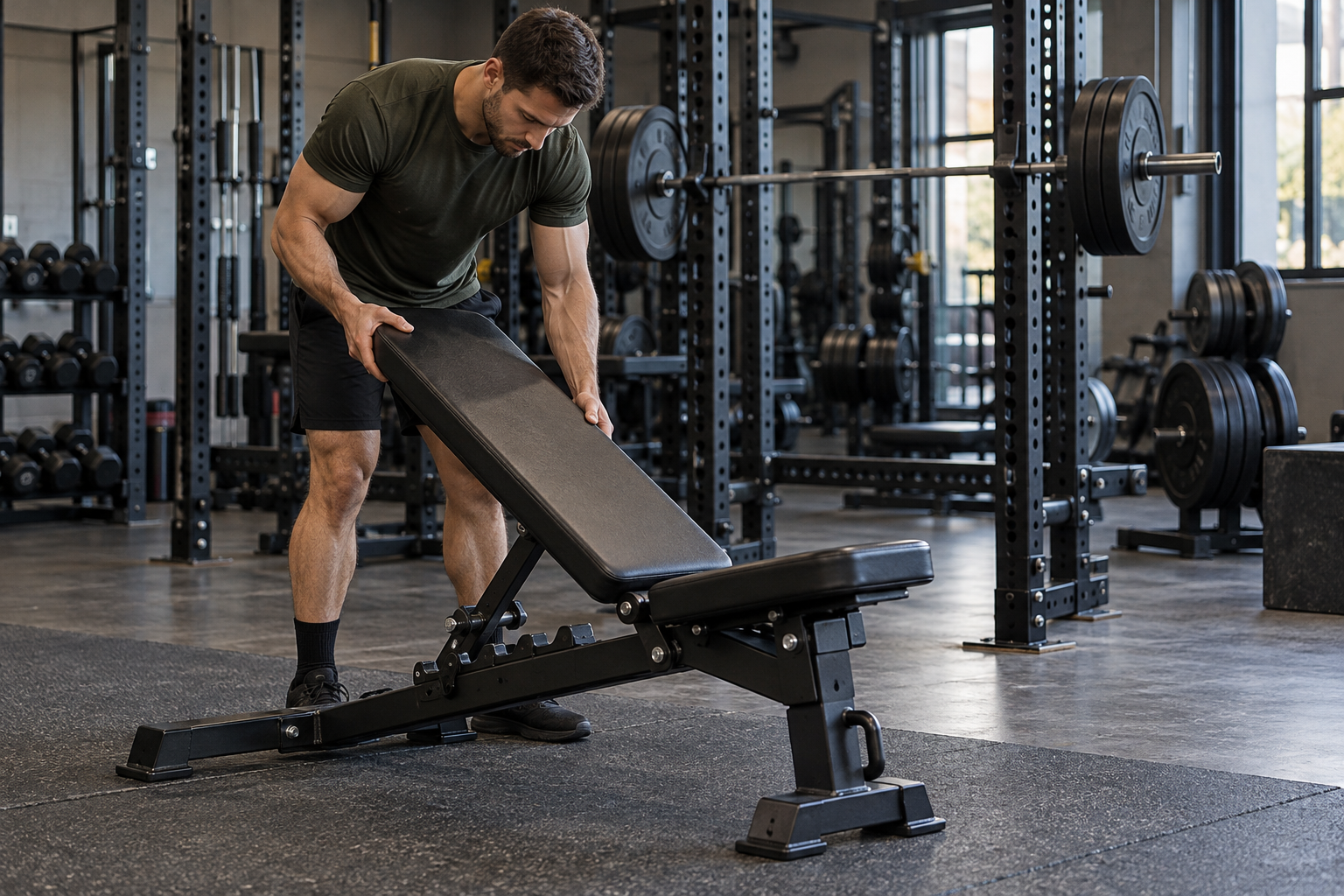
How to choose a training bench: stability and adjustments
A bench may seem like a simple element in the weight room yet it influences many activities. Height, shape of the support, and adjustments change the preparation of the exercise, while footprint and handling affect space organization. The choice must therefore start from what the station will need to allow, avoiding considering products equivalent when they only share a similar shape.
To understand how to choose a training bench it is necessary to connect exercises, users, and room conditions. A flat bench and an adjustable one meet partially different needs. Versatility is useful when the configurations offered are relevant and understandable, whereas an essential solution can be consistent with a specific and well-defined function.
This guide focuses on the features to observe and the information to ask for. It does not prescribe universal measurements nor a technique valid for any exercise. Model instructions and staff support remain references for use, while product comparison must keep the intended use, configuration, and relationship with other elements of the station recognizable.
- Define the exercises that the bench must support
- Compare flat bench and adjustable bench
- Evaluate geometry and support surfaces
- Read stability and usage limits in the documentation
- Check compatibility with racks and dumbbell areas
- Organize adjustments, checks, and reports
- Choose a bench consistent with the work of the room
Define the exercises that the bench must support
The first list should describe the planned activities, without starting from the number of available inclinations.
Dumbbell work, use in a barbell station, and complementary activities require conditions to be evaluated. The manager must know which function is essential and which additional possibilities are merely preferences that do not determine the choice of model.
The weight room bench must be consistent with users and organization. A shared station requires recognizable adjustments and an arrangement that can be maintained throughout the day. The available support influences how use is accompanied, without automatically making a product suitable just because the staff already knows a similar version.
Distinguish a dedicated function from flexible use
A dedicated function can make the station legible and reduce setup changes, while flexible use requires evaluating the configurations actually needed. The choice must not be turned into a contest between simplicity and versatility: every feature must be linked to an activity and the conditions in which it will be used.
Consider who will prepare the adjustments
Adjustments must be understood by whoever prepares the bench, according to the model's instructions. If many users utilize it in organizational autonomy, the manager must consider legibility and accompanying methods. A feature-rich setup does not represent a sufficient advantage if the required configurations remain unclear during the ordinary work of the room.
Compare flat bench and adjustable bench
The flat bench offers a specific configuration, whereas an adjustable one can provide different positions.
The comparison must refer to the activities and product instructions, avoiding automatically attributing a higher value to the second. Preparation and reset are also part of use, especially when the same bench serves multiple exercises and multiple people.
The adjustable bench must be examined through declared mechanisms and configurations. It is necessary to know which parts can be modified and how the intended position is recognized. It is not wise to assume that two products offer equivalent adjustments simply because the commercial description reports the same number of positions or uses a similar designation.
Evaluate the configuration actually needed
The configuration must respond to the program's exercises and the relationship with the station. An adjustment usable on its own may not be relevant to the setup planned with other elements. The staff should distinguish what the product allows from individual exercise choices, avoiding presenting every mechanical possibility as a universal training guideline.
Read the positions provided by the model
The provided positions must be read in the instructions, without introducing supports or modifications to obtain others. If a required function is missing, the point must be addressed during selection. A coherent choice allows using the product under the described conditions, instead of adapting it later through improvised solutions that do not belong to the documented configuration.
Evaluate geometry and support surfaces
Height, length, and shape of supports must be compared with planned activities and users.
Dimensional data alone does not explain how the person will position themselves during the exercise. It is useful to ask for information pertinent to the model and discuss the configuration with the staff, without deriving a one-size-fits-all measurement from the habitual choice of a single user.
The bench geometry must be considered together with the adjustments. If the backrest position changes, preparation conditions may also change. Features must therefore be read as a whole, avoiding selecting a product based on a single element that looks favorable in a photograph or brief description.
Observe the relationship between body and bench
The relationship between body and supports concerns the specific exercise and the person. Product choice must make relevant conditions available, while individual preparation requires appropriate guidance. A doubt about use should not be resolved by imitating a position seen elsewhere, especially when the model features adjustments or characteristics different from the usual station.
Consider coverings and cleaning accessibility
Coverings must also be examined for cleaning and management. Relevant materials and methods must be documentable, so that staff do not transfer procedures from a different surface. A visually neat support does not alone tell how it will be maintained during shared use or how any alterations observed over time will be reported.
Read stability and usage limits in the documentation
Stability must not be judged solely by the weight or appearance of the structure.
It is necessary to read intended use, support conditions, and limits pertinent to the product. A value indicated in a catalog must be understood in its meaning, avoiding using it as an answer to a different question than the one it refers to.
The bench conditions of use must remain linked to the model and configuration. An adjusted position may have specific instructions that should not be deduced from another bench. If the documentation does not clarify an important point for the planned activity, the request to the supplier must address it before confirming selection or introducing the product into the room.
Verify the meaning of declared values
Declared values must be interpreted through pertinent references and not arbitrarily added or transferred. The manager should know what information is needed for their context and how to ask for an explanation. A high figure does not replace checking the complete product, usage methods, and conditions of the station where it will be placed.
Follow the conditions of the planned configuration
Conditions must be respected even in daily management, avoiding unplanned additions or modifications to achieve a desired configuration. If an anomaly is observed, the staff must identify it and follow the relevant procedure. An informal test with additional loads should not replace competent evaluation or the necessary information on the model.
Check compatibility with racks and dumbbell areas
A bench intended for a rack must be compared with the actual configuration, not just with the available width.
Access, preparation, and planned movement require reading the whole. Product data and pertinent indications help verify the proposal, while room organization must consider the activities taking place in neighboring stations.
To compare training benches data can be gathered on models relevant to the required function. The commercial category offers alternatives, but the choice must remain linked to exercises and space. A bench suitable for a previous station does not automatically confirm the equivalence of a different product proposed as a replacement.
Simulate station access and preparation
Access must be considered during the actual sequence, including the preparation of other planned elements. A tidy floor plan can hide difficulties when users move around. Staff can describe representative situations and compare them with the layout, keeping the verification of the whole distinct from the specific instructions of a single exercise.
Consider space when the bench is moved
A movable bench must have a recognizable arrangement after use. Wheels or other handling elements must be used according to product instructions, without considering mobility as authorization for any position. If moving becomes necessary to continuously clear a passageway, the layout requires attention before adding more stations.
Organize adjustments, checks, and reports
Adjustments must remain understandable and usable according to relevant instructions.
Staff should know how to explain controls and how to gather an observed difficulty. Instruction cannot be reduced to showing a finished position: whoever uses the bench must understand the preparation and reset sequence provided by the model.
Controls and maintenance activities must follow product references and appropriate skills. The manager can organize calendars and documents without turning staff into people responsible for any technical intervention. Indications must be accessible, especially when multiple bench models with different mechanisms and configurations coexist in the same room.
Keep bench controls legible
Hard-to-read controls or adjustments perceived as difficult must be described in concrete terms. The contact person can thus understand if additional information or relevant technical insight is needed. It is not wise to normalize anomalous behavior just because the bench continues to be used or because regular users have learned to bypass the difficulty.
Connect anomalies to an identifier
An internal identifier helps link the report and model, even after a relocation. The description must indicate the affected element and observation, avoiding generic formulas like the adjustable one doesn't work. The case must have a recognizable follow-up, while decisions on availability follow the conditions and procedures pertinent to the situation.
Choose a bench consistent with the work of the room
The final choice must make clear which activities will be supported and why the model meets the gathered requirements.
Essential requirements and additional features must remain distinct. An unnecessary function does not automatically compensate for a significant limit for the exercise or the station where the bench will be used and managed every day.
Introduction must include documents, identification, and explanations relevant to staff. The user must be able to receive indications on the actual bench, without reconstructing them through experience on another model. Consistency between product, exercises, and organization makes the service more legible, while any difficulties must be observed and addressed through concrete information.
Compare essential requirements
The comparison can report function, required adjustments, and space compatibility. Missing answers must be requested instead of completed with assumptions. The manager can thus justify the selection and keep what determined the choice recognizable, even when an alternative configuration is suggested during the proposal.
Verify operation after introduction
After introduction, observations on preparation, movement, and cleanup help evaluate actual operation. Modifications must respect conditions and indications pertinent to the product and the room. The bench thus enters the training organization as a defined station, with a comprehensible role and available references for use and management over time.
Comments (0)