
Trolley
You have no items in your shopping cart

 Budgets
 Dumbers
 Discs
 Benches
 Racks and Rigs
 Weights Holders
 Isotonic machines
 Calisthenics
 Cardio
 Kettlebells
 Flooring
 Gym Set
 Accessories
 Combat
 ARTI MARZIALI
 CONTAINER GYM
 Tug-Of-War
 Used Gym Equipment
 PILATES MACCHINARI
 GINNASTICA ARTISTICA
 CAMPI DA PADEL
 Prodotti in Pronta Consegna
 Informazioni
 IRONMAN
 Gift Card
- Donatif
- General information
- 0 I like it
- 128 Views
- 0 comments
- gym flooring, safety flooring, gym safety, shock-absorbing materials
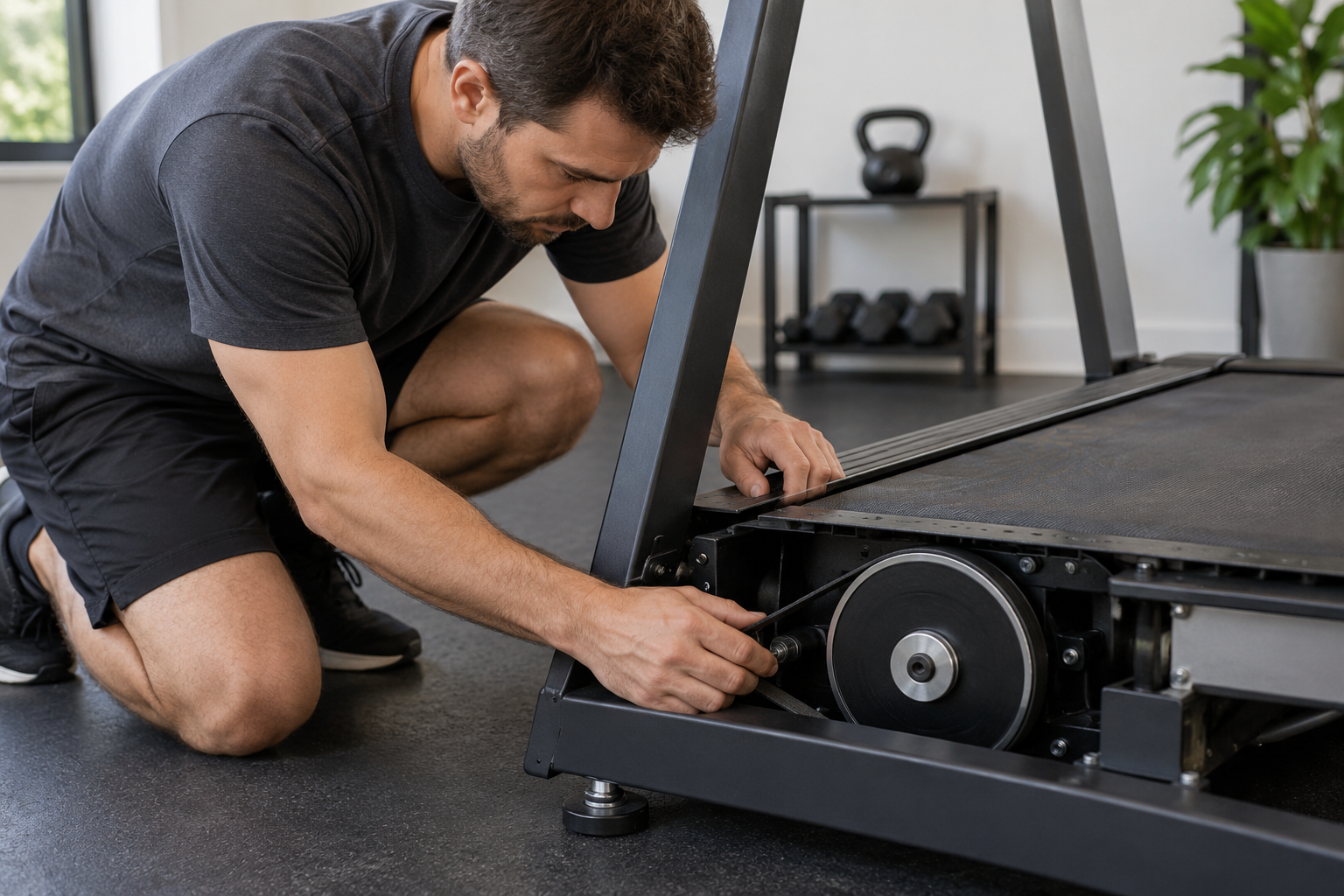
Limitations and maintenance of a budget magnetic treadmill: a practical guide for gyms
Choosing cardio equipment is a major decision for any gym, fitness center, or corporate fitness room. Among the solutions available, the budget magnetic treadmill may attract the attention of purchasing managers due to its low price, generally compact dimensions, and the lack of an electric motor for driving the belt. However, these features are not enough to establish whether the equipment is truly suitable for a professional environment.
Understanding the limitations and maintenance of a budget magnetic treadmill means analyzing the system's operation, actual performance, wear resistance, and the conditions of use intended by the manufacturer. A model designed for occasional home use may have very different characteristics compared to a machine intended for continuous sessions with numerous users. The distinction mainly concerns structural robustness, belt quality, adjustment systems, and the availability of spare parts.
For a gym manager or fitness room director, the goal should not be simply to find the least expensive treadmill, but to evaluate the equipment's compatibility with the service offered. This guide explores the main limitations of budget magnetic models, proposes maintenance checks, and identifies practical criteria for deciding when a manual solution might be adequate and when it is preferable to opt for professional cardio equipment.
- How a magnetic treadmill works
- Main performance limitations of budget models
- Suitability for use in gyms and fitness rooms
- Components subject to wear and mechanical issues
- Routine maintenance and periodic checks
- Safety, ergonomics, and user comfort
- Comparison with motorized treadmills and other cardio machines
- Practical criteria for evaluating a budget magnetic treadmill
- How to plan an investment for a fitness room
How a magnetic treadmill works
The magnetic treadmill belongs to the category of equipment for walking and, in models that allow it, for running without a drive motor. The movement of the belt is generated directly by the user through the push of their feet. This principle distinguishes manual machines from electric treadmills, in which a motor determines the speed of the belt according to the selected settings.
In magnetic models, a resistance system can help regulate the effort required to move the belt. The actual behavior depends on the mechanical design, the geometry of the rollers, the friction between surfaces, and the characteristics of the braking system. Not all manual treadmills use the same technology: professional curved models, for example, may adopt different solutions and should not be automatically equated with budget magnetic versions.
The absence of a drive motor eliminates some components typical of electric machines, but it does not make the equipment maintenance-free. The belt, rollers, bearings, frame, and adjustment mechanisms continue to be subjected to stress during use. The quality of these elements determines much of the operational reliability.
Belt movement and the user's role
In a manual treadmill, the speed of the belt depends on the action exerted by the user and the mechanical resistances present. The person must therefore actively contribute to moving the walking surface. This can change the feel of the exercise compared to a motorized treadmill, especially during startup phases and changes in pace.
In budget models with an inclined deck, the geometry can facilitate belt sliding during walking. However, the actual fluidity depends on the design and the condition of the components. Irregular movement should not automatically be considered a normal characteristic of manual operation.
Function of the magnetic resistance system
The magnetic system can use the interaction between magnets and moving metal components to generate adjustable resistance, according to the configuration provided by the manufacturer. This technology allows for changing the effort without necessarily using braking systems based on direct contact between surfaces.
The presence of magnetic adjustment does not alone guarantee precision or uniformity of resistance. It is important to check how many levels are available, how the adjustment occurs, and whether the behavior remains consistent during use. In budget models, the overall quality of the transmission can affect the regularity of the movement more than the simple presence of the magnetic system.
Main performance limitations of budget models
One of the main limitations of budget magnetic treadmills concerns the ability to offer a workout experience comparable to that of professional motorized machines. In manual models, the speed is not imposed by a motor, and effort adjustment may be less immediate. This aspect must be considered, especially when the structure proposes programs that require pre-set paces.
Another important variable is the size of the walking surface. Compact models may feature relatively short or narrow belts, limiting the freedom of movement for people with different anthropometric characteristics. A surface suitable for slow walking is not necessarily suitable for more dynamic exercises.
The quality of the mechanical system also affects the continuity of the movement. High friction, uneven sliding, and limited adjustments can make the experience less comfortable. These characteristics should not be attributed indiscriminately to all manual treadmills, but evaluated through the specifications and practical tests of the individual model.
Speed control and workout intensity
In motorized treadmills, the user can generally set a speed and maintain it within the machine's operating conditions. In manual magnetic models, however, the pace depends directly on the push exerted. This difference can make repeating sessions that require constant speeds more complex.
For free-walking activities, this characteristic may be acceptable. In interval training programs with precisely defined speeds, however, the fitness manager should evaluate whether the machine allows for sufficient control. The presence of a display does not necessarily imply speed measurement with precision comparable to professional instruments.
Belt dimensions and freedom of movement
The length and width of the belt affect the ability to perform the stride naturally. A reduced surface may require more attention to foot placement and be less suitable for tall people or those with a long stride.
Before purchasing, it is advisable to compare the usable dimensions of the walking surface, not just the external footprint of the equipment. The assessment must consider the declared intended use and the characteristics of the expected users, avoiding the inference of running suitability from the mere presence of a moving belt.
Suitability for use in gyms and fitness rooms
The intended use represents one of the most important criteria for evaluating a budget magnetic treadmill. Equipment designed exclusively for the home environment may not be suitable for a commercial gym, even when its features apparently meet space and budget requirements. The frequency of use and the number of people sharing the machine significantly change the operating conditions.
In a corporate fitness room with limited access, the workload may be different from that of a fitness center open for many hours a day. However, lower attendance does not automatically make a home machine suitable for shared use. It is necessary to verify the conditions of use allowed by the manufacturer and any warranty limitations.
For a manager, the evaluation should start with concrete data: expected number of users, average duration of sessions, type of training, and availability of staff for supervision. This information makes it possible to identify the features that are truly necessary.
Differences between home and professional use
Equipment intended for professional use is generally designed considering robustness needs, component accessibility, and maintenance consistent with shared use. Home models, on the other hand, may be sized for lower usage frequencies and more limited operating conditions.
The distinction must be verified through technical documentation and not deduced solely from the price or external appearance. A compact and well-finished treadmill is not necessarily certified or declared suitable for a commercial gym.
Usage frequency and operational load
A machine used by numerous people throughout the day accumulates work cycles that can accelerate the wear of the belt, rollers, and bearings. Even the variability of users' body weight and walking styles affects mechanical stress.
The manager should estimate the expected usage during peak hours and compare it with the manufacturer's indications. When this information is not available, the uncertainty represents an element to consider in evaluating the purchasing risk.
Components subject to wear and mechanical issues
The operation of a magnetic treadmill depends on several mechanical components that must maintain adequate conditions over time. The belt represents the surface directly used by the person, while the rollers allow movement along the intended path. Bearings, supports, and adjustment systems contribute to the stability and fluidity of the assembly.
In budget models, the quality of materials and workmanship can vary significantly. A less durable belt or an inadequate support system may require more frequent intervention. However, it is not correct to determine the lifespan of equipment solely based on the price range: construction, maintenance, and intensity of use must be considered.
Mechanical anomalies must be addressed promptly. Unusual noises, irregular sliding, lateral deviations of the belt, or sudden variations in resistance can indicate problems that require technical verification. Continuing to use the machine without identifying the cause can increase component deterioration.
Belt, rollers, and sliding system
The belt is subjected to repeated contact with footwear and stress during every step. Its lifespan depends on the materials, tension, alignment, and characteristics of the sliding surface. Incorrect tension can contribute to irregular movement and abnormal wear.
The rollers must maintain smooth rotation and proper alignment. Any adjustments must be made following the manufacturer's instructions, because inappropriate intervention can worsen the belt's behavior or compromise safety.
Bearings, frame, and mechanical adjustments
Bearings contribute to the movement of the rollers and can be subject to deterioration over time. Noises, vibrations, or abnormal resistance may require a check, but they do not allow for identifying the responsible component with certainty on their own.
The frame and adjustment systems must also be checked periodically. Loose connections, deformations, or unreliable locking mechanisms represent conditions that require attention. Maintenance operations must comply with the procedures and limits indicated in the technical documentation.
Routine maintenance and periodic checks
Proper maintenance checklist allows for organizing checks and reducing the risk of small problems turning into major breakdowns. Even if the magnetic treadmill does not use a drive motor, it remains mechanical equipment that requires cleaning, inspections, and adjustments according to the manufacturer's instructions.
The frequency of checks should be defined considering the intensity of use and environmental conditions. In a shared fitness room, it is useful to plan for frequent visual checks and scheduled technical inspections. Procedures must be documented, especially when multiple people are responsible for managing the room.
It is important to distinguish between tasks that can be performed by ordinary staff and interventions that require specific technical expertise. Cleaning and visual observation can be part of daily management, while transmission adjustments, replacements, and work on resistance systems must follow the manufacturer's instructions.
Daily checks and cleaning of the machine
Before use, it is advisable to check that the belt is free of foreign objects, that the handrails are stable, and that there is no obvious damage. A brief observation of the movement can help identify anomalies, provided it is performed under the safety conditions foreseen by the manufacturer.
Cleaning should cover contact surfaces, the frame, and accessible areas. It is necessary to use products compatible with the materials, avoiding the indiscriminate application of liquids or substances that could damage coatings and mechanical components.
Periodic checks and lubrication
Scheduled inspections should include checking belt alignment, the condition of the rollers, the stability of connections, and the operation of adjustments. The frequency must follow the manufacturer's instructions and be adapted to the actual usage frequency.
Lubrication should not be performed automatically on any magnetic treadmill. Some systems provide for specific products and procedures, while others use components that do not require such interventions. Applying unindicated lubricants can alter the behavior of the belt and compromise the materials.
Safety, ergonomics, and user comfort
The safety of a treadmill depends on the interaction between construction characteristics, maintenance, and user behavior. In manual models, the absence of a motor does not eliminate the risks associated with loss of balance, belt slipping, or improper use. It is therefore necessary to carefully evaluate the machine's stability and the presence of adequate supports.
The size of the walking surface, the height of the handrails, and the geometry of the deck affect the user experience. A machine that is comfortable for one person may not be suitable for another with different stature or mobility. For facilities open to a diverse public, the ability to adapt to different profiles represents an important criterion.
Operating instructions should be easily available, and staff should be aware of the machine's main limitations. In the presence of anomalies or damaged components, the station must be removed from service until the necessary verification is performed.
Structural stability and handrails
The frame must maintain a stable position during movement, without abnormal oscillations. Feet, supports, and locking systems must be compatible with the installation surface. The presence of handrails can offer a useful reference, but it does not replace proper machine design.
It is important to verify that the handles are easily reachable and do not hinder natural movement. A handrail that is too low, too high, or unstable can reduce comfort and make it more difficult to maintain proper posture.
Accessibility for users with different needs
A fitness room can be frequented by people with very different levels of training. Some users may prefer a slow and controlled walk, while others seek more intense sessions. The budget magnetic treadmill might not satisfy both needs with the same effectiveness.
The choice should consider ease of access, deck height, belt dimensions, and how the movement is started. When the facility offers programs aimed at people with particular functional limitations, the suitability of the equipment must be evaluated by competent professionals in relation to individual needs.
Comparison with motorized treadmills and other cardio machines
The budget magnetic treadmill is only one of the possible solutions for organizing a cardiofitness area. The choice should be made by comparing the truly necessary functions rather than considering all cardio machines as equivalent alternatives. Motorized treadmills, exercise bikes, and ellipticals have different biomechanical and operational characteristics.
Motorized machines generally allow setting speed and, in models that provide for it, incline via electronic systems. This facilitates the repeatability of certain sessions but introduces electrical and mechanical components that require specific maintenance. Manual machines can offer a simpler configuration without necessarily guaranteeing lower management costs in every situation.
The assessment must also consider the user's experience. An exercise bike allows for seated activity, while an elliptical offers a guided movement that is different from walking. The choice depends on training goals and the composition of the clientele.
When to prefer a motorized treadmill
A motorized treadmill can be more suitable when the facility offers programs based on set speeds, continuous sessions, and precise intensity adjustments. Professional models can also offer wider running surfaces and systems designed for intensive use.
These advantages must be compared with dimensions, electricity consumption, installation requirements, and maintenance. The presence of advanced features does not automatically represent a benefit if they are not used in the facility's programs.
Bikes and ellipticals as operational alternatives
Bikes can be interesting when the goal is to offer cardiovascular activity with a seated position and specific resistance adjustment. Ellipticals, on the other hand, allow for guided cyclical movement that involves the lower limbs and, in some configurations, the upper ones as well.
For a fitness room with limited space, the choice between these pieces of equipment should be based on user preferences, ease of access, and the variety of programs offered. There is no universally superior solution: each machine meets different needs.
Practical criteria for evaluating a budget magnetic treadmill
A professional evaluation should start with verifiable technical requirements. Key practical criteria include intended use, load capacity, walking surface dimensions, structural quality, spare parts availability, and warranty conditions. The initial price must be considered together with these elements.
It is important to request clear information on the allowed operating conditions. High load capacity alone does not prove that the machine is suitable for intensive use. Similarly, the presence of different resistance levels does not guarantee precise adjustment or good movement fluidity.
Whenever possible, a practical test can help verify stability, comfort, and belt behavior. The evaluation should involve people with different physical characteristics, always in compliance with the conditions of use intended by the manufacturer.
What information to look for in the technical data sheet
The technical data sheet should indicate overall dimensions, usable belt surface, maximum user weight, resistance characteristics, and intended use. It is also useful to check the weight of the machine, the presence of adjustments, and indications regarding maintenance.
The availability of complete instructions and references to applicable technical standards helps make the comparison more reliable. Generic commercial descriptions do not replace verifiable information, especially when the equipment is intended for a shared environment.
Technical support and spare parts availability
Before purchasing, it is advisable to verify the possibility of replacing the belt, rollers, and other wear-prone components. The lack of spare parts can make a machine uneconomical even when the initial price is particularly low.
Warranty conditions must be examined carefully, especially regarding professional use. A product purchased for a gym must be accompanied by conditions compatible with the actual intended use, avoiding basing the choice on warranties intended exclusively for home environments.
How to plan an investment for a fitness room
The choice of a budget magnetic treadmill must be part of the overall planning of the cardio area. The manager should evaluate the expected number of users, session duration, and the goals of the proposed programs. A manual machine can be consistent with limited needs, but it should not be automatically considered a substitute for a professional motorized treadmill.
The total cost of ownership includes the purchase price, delivery, installation, maintenance, spare parts, and possible periods of unavailability. The time spent by staff on checks also represents an operational component. An initially cheap solution can lose its cost-effectiveness when it requires frequent intervention or does not meet users' expectations.
For a facility wishing to expand or upgrade its equipment, it is useful to compare different categories of equipment. Professional cardio machines can be evaluated in relation to the needs of the fitness room, considering treadmills, bikes, and ellipticals without limiting the decision to the purchase price alone.
Building a decision matrix for purchase
A practical method consists of assigning weight to the most relevant criteria: professional suitability, safety, comfort, maintenance, footprint, and total cost. Weighting must reflect the facility's needs. In a busy fitness room, reliability and operational continuity can take on greater importance than compactness.
The matrix should distinguish essential requirements from auxiliary features. If a machine is not declared suitable for the intended use, a particularly attractive price should not compensate for this incompatibility. Only alternatives that meet the minimum requirements should be compared through economic and functional scores.
Defining a sustainable maintenance plan
Before installation, it is useful to prepare a check log, identify the responsible staff, and establish procedures for reporting anomalies. The plan should include routine cleaning, visual checks, periodic inspections, and technical interventions according to the manufacturer's indications.
The availability of spare parts and the possibility of obtaining qualified support must be considered already during the selection process. Equipment that requires long lead times to restore operation can compromise service continuity, especially when the fitness room has few cardio stations.
Monitoring usage and cost-effectiveness over time
After purchase, the manager can record usage frequency, user reports, maintenance interventions, and periods of unavailability. This data allows for evaluating whether the machine actually meets the expected needs and identifying recurring critical issues.
In the medium term, comparing the management cost with the number of sessions performed offers a useful indication of the investment's efficiency. A cheap machine that remains underutilized because it is uncomfortable or unsuitable for the facility's programs may represent a less efficient choice compared to more expensive equipment that is used more often. Planning should therefore prioritize technical suitability, operational continuity, and the quality of the experience offered to users.
Comments (0)