
Trolley
You have no items in your shopping cart

 Budgets
 Dumbers
 Discs
 Benches
 Racks and Rigs
 Weights Holders
 Isotonic machines
 Calisthenics
 Cardio
 Kettlebells
 Flooring
 Gym Set
 Accessories
 Combat
 ARTI MARZIALI
 CONTAINER GYM
 Tug-Of-War
 Used Gym Equipment
 PILATES MACCHINARI
 GINNASTICA ARTISTICA
 CAMPI DA PADEL
 Prodotti in Pronta Consegna
 Informazioni
 IRONMAN
 Gift Card
- Donatif
- General information
- 0 I like it
- 140 Views
- 0 comments
- gym flooring, safety flooring, gym safety, shock-absorbing materials
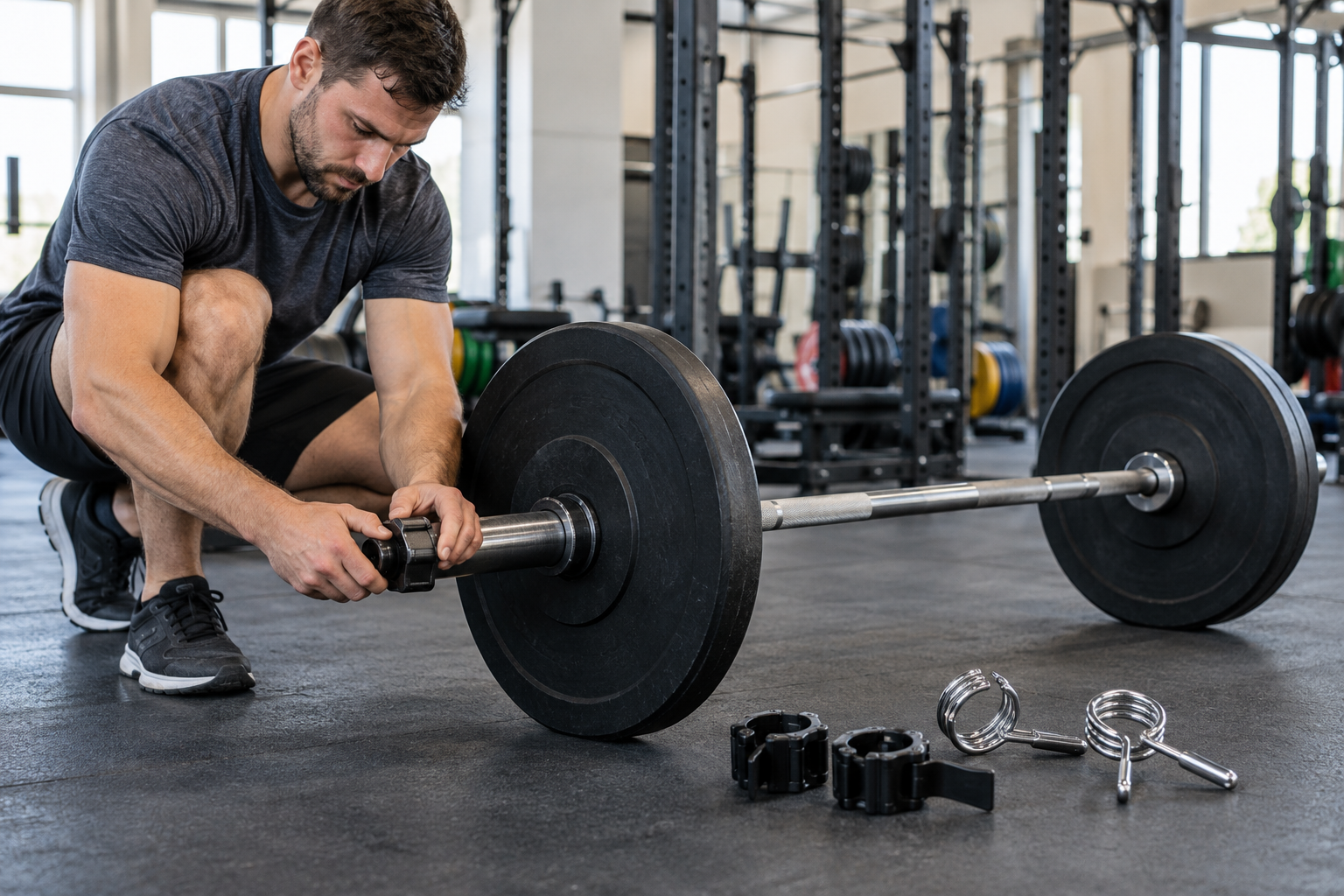
Difference Between Olympic Collars and Standard Collars: How to Choose
Understanding the difference between Olympic collars and standard collars is essential for correctly choosing accessories designed to lock weight plates onto barbells. Although both serve the function of limiting the movement of loads along the ends of the bar, they are not necessarily interchangeable. Mating diameter, closure system, materials, and usage conditions determine the compatibility and reliability of the connection.
For a gym manager or purchasing officer, choosing collars means evaluating a seemingly simple component that impacts workout organization. An incompatible accessory can prevent proper plate locking, while an impractical system can slow down load-changing operations during group sessions. Selection must therefore consider both the technical characteristics and the operational needs of the facility.
This guide compares Olympic and standard collars through verifiable criteria, clarifying dimensional differences, the main locking mechanisms, and the situations in which each solution may be appropriate. The goal is to avoid purchases based solely on price or trade name, distinguishing actual compatibility from stated performance and safety requirements.
- Olympic and standard collars: main differences
- Diameters and barbell compatibility
- Locking systems and technical features
- Safety, grip, and usage conditions
- Which collars to choose for each type of workout
- Materials, durability, and maintenance
- Cost comparison and gym management
- Purchasing criteria and investment protection
Olympic and standard collars: main differences
The most immediate distinction between Olympic collars and standard collars concerns the diameter of the barbell section on which they are installed. Olympic barbells commonly used in professional gyms feature sleeves intended for plates with a nominal 50 mm hole. Standard collars, on the other hand, can use ends of a smaller diameter, frequently around 25 or 28 mm, depending on the model and the system adopted.
This dimensional difference creates the need to use compatible accessories. A collar designed for Olympic sleeves cannot be considered suitable for a standard barbell just because its closing system allows some adjustment. Similarly, a collar intended for smaller diameter bars must not be forced onto an Olympic sleeve.
The designation "Olympic" does not automatically identify a specific level of quality. There are collars with different characteristics in terms of materials, tightening systems, and intended use. For a professional evaluation, it is therefore necessary to examine the product specifications, avoiding the mistake of considering all accessories belonging to the same category as equivalent.
Characteristics of Olympic collars
Olympic barbell collars are designed to be used on compatible sleeves of Olympic barbells. They can adopt lever, screw, or other locking configurations, with different characteristics in terms of installation speed and resistance to sliding.
The choice must consider the actual diameter of the sleeve, expected tolerances, and declared usage conditions. A collar compatible with a specific bar should not automatically be considered suitable for all sports applications.
Characteristics of standard collars
Standard collars are generally associated with barbells featuring ends of a smaller diameter compared to Olympic sleeves. They can be used with straight bars, curved bars, or other compatible equipment, provided that the fastening system corresponds to the dimensional characteristics of the support.
It is important to check whether the bar has smooth or threaded ends. Some systems use specific threaded rings that work with the barbell's threading and cannot be indiscriminately replaced with collars intended for smooth surfaces.
Diameters and barbell compatibility
Dimensional compatibility represents the first criterion to verify before purchasing. The nominal measurement of the plates must not be confused with the actual diameter of the surface on which the collar exerts its locking action. Production tolerances and sleeve geometry can influence the mating between the accessory and the barbell.
For a gym that has different types of bars, it is useful to create an inventory of existing equipment. This allows you to distinguish between Olympic barbells, standard bars, and special tools that might require dedicated closing systems. The goal is to avoid purchasing a single model of collar without having verified compatibility with all stations.
Verification should be based on manufacturers' technical datasheets. When information is not available, it is advisable to precisely identify the bar model and request clarification before making a purchase. A measurement can provide useful indications, but it does not replace specifications regarding tolerances and conditions of use.
Compatibility with Olympic sleeves
Olympic barbell sleeves are commonly associated with plates having a nominal 50 mm hole. The locking system must be designed for the actual diameter of the contact surface and for the characteristics of the sleeve, which can vary according to the model.
Before selecting a collar, it is also useful to check the available space on the end of the bar. The width of the accessory occupies part of the sleeve and can reduce the usable surface for loading plates.
Compatibility with standard and threaded bars
Standard bars can feature different diameters, making it necessary to identify the specific measurement. The presence of threaded ends introduces an additional element of distinction, because some bars use collars designed to work with that particular threading.
A closure system must not be forced when it encounters abnormal resistance. Incompatibility can damage the accessory or the surface of the bar and compromise the ability to properly retain plates.
Locking systems and technical features
In addition to diameter, the main operational difference between collars concerns the mechanism used to lock the plates. Available systems may include lever closures, screw mechanisms, spring collars, and threaded rings. Each configuration has specific characteristics that must be evaluated relative to the intended use.
Installation speed represents an important criterion in gyms with frequent load changes. During a group session, accessories that are simple to apply and remove can make workout organization smoother. However, practicality must not be confused with the ability to retain plates under the expected conditions.
Clamping force and resistance to sliding depend on the collar's design, contact materials, and bar characteristics. It is incorrect to automatically attribute superior performance to a system just because it uses a lever or a metal component. It is necessary to verify any technical data and limitations stated by the manufacturer.
Lever and quick-release collars
Quick-release collars generally use a mechanism that allows you to lock and unlock the accessory through a relatively simple movement. This configuration can be practical when users frequently modify the load during sets.
The quality of the system depends on the geometry of the closure, the strength of the components, and compatibility with the sleeve. An easy-to-operate lever does not, by itself, constitute proof of greater safety.
Screw, spring collars, and rings
Screw collars allow tightening to be achieved through an adjustable mechanism, while spring collars exploit the elastic deformation of the accessory. Threaded rings, on the other hand, are designed for specific bars equipped with compatible ends.
These systems can be appropriate in different contexts. The choice should consider frequency of use, ease of application, maintenance conditions, and manufacturer instructions, avoiding comparisons based solely on construction simplicity.
Safety, grip, and usage conditions
The main function of collars is to limit the movement of plates along the sleeve during training. Inadequate closure can allow unwanted load movements, especially when the bar is tilted or subjected to variations in acceleration. The level of risk depends on the exercise, the quantity of plates, and operating conditions.
The safety of barbell collars must be evaluated considering the entire system formed by the bar, plates, and locking accessories. Even a correctly installed collar does not eliminate risks related to inappropriate lifting technique, excessive load, or incorrect station management.
It is essential to respect the declared intended use. A collar designed for controlled workouts may not be suitable for certain dynamic applications. When the manufacturer does not provide sufficient information on permitted conditions, it is advisable to request clarification rather than assume the accessory is suitable for any exercise.
Plate sliding resistance
Sliding resistance depends on the interaction between the collar and the sleeve. Materials, geometry, and surface conditions can influence the behavior of the connection. Any test data must be interpreted by verifying the conditions under which they were obtained.
It is incorrect to use a commercial holding value as an absolute guarantee in any situation. The presence of dust, residue, or worn components can modify the system's behavior compared to initial conditions.
Dynamic workouts and load variations
Exercises involving rapid accelerations can subject locking systems to different conditions compared to slow, controlled movements. For activities such as Olympic weightlifting and functional training, it is necessary to use accessories expressly compatible with the intended methods.
Instructors should verify that collars are applied correctly before sets. In the presence of abnormal plate movement or closure difficulties, the accessory must be checked and replaced when necessary.
Which collars to choose for each type of workout
The choice of collars must be linked to the exercises actually performed in the facility. A gym dedicated primarily to bodybuilding may have different requirements compared to a center specialized in weightlifting or functional training. Dimensional compatibility remains the primary requirement, but the frequency of load changes and the characteristics of the movements impact the practicality of the solution.
In stations used by numerous users, a rapid system can facilitate daily management. However, it is not necessary to adopt the same model for all bars when the facility has equipment with different characteristics. A reasoned selection makes it possible to reduce errors and maintain equipment consistent with the activities.
To evaluate accessories, it is useful to start from the characteristics of the gym barbells present in the facility, checking sleeve diameters, configurations, and intended uses. This approach makes it possible to choose collars based on the bars actually used, rather than purchasing accessories independently of the training system.
Bodybuilding and general fitness
In bodybuilding and general strength training, collars are used during exercises such as presses, rows, and barbell movements. The choice must consider the type of bar and the need to keep plates correctly positioned during sets.
In a weight room with numerous stations, it can be useful to standardize compatible accessories, making replacement and control simpler. This solution must still respect any dimensional differences between equipment.
Weightlifting and functional training
Activities that include rapid movements and frequent load changes require particular attention to declared usage conditions. The choice should favor systems compatible with the sleeves and adequate for the anticipated stresses.
Application speed can represent an operational advantage, especially in group-organized sessions. However, the collar must be checked before exercise and used according to the manufacturer's instructions.
Materials, durability, and maintenance
Collars can be made with metal components, polymer materials, or combinations of different elements. The choice of material influences weight, operating modes, and maintenance characteristics, but it alone does not determine the overall quality of the accessory. The design of the locking system remains a fundamental element.
In a professional gym, durability also depends on the frequency of use and user behavior. Accessories subjected daily to numerous openings and closures can show wear on mechanisms, contact surfaces, or elastic elements. For this reason, it is useful to select products that allow simple checks and orderly management of replacements.
Routine maintenance should include cleaning, integrity checks, and functional testing. It is inappropriate to use lubricants or treatments not provided by the manufacturer, as they could alter the friction necessary for locking. Damaged accessories must be removed from use when they no longer guarantee the expected operation.
Metal collars and construction features
Metal components can offer certain characteristics of rigidity and resistance, but actual performance depends on the alloy, geometry, and locking system. A metal collar should not be automatically considered superior to a model made with different materials.
It is useful to check the quality of contact surfaces and the possible presence of elements designed to limit sleeve damage. Corrosion resistance can also take on importance in environments subject to humidity.
Polymer collars and elastic components
Polymer materials can be used for the collar body or for specific locking system components. Their characteristics depend on the formulation and design, making it necessary to examine declared performance rather than making generic evaluations.
During checks, it is advisable to observe any cracks, deformations, or closure difficulties. An accessory that no longer maintains proper tightening must be replaced, regardless of the material it was made from.
Cost comparison and gym management
The price of collars can vary based on materials, closure mechanism, construction features, and intended use. For a purchasing manager, the economic comparison must start with compatibility with existing equipment. An inexpensive product that is not suitable for the gym's sleeves does not represent real savings.
It is also important to consider the number of pairs needed. A facility with many stations may require a supply distributed across different areas, preventing users from having to constantly move accessories. The quantity to purchase should derive from the number of bars used simultaneously and the organizational methods of the room.
The overall cost also includes replacements due to wear, damage, or loss. A practical solution to manage can reduce the time dedicated to tidying up equipment, but this advantage must be evaluated in relation to actual usage habits and not turned into a generic promise of savings.
Initial price and documented performance
When comparing two models, it is useful to check compatible diameter, closure system, materials, and usage conditions. A higher price may be justified by specific features, but it does not automatically constitute proof of greater reliability.
Offers should be compared also considering the package contents. It is necessary to check whether the price refers to a single collar or a pair, avoiding errors in estimating the overall supply.
Organization and availability of accessories
A gym can simplify management by assigning compatible accessories to different stations. This organization reduces the likelihood that users will use unsuitable accessories and facilitates the identification of missing components.
It is useful to provide a reasonable number of spare parts and define periodic checks. Standardization can be advantageous when bars share the same characteristics, while a mixed supply requires clear identification of the different systems.
Purchasing criteria and investment protection
The choice between Olympic and standard collars must be made starting from the characteristics of the barbells present in the gym. Sleeve diameter, end configuration, and usage conditions determine which accessories can be considered compatible. Only after this verification does it make sense to compare closure systems, materials, and prices.
An orderly purchasing process makes it possible to reduce the number of alternatives and concentrate on truly important parameters. The manager can classify available bars, identify the types of collars needed, and review product documentation. This method avoids attributing value to features that do not produce concrete benefits in the operational context.
For a professional gym, it is also important to evaluate supply continuity. The ability to source compatible accessories over time facilitates the replacement of worn components and makes it possible to maintain a homogeneous supply. Clarity of user instructions also contributes to simpler management.
Technical checklist before ordering
Before confirming the purchase, it is useful to check a few essential elements: Does the declared diameter correspond to the sleeve? Is the collar compatible with the bar's surface? Is the closure system suitable for the frequency of use? Are the expected operating conditions included in the intended use? Are maintenance and inspection instructions available?
These questions make it possible to distinguish necessary features from accessory ones. When documentation does not clarify an important requirement, it is preferable to request information from the supplier before proceeding.
When to choose Olympic or standard collars
Olympic collars are the appropriate choice when the gym uses barbells with compatible Olympic sleeves. Standard collars instead meet the needs of bars with smaller diameters or specific fastening systems. The distinction does not concern absolute superiority, but the correct correspondence between accessory and equipment.
If a facility has both types of barbells, it may be necessary to maintain two categories of collars. In this case, clear identification and orderly distribution of pairs help limit errors during sessions.
A decision consistent with professional use
Investment protection stems from choosing accessories that are compatible, documented, and adequate for training methods. Purchasing collars with features superior to actual needs does not automatically guarantee an operational advantage, just as favoring the lowest price can prove inefficient when it compromises practicality or compatibility.
A comparison based on diameters, closure systems, usage conditions, and maintenance makes it possible to make a reasoned decision. For the gym manager, this means having accessories consistent with existing equipment, simplifying daily management, and reducing the risk of unusable purchases or premature replacements.
Comments (0)