
Trolley
You have no items in your shopping cart

 Budgets
 Dumbers
 Discs
 Benches
 Racks and Rigs
 Weights Holders
 Isotonic machines
 Calisthenics
 Cardio
 Kettlebells
 Flooring
 Gym Set
 Accessories
 Combat
 ARTI MARZIALI
 CONTAINER GYM
 Tug-Of-War
 Used Gym Equipment
 PILATES MACCHINARI
 GINNASTICA ARTISTICA
 CAMPI DA PADEL
 Prodotti in Pronta Consegna
 Informazioni
 IRONMAN
 Gift Card
- Donatif
- General information
- 0 I like it
- 74 Views
- 0 comments
- gym flooring, safety flooring, gym safety, shock-absorbing materials
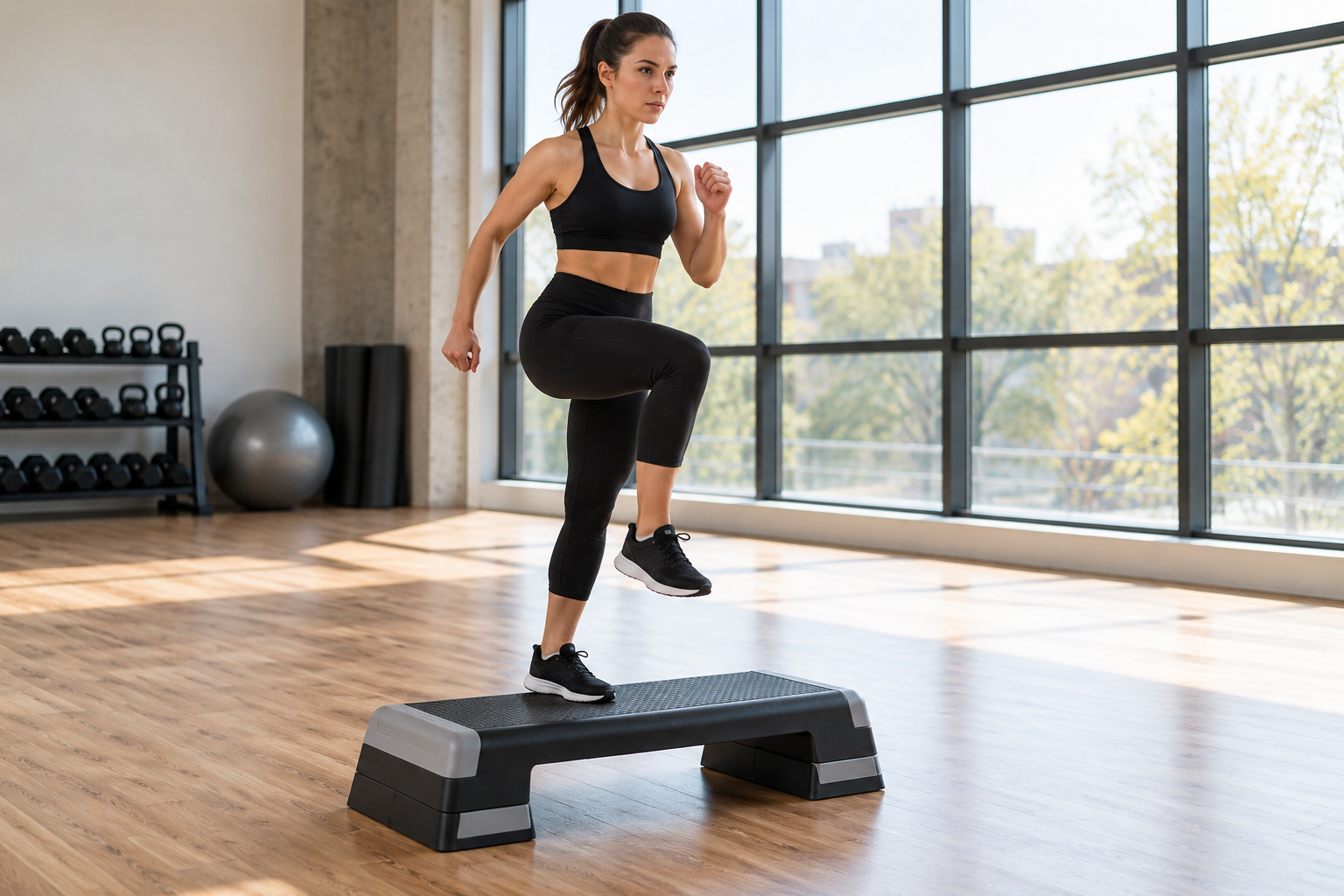
How to choose a training step platform: a practical guide for professional gyms
The step platform is one of the most versatile pieces of equipment for organizing cardiovascular workouts, coordination exercises, and muscle conditioning programs. Thanks to its ease of use and numerous possible applications, it is found in traditional gyms, fitness centers, personal training studios, and rooms dedicated to group classes. However, when equipment is intended for professional use, the choice requires a more in-depth evaluation than a simple comparison of dimensions and prices.
Understanding how to choose a training step platform means analyzing structural characteristics, stability, materials, height adjustment, and wear resistance. A platform used daily by many members must maintain predictable behavior during repeated movements, changes in direction, and sequences performed at different intensities. The quality of the support surface and the solidity of the supports directly affect the functionality of the equipment.
For a gym manager or purchasing manager, the goal is to identify a solution consistent with the proposed training programs, the user profile, and the gym management methods. This guide explores the main technical and operational criteria to consider, avoiding product rankings and focusing on the elements that allow for an informed and sustainable purchase over time.
- Fundamental characteristics of a professional step platform
- Adjustable height and workout intensity
- Construction materials and wear resistance
- Stability and safety during exercises
- Platform dimensions and ergonomics
- Choosing the platform based on the type of training
- Maintenance and equipment management
- Purchasing criteria for gyms and fitness centers
- Evaluating the long-term investment
Fundamental characteristics of a professional step platform
A professional step platform must offer a balanced combination of stability, mechanical resistance, and ease of use. Unlike solutions intended for occasional home use, equipment used in gyms can be subjected to numerous consecutive sessions throughout the day. This involves repeated stress on the platform, the supports, and the points of contact with the floor.
The quality of a platform does not depend solely on the maximum weight declared by the manufacturer. It is also necessary to consider the behavior of the structure during dynamic movements, when the load is applied rapidly or concentrated on a limited portion of the surface. Alternating steps, descents, lunges, and choreographic sequences can generate different stresses than those produced by a person simply standing still on the platform.
For this reason, the evaluation should start from the intended use indicated by the manufacturer. A platform designed for traditional aerobic exercises should not automatically be considered suitable for intense jumps, plyometric exercises, or use with weights. Every application must fall within the expected operating conditions.
Platform structure and load distribution
The top platform must distribute stresses without exhibiting excessive deformation during use. The presence of structural reinforcements and an adequate geometry can contribute to overall rigidity, but they must be evaluated together with the characteristics of the material used.
Controlled and predictable flexing may be compatible with the equipment design, while abnormal movements, persistent creaking, or instability require attention. Structural quality must be verified under the conditions of use declared by the manufacturer.
Maximum load and conditions of use
The maximum load indicates the weight limit established by the manufacturer under specific conditions. This value must be interpreted correctly, distinguishing between static loads and dynamic stresses. A high declared load does not automatically authorize every exercise.
For a professional gym, it is appropriate to request information on operational limitations, potential use with additional weights, and correct usage methods. This data allows instructors to organize sessions consistent with the equipment's characteristics.
Adjustable height and workout intensity
Height is one of the most important parameters when choosing a step platform. By changing the level difference between the floor and the platform, it is possible to vary the mechanical characteristics of the movement and adapt the exercise to the user's capabilities. A greater height generally requires a greater joint range of motion and can increase muscle engagement, but it does not automatically determine a better workout.
Traditional step platforms can provide different adjustment levels, often obtained through modular supports. Representative configurations of 10, 15, and 20 centimeters are common in some types of equipment, but the actual intervals depend on the model. It is important to verify the heights actually available and how they are achieved.
For a fitness center that welcomes users with different levels of preparation, the ability to quickly change the height represents an organizational advantage. However, adjustment must occur through stable systems compatible with the manufacturer's instructions, avoiding improvised combinations of supports.
Lower heights for beginners and group classes
Lower configurations can facilitate learning fundamental movements and allow users to focus on coordination. In group classes, a moderate height can also help make sequences involving numerous ascents and descents more accessible.
The choice must still consider joint mobility, motor control, and individual characteristics. The instructor should be able to adapt the exercise without forcing all participants to use the same configuration.
Higher adjustments for advanced workouts
Greater heights can be used for specific muscle conditioning exercises, provided they are compatible with the platform's design. Increasing the level difference changes the work required of the lower limbs and can make some progressions more challenging.
However, it is not appropriate to use height as the sole intensity parameter. The frequency of movements, the duration of the session, rest periods, and execution technique affect the overall load. Professional programming must consider these elements in an integrated manner.
Construction materials and wear resistance
The choice of materials influences the durability, weight, and structural response of the platform. Many step platforms use polymeric materials designed to offer a combination of rigidity, impact resistance, and ease of cleaning. The actual characteristics depend on the material's formulation, the structure's geometry, and the quality of the production process.
In a professional gym, equipment is frequently moved, stacked, and used by different people. This makes resistance to accidental impacts and concentrated stress important. An apparently robust surface could deteriorate prematurely if not designed for the intended workload.
The resistance of professional step platforms must therefore be evaluated by considering the entire structure. The platform, supports, anti-slip elements, and connection points all contribute to overall durability. A single component of insufficient quality can compromise the functionality of the equipment.
Polymeric materials and construction quality
Technical plastic materials can offer advantages in terms of low weight, moisture resistance, and ease of handling. However, performance varies significantly based on the product's composition and structure.
For the purchasing manager, it is useful to verify the declared professional intended use, storage conditions, and any limitations regarding temperature or sun exposure. A platform intended exclusively for indoor environments should not be left permanently outdoors without specific authorization from the manufacturer.
Impact resistance and support integrity
During daily management, platforms can suffer impacts against floors, walls, and other equipment. The construction quality must limit the risk of damage that could compromise stability and safety.
It is important to periodically check for cracks, deformations, and breaks in the supports. Any damaged components must be replaced according to the manufacturer's indications, avoiding improvised repairs that could alter the load distribution.
Stability and safety during exercises
Stability is a fundamental requirement for any step platform used in a professional setting. During aerobic sequences, the user applies repeated loads and can quickly change the direction of movement. The platform must maintain a predictable position without slipping on the floor or exhibiting excessive wobbling.
The behavior of the platform depends on the interaction between the top surface, the structure, and the flooring underneath. A product equipped with anti-slip supports can still be less stable if used on a dirty, irregular, or incompatible surface contrary to the manufacturer's instructions.
The safety of fitness equipment therefore requires an evaluation that includes both the product's characteristics and the environment's conditions. For a gym manager, it is important to establish simple procedures that allow staff to quickly verify the suitability of workstations before classes begin.
Anti-slip surface and movement control
The top surface must offer an adequate level of grip for the planned activities. Textured finishes or specific inserts can help limit shoe slippage, but their effectiveness also depends on the presence of dust, sweat, and humidity.
An excessively rough surface may be uncomfortable during some movements, while a finish that is too smooth can reduce the safety of the footing. It is therefore useful to evaluate the platform's behavior under the structure's typical operating conditions.
Bottom supports and floor stability
The bottom contact points must help keep the platform steady during exercise. High-grip materials and a correct distribution of the support points can improve stability, provided they are compatible with the flooring present.
Before purchasing, it is advisable to verify the behavior of the platform on surfaces similar to those used in the gym. Rubber floors, resilient sports surfaces, and rigid coverings can offer different friction conditions.
Platform dimensions and ergonomics
The dimensions of the platform influence the freedom of movement and the ability to perform different exercises. A sufficiently large surface allows for the organization of sequences with alternating steps, lateral movements, and changes in direction. However, a larger platform occupies more space and can be less practical to handle.
For a professional gym, the sizing must consider both the users' characteristics and the type of activity proposed. Aerobic step lessons may require different surfaces than muscle reinforcement exercises performed individually.
Ergonomics also includes the shape of the edges, the visibility of the platform, and the ease of access. A well-designed geometry helps make the equipment's position intuitive and facilitates the organization of stations during classes.
Surface length and width
The length of the platform determines the space available for movements along the main axis, while the width influences the possibility of performing transversal movements. The choice must be linked to the planned sequences and the users' characteristics.
It is useful to compare the actually usable dimensions, avoiding considering only the external footprint. Any raised edges or areas not intended for standing can reduce the functional surface.
Edges, profile, and accessibility
The shape of the edges can influence how easily the user identifies the limit of the platform. A regular profile without protruding elements helps make movements during training more predictable.
For classes attended by people with different levels of experience, it is important that the equipment allows for gradual progression. The combination of adequate height, stable surface, and consistent dimensions facilitates learning fundamental movements.
Choosing the platform based on the type of training
A step platform can be used in different programs, but not all configurations are suitable for every exercise. The choice should start from the analysis of the activities the gym intends to offer. Aerobic classes, functional circuits, and individual sessions have specific needs in terms of size, stability, and height adjustment.
In group classes, ease of movement and speed of adjustment are particularly important. When numerous participants need to prepare their own station, a simple and intuitive system helps reduce organizational time and facilitates the instructor's work.
In functional training programs, however, it may be necessary to check more carefully for compatibility with exercises involving asymmetrical footing, lunges, or the use of weights. Versatility is an advantage only when applications fall within the conditions declared by the manufacturer.
Aerobic step classes and cardiovascular activity
Aerobic step involves rhythmic sequences characterized by ascents, descents, and coordinated movements. For these activities, a stable surface, an easily adjustable height, and dimensions appropriate to the variety of motor combinations are important.
The choice must also consider the duration of the lessons and the frequency of use. A platform intended for multiple daily classes must maintain constant functional characteristics and allow for quick cleaning between sessions.
Functional training and muscle conditioning
In functional circuits, the platform can be used for step-ups, lunges, and other exercises compatible with the structure. The height adjustment allows for modifying some movement characteristics and adapting the difficulty to individual abilities.
It is important to distinguish these applications from high-impact plyometric exercises. A traditional step platform should not automatically be considered equivalent to a box designed for jumps, as geometry, stability, and load conditions may be different.
Maintenance and equipment management
The maintenance of step platforms is generally less complex than that of machines equipped with mechanical or electronic components. However, structural simplicity does not eliminate the need for periodic checks. Intensive use can cause wear on anti-slip surfaces, deterioration of supports, and damage due to handling.
For a fitness center, it is useful to establish a verification procedure that includes checking the platform, adjustment elements, and contact points with the floor. Inspections should be more frequent when the equipment is used daily by many users.
Proper management also includes storage methods. Platforms stacked improperly or placed in passageways can be damaged and create obstacles. A dedicated storage area helps keep the room tidy and facilitates staff operations.
Cleaning and hygiene of surfaces
Platform surfaces frequently come into contact with shoes and hands. It is therefore important to plan cleaning procedures compatible with the materials used. Excessively aggressive products can alter some finishes or compromise anti-slip inserts.
The manufacturer's instructions should guide the choice of detergents and treatment methods. After cleaning, the platform must be dry and ready for use, avoiding residues that could change the grip.
Storage and handling of platforms
The ability to stack platforms can be an advantage for multipurpose rooms. However, it is necessary to verify that the model is designed for this storage method and to respect any limits indicated by the manufacturer.
The equipment's weight influences the ease of handling, especially when staff must prepare numerous stations. A lightweight solution can be practical, provided it maintains the structural characteristics required for professional use.
Purchasing criteria for gyms and fitness centers
Selecting a step platform should be based on comparable and verifiable parameters. For a purchasing manager, it is useful to prepare a sheet that includes dimensions, available heights, declared load, materials, anti-slip characteristics, and conditions of use. This approach allows for comparing different proposals without giving excessive importance to price alone.
It is also advisable to verify the availability of technical documentation and instructions for use. Indications regarding height adjustment, maintenance, and permitted exercises represent important information for the daily management of the equipment.
When the platform is purchased together with other tools for the class room, it may be useful to evaluate consistency with the gym accessories planned for the layout. The goal is to build a functional endowment, in which each element responds to concrete needs and can be managed with simple procedures.
Technical documentation and manufacturer information
Complete documentation should allow for clearly identifying the intended use, load limits, and authorized height configurations. It is also important to check for any indications regarding flooring and environmental conditions.
Generic commercial statements do not replace precise technical data. Expressions such as maximum resistance or universal use must be investigated through verifiable information, especially when the equipment will be intended for intensive use.
Supplier reliability and availability of components
The possibility of obtaining replacement supports or other components can help extend the service life of the platform. Before purchasing, it is therefore useful to check which spare parts are available and what warranty conditions are applied.
A specialized supplier should also be able to clarify any doubts regarding usage methods. This support becomes particularly important when the gym intends to use the platforms in programs other than traditional aerobic classes.
Evaluating the long-term investment
The purchase of step platforms for a professional gym should be considered within the scope of overall equipment planning. The initial cost is only one component of the investment, while durability, maintenance, spare parts availability, and ease of management affect the actual value over time. An economically advantageous solution at the time of purchase might require more frequent replacements if not adequate for the planned workload.
For a class room, the number of platforms needed depends on the planned capacity, the organization of classes, and space availability. It is useful to also consider any spare units, especially when activities are scheduled with high frequency. A uniform equipment set can simplify adjustments and make the instructors' work easier.
The economic evaluation should also include the time required to prepare and tidy up the room. Platforms that are easy to move, adjust, and store can help reduce operational activities between one lesson and another. This advantage becomes more relevant in facilities that use the same environment for different disciplines.
Total cost of ownership and operational life
The total cost of ownership includes purchase, any spare parts, maintenance, and replacement of damaged units. To correctly compare multiple solutions, it is appropriate to consider a homogeneous period of use and estimate the frequency of the planned sessions.
Actual durability depends on construction quality and conditions of use. A platform designed for repeated professional activities can offer advantages over a solution intended exclusively for occasional use, provided it is used and maintained according to the manufacturer's instructions.
Defining requirements before the purchasing decision
Before proceeding with the order, the purchasing manager should identify the planned exercises, the number of users, the necessary heights, and the characteristics of the flooring. This information allows for establishing concrete technical requirements and selecting equipment consistent with the structure's organization.
Understanding how to choose a training step platform means prioritizing stability, safety, and compatibility with the proposed activities, avoiding considering mere declared versatility as a guarantee of suitability. The ability to adjust the height and use the platform for different exercises is an advantage only when each configuration respects the conditions foreseen by the manufacturer.
For a gym that intends to offer group classes and functional programs with continuity, investing in platforms suitable for the professional context allows for better organization of stations, simplification of daily management, and maintenance of predictable operational characteristics. A selection based on technical data, user needs, and management costs helps build a reliable endowment consistent with the sports facility's goals.
Comments (0)