
Trolley
You have no items in your shopping cart

 Budgets
 Dumbers
 Discs
 Benches
 Racks and Rigs
 Weights Holders
 Isotonic machines
 Calisthenics
 Cardio
 Kettlebells
 Flooring
 Gym Set
 Accessories
 Combat
 ARTI MARZIALI
 CONTAINER GYM
 Tug-Of-War
 Used Gym Equipment
 PILATES MACCHINARI
 GINNASTICA ARTISTICA
 CAMPI DA PADEL
 Prodotti in Pronta Consegna
 Informazioni
 IRONMAN
 Gift Card
- Donatif
- General information
- 0 I like it
- 88 Views
- 0 comments
- gym flooring, safety flooring, gym safety, shock-absorbing materials
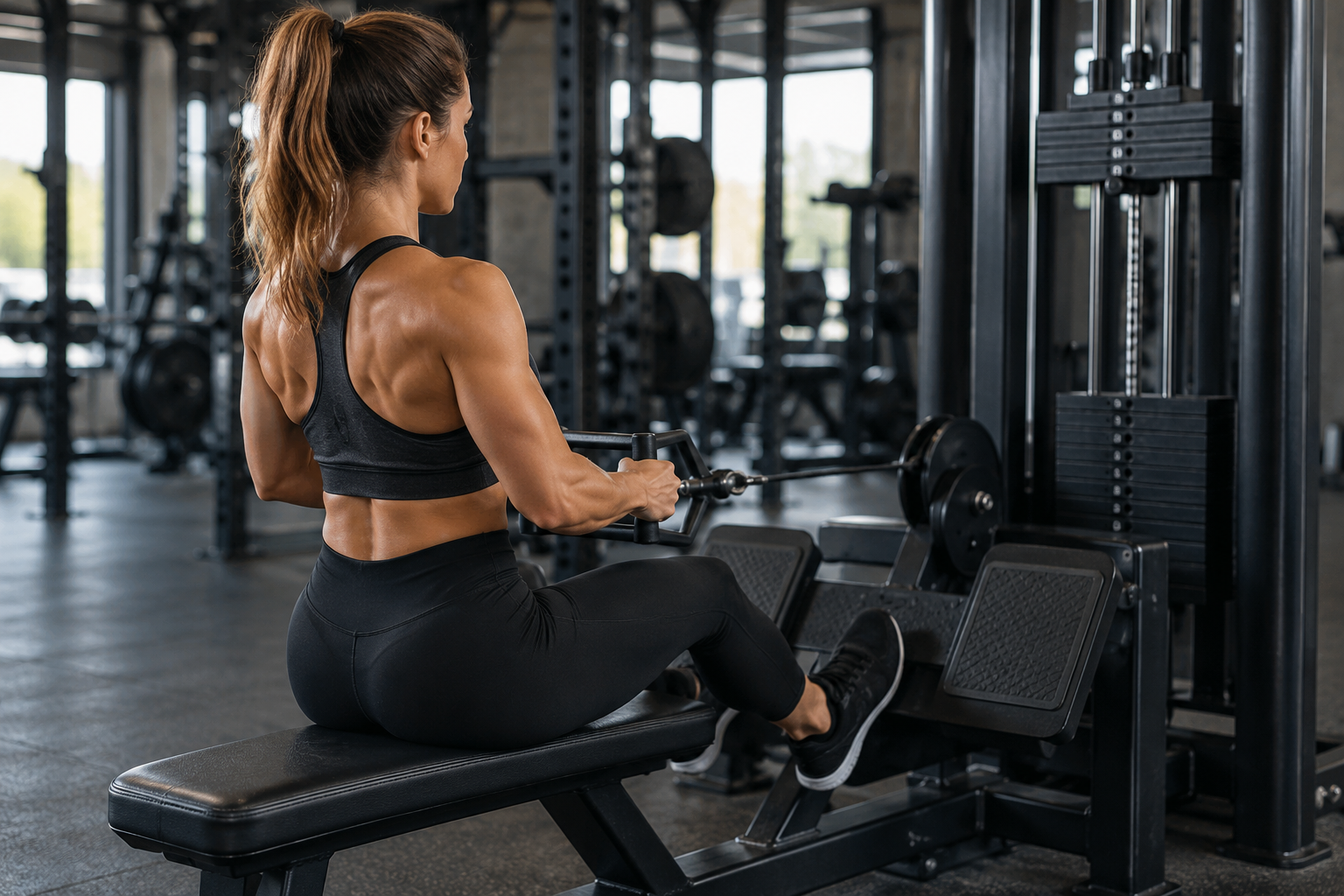
Machine row exercises for the back: technique and progressions for professional gyms
The machine row is a rowing machine used in professional weight rooms to train back muscles through a predominantly horizontal pulling movement. Compared to some free-weight exercises, it allows you to follow a trajectory defined by the frame and adjust the resistance progressively. These features make it an attractive option for gyms that accommodate users with different experience levels, from members learning the fundamentals of strength to athletes looking for specific muscle stimulation.
Correctly programming machine row exercises for the back requires attention to torso position, seat adjustment, handle selection, and load management. A well-designed machine can facilitate the repeatability of the movement, but it does not eliminate the need for controlled technique. The effectiveness of the exercise depends on the user's ability to coordinate arm movement with shoulder blade movement, avoiding compensations that modify the intended stimulus.
For a gym manager or purchasing officer, the machine row also represents an organizational choice. The quality of adjustments, structural stability, ease of access, and maintenance requirements affect daily usage. This guide examines biomechanical aspects, main variants, training progressions, and practical criteria for integrating a rowing machine into a professional strength room.
- How the machine row works and what it is for
- Muscles involved in machine row exercises
- Machine adjustments and starting position
- Correct machine rowing technique
- Exercise variants and different handles
- Programming, loads, and progressions
- Common errors and safety criteria
- How to choose a professional machine row
- Investment and integration into the strength room
How the machine row works and what it is for
The machine row allows you to perform a rowing movement against adjustable resistance. The user grabs the handles and pulls them toward the torso through a combination of shoulder, shoulder blade, and elbow movement. The machine can use a weight stack connected to cables and pulleys or arms that can be loaded with weight plates. In both cases, the resistance is transmitted through a structure designed to guide the movement.
Many models feature a front chest support, which is useful for limiting the need to autonomously maintain torso inclination. Other configurations provide a seat without chest support and require greater stabilizing contribution from the trunk. These differences affect execution and must be considered when comparing equipment intended for the same training area.
The machine row is primarily used to develop strength and muscle mass in the dorsal region. It can be included in general training programs, athletic preparation paths, and sessions dedicated to back muscles. Its utility derives from the ability to manage load, range of motion, and volume relatively precisely, provided the machine is adjusted correctly.
Resistance systems and trajectory
Weight stack machines generally allow you to select resistance via a pin. Plate-loaded models require manual insertion of weights onto the specific supports. The choice between these solutions depends on operational needs and the characteristics of the training program.
The trajectory of the handles can be convergent, divergent, or follow a more constrained path. There is no universally better geometry: it is necessary to evaluate compatibility with the intended movement and the possibility of maintaining a comfortable position during execution.
Differences compared to free-weight rowing
In barbell or dumbbell rowing, the athlete must directly manage the load trajectory and stabilize the body. The machine row introduces mechanical constraints that can reduce some coordination requirements, allowing more focus on the pulling movement.
This does not mean that one mode is necessarily superior to the other. The exercises can be complementary and the choice depends on the goal, technical level, and overall distribution of work in the programming.
Muscles involved in machine row exercises
Machine row exercises mainly involve the latissimus dorsi, trapezius, rhomboids, and various muscles that participate in shoulder and shoulder blade movements. The relative contribution changes according to the trajectory of the handles, the position of the elbows, and the machine's design. Therefore, it is incorrect to attribute identical muscle stimulation to all variants.
The latissimus dorsi contributes to humerus extension and adduction movements, while the trapezius and rhomboids participate in scapular control and retraction. The posterior deltoid can intervene significantly in some configurations. The biceps brachii, brachialis, and brachioradialis collaborate in elbow flexion, which is necessary to complete the pull.
Trunk musculature contributes to stabilization, especially in models without chest support. In machines with front support, the stabilization requirement may be different, but it remains important to maintain a position consistent with the manufacturer's instructions. Perception of effort should not be used as the sole indicator of actual muscle involvement.
Latissimus dorsi and central back musculature
The latissimus dorsi participates in pulling the humerus toward the body. Its activity depends on the arm's position and the direction of resistance. A trajectory with the elbows relatively close to the torso can change joint demands compared to a row with more open elbows.
The trapezius and rhomboids contribute to movement and shoulder blade stabilization. Scapular control allows for a more coordinated row without turning the final phase into excessive trunk compensation.
Arms, shoulders, and stabilizer muscles
Elbow flexors participate in pulling, but the goal of a machine row intended for the back should not be limited to moving the handles through arm action alone. Coordination between elbows and shoulders is essential.
Scapular stabilizers and trunk musculature contribute to maintaining the position. Insufficient control can make the movement less repeatable and increase the need for compensation.
Machine adjustments and starting position
Correctly adjusting the machine row is the first step to effective execution. Seat, chest support, and handles must allow the user to reach a stable starting position without straining the joints. Geometry varies between models, so instructions must be adapted to the machine actually available.
In a configuration with chest support, the seat should be adjusted to allow adequate contact with the support and an arm trajectory consistent with the exercise. Feet must find a stable position on the provided supports or the floor, according to instructions. The torso should not be forced to continually modify its position to reach the handles.
Machine row adjustment must be verified for every user, especially in gyms frequented by people of different heights. A position suitable for a tall athlete might be uncomfortable for a shorter person. The ability to make quick adjustments is therefore an important element even when choosing equipment.
How to adjust seat height
Seat height should allow for a comfortable handle trajectory and a correct relationship between shoulders, elbows, and supports. There is no universal height, as body proportions and machine geometry can vary.
It is useful to perform a few light repetitions to verify that the movement does not require excessive shoulder shrugging or forced adjustments. The setting must be changed when the position feels unnatural.
Chest support and foot position
Chest support should offer stability without hindering regular breathing or compressing the torso excessively. The user must maintain the intended contact during the pull, avoiding moving away from the support to complete the repetition.
Foot position contributes to general stability. Supports must be used according to the manufacturer's instructions, without adopting postures that make it difficult to maintain body control.
Correct machine rowing technique
Correct execution begins with choosing a load that allows for control of the entire trajectory. After adjusting the machine, the user grabs the handles and assumes a stable position. The pulling phase consists of bringing the elbows back while following the planned path, coordinating arm movement with shoulder blade movement.
During the concentric phase, it is important to avoid using torso momentum to accelerate the load. On machines with chest support, contact with the pad should remain consistent with the intended technique. Shoulder position must be controlled without imposing rigid and continuous retraction that prevents normal scapular movement.
The return phase requires just as much attention. The load must be accompanied back to the starting position, maintaining tension and control. Letting the handles return abruptly can reduce repetition quality and generate unnecessary stress on machine components.
Pulling phase and elbow movement
The pull should be guided by coordinated arm and shoulder movement. The direction of the elbows depends on the type of handle and the machine's trajectory. Forcing a different path than planned can make the exercise uncomfortable.
The final phase does not necessarily require bringing the elbows as far back as possible. The useful range ends when the movement can be completed without marked compensation or loss of position.
Eccentric phase and return control
During the return, the user gradually accompanies the handles, allowing the arms to extend according to the available excursion. Scapular movement must remain controlled and compatible with the structure.
A correctly managed eccentric phase facilitates set repeatability and allows for better assessment of the load used. If the weight pulls the body toward the starting position, it is advisable to reduce the resistance.
Exercise variants and different handles
Machine rows can feature neutral or pronated grips, or configurations that allow for multiple hand positions. Some models allow for independent movement of the two arms, while others use a linked system. These features modify execution possibilities and can offer different stimuli within the same program.
The choice of grip should consider joint comfort, trajectory, and training goal. A neutral grip may be comfortable for many users, but it should not be automatically considered superior. Hand position modifies the relationship between the arm, elbow, and shoulder, influencing the sensation of the movement.
Variants should be selected without seeking excessively rigid muscle differences. Changing the grip can change the relative contribution of certain muscles, but it does not mean completely isolating a single region of the back. It is more useful to evaluate execution quality and compatibility with the programming.
Neutral grip and pronated grip
The neutral grip generally involves palms facing each other and can favor a trajectory with elbows relatively close to the torso, depending on the machine configuration. The pronated grip modifies forearm position and can be accompanied by a different elbow path.
The choice should be made through a controlled test. The user must be able to complete repetitions without discomfort and without continually changing position to compensate for an unsuitable grip.
Unilateral machine rowing
In models with independent arms, unilateral rowing allows you to train one side at a time. This mode can be useful for observing differences in control and coordination between the two upper limbs.
It is important to keep the trunk stable and avoid excessive rotation to artificially increase the range of motion. The load must be chosen based on the ability to perform the movement with control, without assuming that unilateral training will automatically correct any asymmetries.
Programming, loads, and progressions
Machine row exercises for the back can be included in programs oriented toward strength, hypertrophy, or muscle conditioning. The choice of sets, repetitions, and rest must depend on the user's level, goals, and total volume dedicated to pulling movements. There is no one-size-fits-all scheme.
For a beginner, the initial goal should be to learn a repeatable trajectory with a manageable load. Once technique is consolidated, it is possible to progressively increase resistance or the number of repetitions. For more experienced users, the machine row can be used as a primary or complementary exercise, according to program structure.
Progression should be based on observable criteria. If the user completes all intended repetitions while maintaining control, consistent range of motion, and an appropriate effort margin, a load increase can be considered. Increasing resistance when technique worsens makes it harder to measure actual improvement.
How to choose sets and repetitions
In a general hypertrophy program, for example, you can use two or three initial sets of eight to twelve repetitions, adapting the load to the user's capacity. This interval represents a practical possibility, not an exclusive rule for muscle development.
For different goals, other repetition ranges may be appropriate. The choice must consider experience, recovery, and the presence of additional back exercises within the same week.
Applying progressive overload
Progressive overload consists of gradually increasing the training demand as the body develops sufficient capacity. On the machine row, this can be applied by increasing load, repetitions, or volume, without modifying all variables simultaneously.
It is useful to record machine adjustments, load used, and completed repetitions. This information allows you to compare subsequent sessions and distinguish real progress from differences due to position or technique.
Common errors and safety criteria
One of the most common errors is using excessive load, turning the row into a movement accompanied by torso swinging. This behavior can reduce repetition repeatability and alter the intended work. The selected weight should allow for a controlled concentric phase and a managed return without loss of position.
A second error concerns adjustments. A seat that is too high or too low can make the trajectory uncomfortable, while inadequate chest support can compromise stability. It is important to verify position before starting, especially when the machine is used consecutively by different people.
Safety also depends on equipment condition. Cables, pulleys, pins, supports, and load selection systems must be checked according to the manufacturer's instructions. Abnormal noises, irregular movements, or damaged components require technical verification before allowing further use.
Excessive load and postural compensations
When the load is too high, the user may lift the torso, lose contact with the support, or drastically reduce the range of motion. These signs indicate that the resistance might not be appropriate for the required technique.
Correction should start by reducing the load and restoring a stable position. It is preferable to complete a controlled set rather than increase weight at the expense of movement quality.
Safety checks before use
Before starting, it is necessary to verify that adjustments are locked correctly and that the handles are intact. In weight stack models, the selection pin must be inserted according to the manufacturer's directions.
In plate-loaded models, loading must comply with stated limits and planned methods. Any mechanical anomalies must be reported to the responsible staff, and the machine must be taken out of service when safety cannot be guaranteed.
How to choose a professional machine row
For a purchasing officer, choosing a machine row should start with the user profile and activities offered by the gym. A generalist strength room might prioritize ease of adjustment and accessibility, while a facility oriented toward athletic preparation might place greater importance on handle variety and loading possibilities.
Features to compare include frame stability, trajectory geometry, seat adjustments, pad quality, and resistance system. Stated load capacity and intended use must be consistent with professional use. It is also important to verify that the equipment can be used by people with different physical characteristics.
When comparing professional isotonic machines, the machine row should be evaluated together with other stations dedicated to pulling. The choice should not depend solely on the number of available functions, but on the ability to integrate the machine into a complete training program and the actual layout of the room.
Structure, adjustments, and comfort
A stable structure must maintain consistent behavior during use. Adjustments must be easily accessible and maintain the selected position without abnormal play.
Upholstery must offer adequate support and resist repeated use. It is also useful to check for ease of cleaning and the potential availability of replaceable components.
Maintenance and availability of support
Maintenance depends on the machine's configuration. In models with cables and pulleys, specific checks of transmission components may be necessary, whereas in lever-based machines, you need to check joints and loading systems.
Before purchasing, it is advisable to request information on commercial warranty, spare parts, and technical support. A machine intended for intensive use must be kept efficient through clear procedures and qualified interventions.
Investment and integration into the strength room
The machine row can represent an important component of the area dedicated to the back, but the purchase decision must consider the equipment already present. If the gym has lat pulldowns, stations for free-weight rows, and other pulling equipment, it is useful to evaluate what additional functions the new machine can offer. The presence of multiple similar exercises does not automatically guarantee higher service quality.
Planning should include footprint, space needed for access, any plate loading, and circulation paths. A well-placed machine must allow users to adjust the seat and use the handles without interfering with nearby stations. Ease of supervision by instructors is also a useful criterion.
The total cost of the investment includes initial price, installation, maintenance, and expected operating life. An economically convenient solution must meet the gym's needs over time, not just the budget available at the time of purchase.
Integrating the machine row into gym programs
The machine can be included in sessions dedicated to the back, complete upper-body programs, and general strength paths. Its presence allows you to propose a horizontal pulling movement with different characteristics compared to free-weight exercises.
Instructors should define shared criteria for adjustments, progressions, and supervision. This contributes to making usage more consistent and facilitates monitoring member results.
Evaluating intended use and operational return
Before purchasing, it is useful to estimate the number of interested users, frequency of use, and the machine's contribution to room organization. A versatile and easily adjustable station can be particularly useful when used by people with different experience levels.
It is also appropriate to compare multiple technical configurations through updated data sheets and, when possible, practical tests. The sensation of movement, ease of access, and quality of adjustments can emerge more clearly during direct use.
Investing in a professional machine row means choosing equipment capable of supporting structured training programs and continuous use. When technique, progressions, and construction features are evaluated together, machine row exercises for the back can become a reliable component of strength programming, contributing to the functionality of the weight room and the quality of the experience offered to users.
Comments (0)