
Trolley
You have no items in your shopping cart

 Budgets
 Dumbers
 Discs
 Benches
 Racks and Rigs
 Weights Holders
 Isotonic machines
 Calisthenics
 Cardio
 Kettlebells
 Flooring
 Gym Set
 Accessories
 Combat
 ARTI MARZIALI
 CONTAINER GYM
 Tug-Of-War
 Used Gym Equipment
 PILATES MACCHINARI
 GINNASTICA ARTISTICA
 CAMPI DA PADEL
 Prodotti in Pronta Consegna
 Informazioni
 IRONMAN
 Gift Card
- Donatif
- General information
- 0 I like it
- 70 Views
- 0 comments
- gym flooring, safety flooring, gym safety, shock-absorbing materials
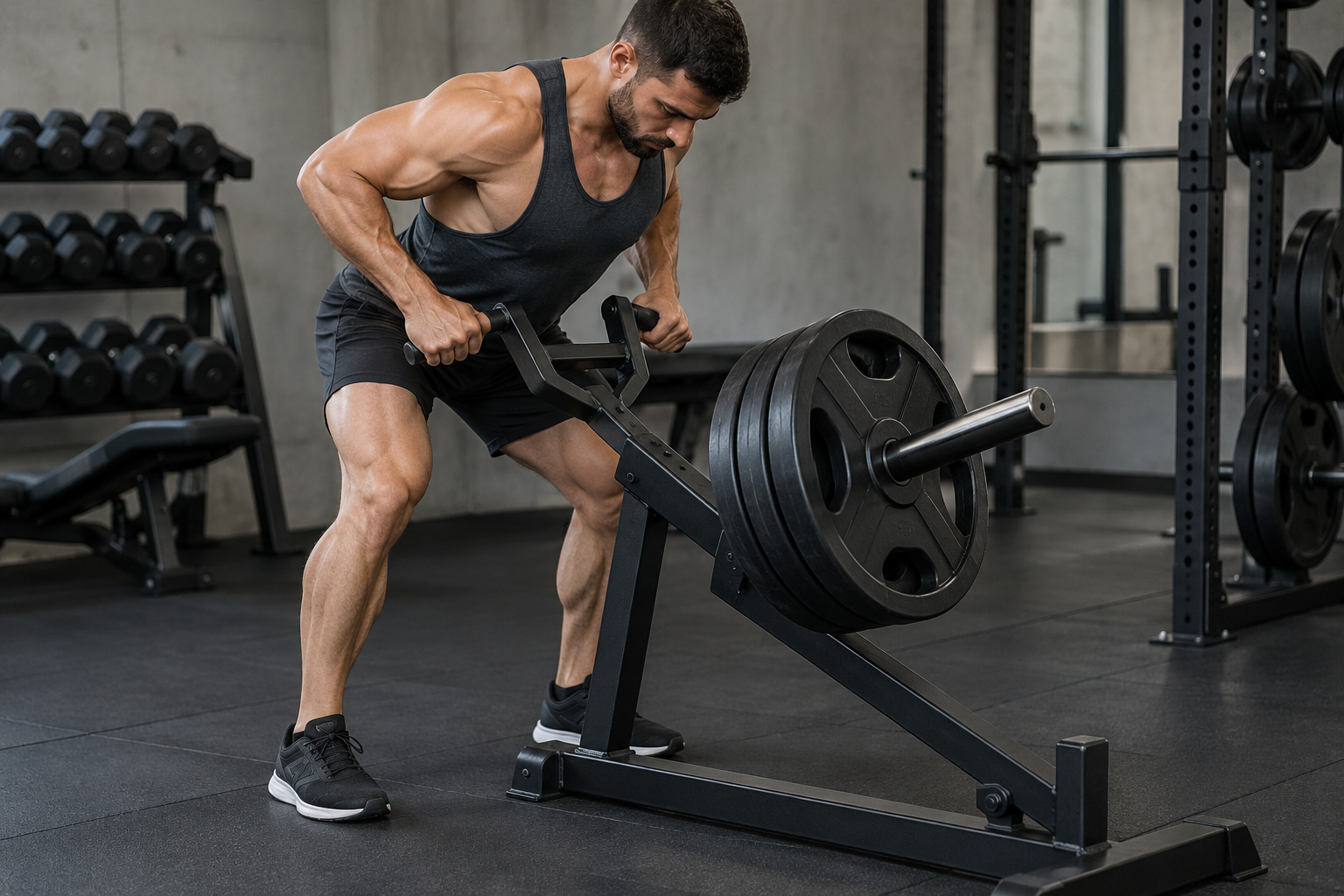
T-bar machine back exercises: technique and progressions for professional gyms
The T-bar machine is equipment used in strength training to perform rowing movements and develop back musculature. Thanks to a lever system that guides the load path, it allows for pulling exercises with different characteristics compared to free barbell rows. In professional gyms, it represents an interesting solution for integrating work for the lats, scapular muscles, and elbow flexors.
Properly planning T-bar machine back exercises requires attention to torso position, grip choice, range of motion, and load progression. The presence of a guided trajectory does not eliminate the need for precise technique. Inadequate adjustments or excessive resistance can modify the movement and reduce the quality of the muscular stimulus.
For a gym manager or purchasing manager, evaluating the T-bar machine also includes structural stability, loading system features, footprint, and ease of maintenance. This guide delves into the main exercises, biomechanical criteria, and programming methods, offering operational guidance for integrating the equipment into a professional strength room without basing the choice on a simple list of products.
- How a T-bar machine works
- Muscles involved in the T-bar machine row
- Positioning and machine adjustments
- Correct T-bar machine row technique
- Exercise variations and grips
- Programming, sets, and load progressions
- Common mistakes and safety during execution
- Criteria for choosing a professional T-bar machine
- Evaluating the weight room investment
How a T-bar machine works
The T-bar machine generally uses a lever arm connected to a pivot point. The user grabs the handles and lifts the load through a pulling movement, bringing the elbows toward the back of the body. Resistance can be generated by weight plates loaded onto a specific support or, in some configurations, by weight selection systems integrated into the machine.
Construction features vary between models. Some machines have a chest support that allows the torso to be stabilized during the row, while others require the athlete to maintain an inclined position autonomously. This difference changes the stabilization requirements and must be considered when choosing the exercise.
The load trajectory depends on the lever geometry and handle position. The movement does not necessarily coincide with that of a free row, as the machine imposes a defined path. The user's goal is to adapt their body position to the structure, maintaining a controlled pull compatible with their joint characteristics.
Lever system and resistance distribution
The lever system determines how resistance is transmitted during movement. In plate-loadable models, the load actually perceived also depends on the position of the weights relative to the fulcrum and the angle of the arm during the pull.
For this reason, the nominal weight of the plates does not necessarily correspond to the same perceived resistance on different machines. Comparing two pieces of equipment only through the loaded kilograms can therefore be less than significant.
T-bar machine with and without chest support
The chest support helps limit part of the work required to maintain an inclined torso. It can be useful when the main goal is to focus on the pulling of the upper limbs and dorsal musculature.
Versions without support, on the other hand, require greater control of the trunk and hip position. They are not automatically superior or inferior: the choice depends on the user's capabilities and program goals.
Muscles involved in the T-bar machine row
The T-bar machine row involves several upper body muscle groups. The latissimus dorsi participates in humerus movements, while the trapezius and rhomboids contribute to managing the shoulder blades. The posterior deltoid can also intervene significantly, especially in configurations that provide for a trajectory with the elbows relatively wide.
Elbow flexors, including the biceps brachii, brachialis, and brachioradialis, contribute to the pull. The forearms participate in maintaining the grip on the handles. In models without chest support, the trunk musculature and spinal extensors must also support the inclined position during the set.
The relative involvement of the muscles depends on hand position, elbow trajectory, and machine conformation. It is not correct to consider a certain grip capable of completely isolating a single muscle. Rowing remains a multi-joint movement in which multiple muscle groups collaborate.
Latissimus dorsi and pulling muscles
The latissimus dorsi contributes to humerus extension and adduction. During the row, its participation varies according to arm position and resistance direction.
A trajectory that keeps the elbows relatively close to the torso can change the demands compared to a row with wider elbows. The choice must in any case respect the path provided by the machine and the user's mobility.
Trapezius, rhomboids, and scapular stabilizers
The trapezius and rhomboids contribute to controlling the shoulder blades during the pull. Their activity allows for coordinating the movement of the shoulder girdle with that of the arms.
Adequate control does not require keeping the shoulder blades rigidly locked for the entire repetition. It is preferable to allow a natural and controlled scapular movement, compatible with the intended technique.
Positioning and machine adjustments
The starting position directly influences the quality of the exercise. Before loading the machine, the user must check the distance from the handles, foot stability, and any chest support adjustment. A correct configuration allows one to reach the handles without assuming forced postures.
In machines with front support, the chest should rest stably on the pad, without hindering breathing or excessively compressing the body. The position must allow the arms to move along the intended trajectory, maintaining an adequate range of motion.
In configurations without support, it is necessary to assume a controlled inclined position, maintaining a stable weight distribution on the feet. The torso angle depends on the structure and body proportions. It is not appropriate to impose identical inclination on all users without considering the equipment's characteristics.
Foot position and platform use
When the machine has a platform, the feet must be placed in the areas provided by the manufacturer. A stable base facilitates control of the pull and reduces the need to compensate through unwanted movements.
The width of the stance can be adapted within the limits allowed by the structure. The goal is to maintain balance and freedom of movement without interfering with the machine arm.
Chest support height and distance
In adjustable models, the pad must be positioned so as to support the torso without preventing shoulder movement. An adjustment that is too high or too low can modify the trajectory and make execution uncomfortable.
Before the training set, it is useful to perform a few repetitions with light load. This check allows identifying any positioning problems and correcting them before increasing the resistance.
Correct T-bar machine row technique
The T-bar row technique should start from a stable position, with the handles gripped firmly and arms extended according to the allowed range of motion. The pulling phase consists of bringing the handles toward the body through a coordinated movement of elbows, shoulders, and shoulder blades.
During the concentric phase, the user should avoid accelerating the load through torso jerks. In machines with chest support, contact with the pad must remain consistent with the instructions. The pull ends when the movement can be completed without marked compensations or loss of control.
The return phase requires a progressive accompaniment of the load. Letting the lever drop abruptly reduces the quality of the repetition and can generate unnecessary stress. A controlled speed allows for maintaining a more repeatable technique and better evaluating exercise intensity.
Correctly executing the pulling phase
The pull should start from a coordinated movement, without trying to lift the weight exclusively through elbow flexion. The user must follow the handle trajectory while keeping the body stable.
The final position depends on the machine's geometry. It is not necessary to bring the elbows as far back as possible if this requires shoulder or trunk compensations.
Controlling the eccentric phase
During the descent, the load must be accompanied toward the starting position. The arms can extend progressively, maintaining control of the scapular position and the torso.
If the lever drags the user or causes a loss of stability, the load might be too heavy. Reducing the resistance allows for restoring a more controlled trajectory.
Exercise variations and grips
T-bar machines can offer different grips, allowing for modification of hand position and elbow trajectory. Common configurations include neutral, pronated, and grips with different widths. Actual availability depends on the model.
Grip choice influences joint comfort and how force is applied. A narrow grip can accompany a trajectory with elbows relatively close to the body, while a wider grip can modify shoulder movement. These differences should not be interpreted as an absolute separation of the trained muscle groups.
Variations can be used to diversify programming, but they do not need to be changed frequently. To track progress, it is often useful to maintain a stable configuration for a sufficient period, recording loads and repetitions.
Narrow-grip row
The narrow grip can favor a trajectory where the elbows remain relatively close to the torso. The feeling of the movement still depends on the machine structure and handle position.
It is important to avoid excessively modifying posture to reach a certain width. Execution should remain compatible with the user's mobility and the guided trajectory.
Wide-grip row
A wider grip can modify elbow position and increase the relative contribution of some muscles in the upper back region. The variation must be performed only if provided for by the machine.
The usable load might differ compared to the narrow grip. For this reason, it is appropriate to record performance separately in different configurations.
Programming, sets, and load progressions
T-bar machine back exercises can be included in programs dedicated to strength, hypertrophy, and muscular conditioning. The choice of training variables must consider the user's level, goals, and the total volume of pulling expected for the week.
For a beginner, the initial goal should be to acquire a stable technique through moderate loads. Once the movement is consolidated, it is possible to progressively increase the number of repetitions or resistance. More experienced users can use the T-bar machine as a main exercise or as a complement to other forms of rowing.
Progression should be based on measurable criteria. Increasing the load is appropriate when the user is able to complete the planned repetitions while maintaining a consistent range of motion and adequate control. If the increment entails jerks or marked reductions in movement, it is preferable to maintain the previous resistance.
How to set sets and repetitions
For a general hypertrophy-oriented program, a practical possibility consists of initially using two or three sets of eight to twelve repetitions. The load should allow completing the work with a stable technique and an appropriate level of effort.
These values do not represent a universal rule. Athletes with more experience can use different patterns, provided they are consistent with the overall programming and recovery capacity.
Applying progressive overload
Progressive overload consists of gradually increasing the training demand. On the T-bar machine, it can be applied through load, repetition, or volume increments, maintaining a comparable technique between sessions.
It is useful to record plate weight, grip configuration, and number of repetitions. Since different machines can have different lever ratios, loads should preferably be compared on the same equipment.
Common mistakes and safety during execution
One of the most frequent mistakes is selecting excessive resistance, using torso movements to complete the pull. This behavior can modify the stimulus and make it difficult to maintain a repeatable technique. In models without chest support, control of the trunk position becomes particularly important.
Another mistake concerns the range of motion. Some users excessively reduce the range to use heavier loads, while others try to reach final positions incompatible with their own mobility. The goal should be to maintain a controlled movement, adequate for the machine and individual characteristics.
Safety also depends on the correct loading of plates and the state of the structure. Pins, supports, joints, and locking systems must be checked according to the manufacturer's instructions. Any anomalies require a check before continuing use.
Torso jerks and compensations
Jerks can allow for moving a load higher than what is manageable with a controlled technique. However, they make it harder to evaluate the work actually performed by the back musculature.
When marked compensations appear, it is appropriate to reduce resistance and restore a stable position. The goal should not be to move as much weight as possible regardless of movement quality.
Loading plates and machine checks
In plate-loadable models, the load must be distributed according to the manufacturer's instructions. When locking systems or safety devices are provided, they must be used correctly.
Before the set, it is necessary to verify that the plates are positioned stably and that the lever path is free. Abnormal noises, excessive play, or damaged components must be reported to the responsible personnel.
Criteria for choosing a professional T-bar machine
Choosing a professional T-bar machine should start from analyzing the activities offered by the gym. A generalist strength room can prioritize ease of use and accessible adjustments, while a structure dedicated to athletic preparation might attach more importance to the possibility of using high loads and different configurations.
Parameters to compare include frame stability, lever geometry, handle quality, chest support presence, and declared load capacity. The machine must be designed for the intended use and allow for execution compatible with users of different builds.
When comparing professional isotonic machines, the T-bar machine should be evaluated together with other pulling equipment. An effective choice considers the complementarity of available movements, avoiding the introduction of very similar stations without a real operational need.
Stability, materials, and construction quality
The frame must maintain stability during use and support the planned stresses. It is appropriate to check the declared capacity, connection characteristics, and the quality of components subject to movement.
The handles must offer a reliable grip and be compatible with the machine's trajectory. In models with chest support, the quality and resistance of the pads also contribute to overall functionality.
Maintenance and technical support
The joints of the lever system and connection points require periodic checks. Frequency and procedures must follow the manufacturer's instructions and consider the gym's intensity of use.
Before purchasing, it is useful to verify the availability of spare parts, warranty conditions, and the possibility of qualified support. A machine intended for continuous professional use must be kept efficient over time.
Evaluating the weight room investment
For a gym manager, purchasing a T-bar machine must be linked to the needs of the strength room. The equipment can expand back training possibilities, but its usefulness depends on the presence of interested users and complementarity with respect to stations already available.
The evaluation should include footprint, space required for plate loading, accessibility, and position relative to other machines. A loadable T-bar machine also requires proper organization of weights, avoiding leaving plates on the floor or in walkways.
The total investment cost does not coincide only with the purchase price. It is appropriate to consider installation, maintenance, any accessories, and expected operational life. The choice should be based on verifiable technical characteristics and the machine's ability to support daily use.
Integrating the T-bar machine into the back area
The T-bar machine can be placed near other stations dedicated to pulling, maintaining sufficient distances for access and movement. The layout must allow users to load and unload plates without interfering with adjacent equipment.
From a programming perspective, it can be used along with lat machines, dumbbell rows, and other back exercises. The combination must be defined by considering the total volume and the members' goals.
Defining priorities before purchase
The purchasing manager should establish which features are indispensable: chest support, adjustments, loading type, footprint, and load capacity. A comparative sheet allows for evaluating multiple solutions using homogeneous criteria.
It is also useful to involve instructors in the evaluation, as they will be responsible for supervision and including the exercises in programs. When possible, a practical test can help verify comfort, trajectory, and ease of use.
Investing in a professional T-bar machine means choosing equipment capable of offering an effective, repeatable pulling movement consistent with the gym's outfitting. A decision based on construction quality, technical requirements, and usage methods allows for enhancing T-bar machine back exercises within structured programs, contributing to the functionality of the weight room and the quality of the service offered to users.
Comments (0)