
Trolley
You have no items in your shopping cart

 Budgets
 Dumbers
 Discs
Discs
 Benches
 Racks and Rigs
 Weights Holders
 Isotonic machines
 Calisthenics
 Cardio
 Kettlebells
 Flooring
 Gym Set
 Accessories
 Combat
 ARTI MARZIALI
 CONTAINER GYM
 Tug-Of-War
 Used Gym Equipment
 PILATES MACCHINARI
 GINNASTICA ARTISTICA
 CAMPI DA PADEL
 Prodotti in Pronta Consegna
 Informazioni
 IRONMAN
 Gift Card
- Donatif
- General information
- 0 I like it
- 515 Views
- 0 comments
- gym flooring, safety flooring, gym safety, shock-absorbing materials
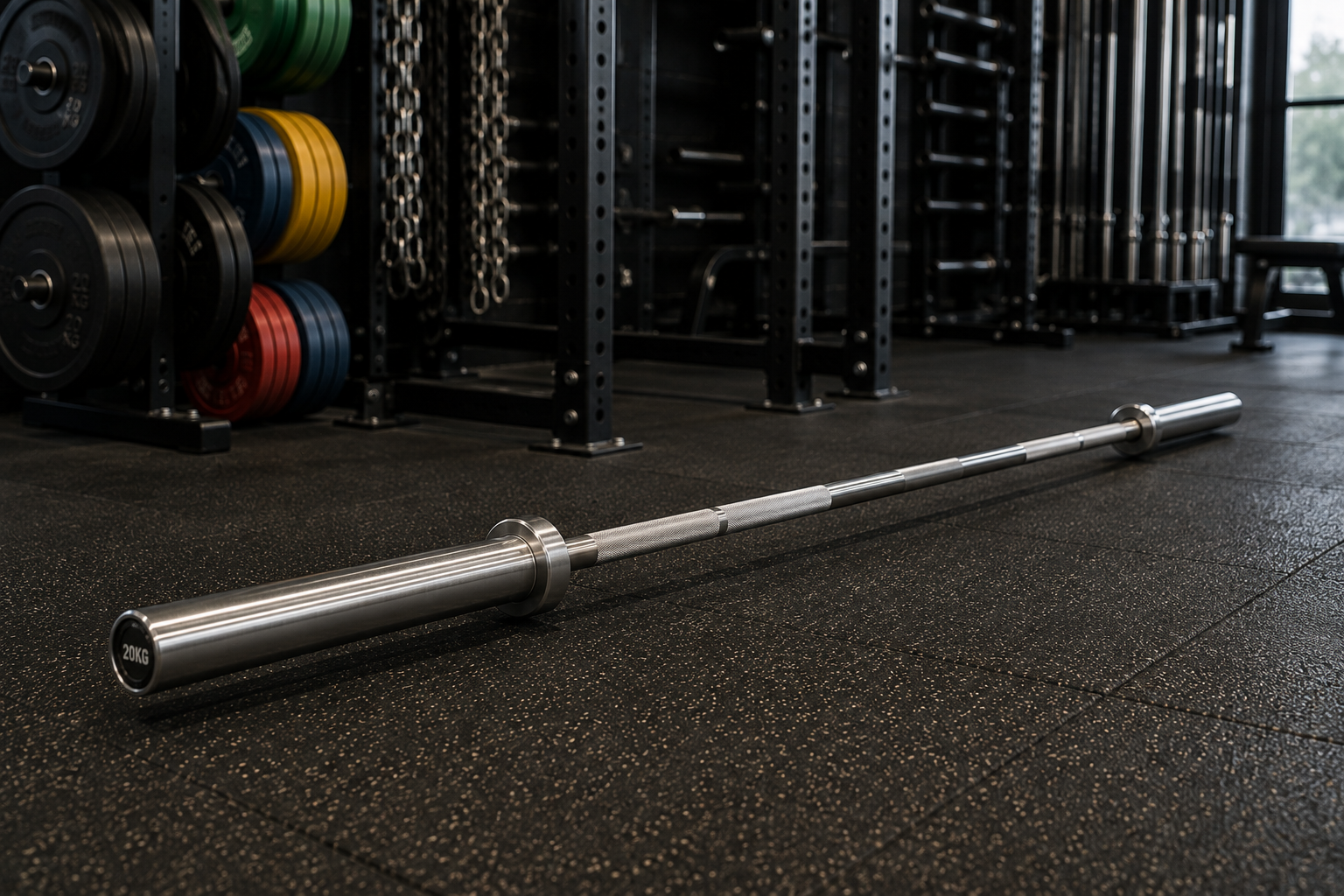
Olympic vs. Standard Barbell: Which diameter does your Home Gym really need?
When designing a home gym, one of the most important decisions concerns the choice of the barbell. Many enthusiasts focus exclusively on the stated maximum weight or the price, neglecting an element that will influence every future purchase: the diameter of the barbell and the compatible plates.
The choice between Olympic vs. standard barbell is not just about an aesthetic or dimensional difference. It means deciding which equipment ecosystem will accompany your workouts in the years to come, determining upgrade costs, compatibility with new accessories, safety during lifts, and the ability to progressively increase loads.
Those who wish to build a strength-oriented home gym should carefully evaluate every aspect before purchasing. An apparently economical decision today can translate into a much greater expense tomorrow, when it becomes necessary to replace the barbell, plates, and accessories to adapt to more advanced training levels.
Main differences between Olympic and standard barbells
The most obvious difference concerns the diameter of the sleeves intended for the plates. Standard models generally use a diameter of about 28 mm, while Olympic ones adopt 50 mm sleeves, the international standard used in professional gyms and competitions.
This distinction entails substantial differences in the design of the barbell. Olympic models integrate rotating sleeves, more robust construction, better materials, and a significantly higher load capacity compared to standard versions.
For those who wish to develop strength over time, understanding these differences means avoiding impulsive purchases destined to be replaced after a few months of use.
How the two standards were born
Standard barbells were designed for occasional home training, favoring low costs and simple construction. Olympic barbells, on the other hand, were developed to meet the needs of professional training and international competitions.
This different design philosophy explains why almost all professional equipment today uses the Olympic diameter.
Differences in daily use
During multi-joint exercises, the Olympic barbell offers greater stability, a more secure grip, and better load distribution. Rotating sleeves also reduce stress on wrists and elbows during dynamic movements.
Standard models are only suitable for light use and training programs with limited loads.
Why the diameter is so important
The diameter determines the entire compatibility of the equipment. Once a 28 mm or 50 mm system is purchased, every new plate must comply with that standard.
Many users discover too late that changing standards means simultaneously replacing the barbell, plates, and numerous accessories, significantly increasing the overall cost of the upgrade.
For this reason, the initial choice should be made thinking about future goals rather than just immediate needs.
The difference between 28mm and 50mm barbell
The difference does not only concern the hole of the plates. Rigidity, build quality, ability to absorb stress, and availability of compatible accessories change.
The Olympic standard also offers a much wider range of professional products available on the market.
Thinking about future developments
A home gym grows over time. New plates, supports, racks, bumper plates, and accessories are purchased progressively. Choosing the correct standard from the beginning avoids double expenses.
Those who plan long-term strength training generally derive greater benefit from an Olympic system.
Load capacity and performance
One of the most important aspects concerns the maximum manageable weight. Olympic barbells are designed to support very high loads while maintaining elasticity and safety.
Standard models, on the other hand, quickly reach their structural limit, especially during squats, deadlifts, and bench presses.
This aspect becomes decisive for those following strength progression programs.
Materials and resistance
The steel used in Olympic models generally has superior mechanical characteristics, ensuring greater durability and less deformation.
Better build quality also contributes to safety during intense workouts.
Importance of rotating sleeves
Rotating sleeves allow the plates to rotate independently of the barbell, improving fluidity and control of the movement.
This feature is particularly useful in explosive exercises but also offers benefits in traditional training.
Compatibility with plates and accessories
The availability of accessories represents one of the greatest advantages of the Olympic standard. Racks, supports, collars, bumper plates, and numerous other products are designed primarily for the 50 mm diameter.
The second-hand market also offers a much wider choice for Olympic equipment.
Those who invest in a professional standard today maintain greater flexibility in future purchases.
Choosing the correct gym plate diameter
Before buying new plates, it is essential to check the diameter of the center hole. A simple incompatibility makes it impossible to use them with your barbell.
This check avoids frequent errors during online purchases.
Available accessories
The Olympic standard allows you to choose from a significantly higher quantity of accessories dedicated to strength and powerlifting.
This makes it easier to customize your home gym over time.
Long-term cost analysis
Many choose the standard barbell to save money immediately. However, this assessment considers exclusively the initial price.
If goals evolve, the total cost of replacing the entire system often exceeds that of a higher initial investment.
Analyzing the total cost of ownership allows for much more informed decisions.
Apparent savings
Buying cheap today can mean spending twice tomorrow. Complete equipment replacement is one of the most frequent expenses in home gyms.
Initial planning significantly reduces this risk.
Value over time
Olympic equipment generally maintains better resale value on the second-hand market thanks to its universal compatibility.
This helps to preserve the value of the investment.
Which one to choose for a Home Gym
The answer depends on the goals. Those who wish to train occasionally with light loads may find a 28 mm standard sufficient.
Those who instead aim to build a complete gym, oriented towards strength and destined to grow over time, generally find greater convenience in the Olympic standard.
Before purchasing, it is also useful to evaluate the available space, future budget, and the possibility of integrating new equipment.
Beginner training
Beginners may be tempted by the lower price of standard kits, but they should also consider personal growth prospects.
Many users quickly increase loads during the first year of training.
Advanced training
For strength programs, powerlifting, or intensive workouts, a professional home barbell is almost always the most recommended choice.
It offers greater safety, durability, and potential for evolution.
The most common mistakes to avoid
The main mistake consists of evaluating exclusively the initial price without considering the overall home gym project.
Another frequent mistake concerns the purchase of incompatible plates or accessories not suitable for the chosen standard.
Careful planning avoids financial waste and improves the training experience.
Thinking only about cost
Qualitative differences emerge especially after months of intensive use.
Investing in better products reduces replacements and maintenance.
Neglecting compatibility
Every new purchase should be evaluated considering the entire equipment ecosystem.
This approach makes the gym more versatile and easily expandable.
How to evaluate the best investment
The choice of the barbell should reflect a long-term vision. Considering only the initial cost means ignoring future compatibility, equipment durability, and the possibility of progressively increasing loads.
For those who wish to build a complete and professional home gym, moving towards the Olympic standard represents in most cases a more sustainable decision. Exploring the features of the different solutions available at home gym equipment allows you to compare products designed to accompany the growth of your training over time.
Evaluating materials, load capacity, compatibility, and build quality allows you to turn the purchase of the barbell into an investment destined to last many years, reducing the risk of premature replacements and ensuring a safer, more effective, and satisfying training experience.
Comments (0)