
Trolley
You have no items in your shopping cart

 Budgets
 Dumbers
 Discs
Discs
 Benches
 Racks and Rigs
 Weights Holders
 Isotonic machines
 Calisthenics
 Cardio
 Kettlebells
 Flooring
 Gym Set
 Accessories
 Combat
 ARTI MARZIALI
 CONTAINER GYM
 Tug-Of-War
 Used Gym Equipment
 PILATES MACCHINARI
 GINNASTICA ARTISTICA
 CAMPI DA PADEL
 Prodotti in Pronta Consegna
 Informazioni
 IRONMAN
 Gift Card
- Donatif
- General information
- 0 I like it
- 737 Views
- 0 comments
- gym flooring, safety flooring, gym safety, shock-absorbing materials
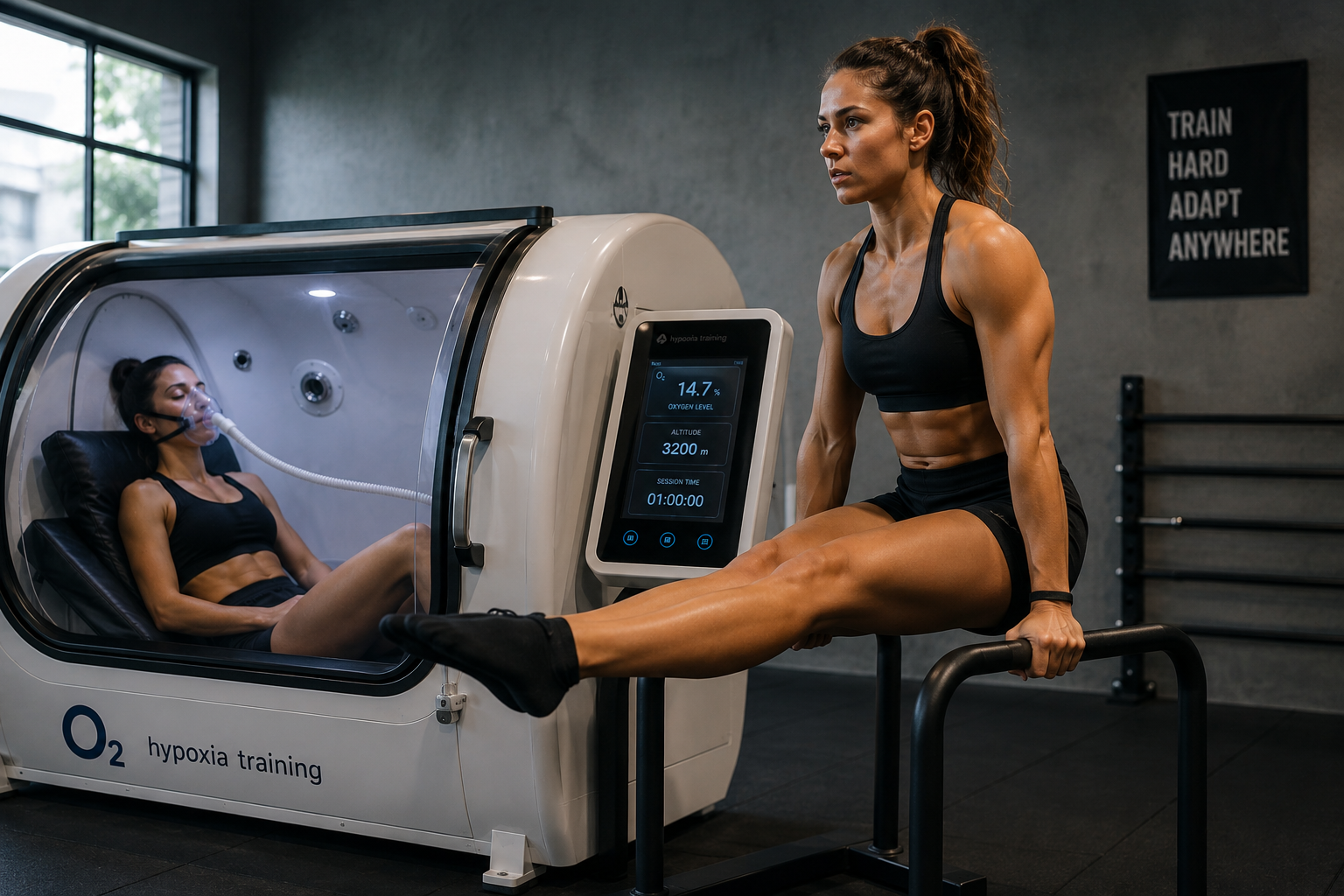
Integrating hypoxia and calisthenics: new frontiers for performance
Calisthenics represents one of the most interesting disciplines in the modern training landscape because it combines strength, motor control, mobility, and the ability to manage one's body in space. Movements like the planche, front lever, muscle-up, and handstands require a high level of neuromuscular coordination, as well as a great capacity to maintain muscle tension for prolonged periods.
In recent years, the integration of bodyweight training and simulated high-altitude environments has opened new possibilities for athletes who want to improve the quality of their sessions. The use of controlled hypoxia allows for the introduction of an additional stimulus within programming, modifying the physiological context in which the training is performed.
The combination of hypoxic calisthenics and dedicated facilities allows for the exploration of new strategies to increase training density, improve fatigue management, and develop greater body awareness. Understanding how this approach works allows advanced enthusiasts to more accurately evaluate the value of a hypoxic environment applied to the discipline.
- Principles of integrating hypoxia and calisthenics
- Physiological effects of bodyweight training at simulated altitude
- Muscular endurance and isometric strength in hypoxia
- Benefits of hypoxia for calisthenics athletes
- How to organize calisthenics sessions in a hypoxic environment
- The role of advanced indoor calisthenics facilities
- Hypoxia and performance: an approach for advanced athletes
- A new training model for modern calisthenics
Principles of integrating hypoxia and calisthenics
Hypoxic training consists of performing physical activity in an environment where oxygen availability is modified through specific technological systems. Unlike a simple increase in perceived difficulty, the hypoxic environment acts on the context to which the body must adapt during exertion.
In calisthenics, this element can be particularly interesting because many exercises require prolonged muscle contractions, breath control, and the ability to maintain high levels of tension without continuous movement. Hypoxia therefore introduces an additional variable in the management of effort.
The ability to use a controlled environment allows for more precise exposure programming compared to natural conditions that are not easily replicable. The athlete can focus on the technical quality of the movement while keeping external conditions constant.
The unique characteristics of calisthenics
Calisthenics requires a specific relationship between relative strength, body control, and muscular endurance. Unlike disciplines based primarily on lifting external loads, every movement depends on the athlete's ability to coordinate multiple muscle groups simultaneously.
Elements such as long levers, static positions, and complex transitions require high efficiency in the production and maintenance of strength.
Hypoxia as an additional stimulus
The hypoxic environment does not replace traditional technical work, but can be integrated as a complementary tool. The goal is to create new training conditions that allow the athlete to develop capabilities useful for their discipline.
Correct management of the stimulus is fundamental to avoid compromising the quality of movement and to maintain high attention to technique.
Physiological effects of bodyweight training at simulated altitude
Training at simulated altitude modifies the context in which the cardiovascular and muscular systems must work. The lower availability of oxygen represents a stimulus that can influence the perception of effort and the strategies with which the body manages physical activity.
For calisthenics athletes, this aspect can be interesting because many skills require the ability to maintain high performance even when fatigue increases progressively.
The integration of hypoxia must, however, be inserted within a balanced program, considering volume, intensity, and recovery.
Adaptations of the organism
Controlled exposure to hypoxia stimulates a series of physiological responses related to oxygen management. These adaptations are one of the elements that make the use of hypoxic environments in sports interesting.
In the context of calisthenics, the goal is not only to improve an isolated parameter, but to develop a greater capacity to sustain technically demanding sessions.
Managing muscular fatigue
Many advanced exercises require precise control even in the final phases of a set, when fatigue tends to reduce the quality of movement.
Training in hypoxic conditions can represent a stimulus to improve the ability to perceive and manage effort during prolonged activities.
Muscular endurance and isometric strength in hypoxia
One of the most interesting aspects of the relationship between calisthenics and hypoxia concerns isometric work. Positions such as the planche, front lever, and handstand require static contractions maintained over time, where the ability to control muscle tension is fundamental.
Isometric endurance in hypoxia can be considered a strategy to increase the environmental difficulty of training, creating an additional stimulus during already highly demanding exercises.
The goal is not simply to resist longer, but to develop a better capacity to organize effort and maintain technical precision even in more complex conditions.
Planche and tension control
The planche represents one of the iconic exercises of advanced calisthenics because it requires shoulder strength, core, wrists, and a remarkable capacity for coordination.
A hypoxic environment can be used as part of a broader strategy to train fatigue management during work characterized by high muscle tension.
Front lever and maintenance capacity
The front lever requires constant control of body position and strong activation of the posterior chain.
Including specific sessions in a hypoxic environment can offer a new stimulus to athletes who have already developed a good technical base.
Benefits of hypoxia for calisthenics athletes
The use of hypoxia in calisthenics can offer several advantages, especially for those who have already reached intermediate or advanced levels and are looking for new tools to improve their preparation.
One of the main aspects concerns the possibility of increasing the complexity of the stimulus without necessarily modifying the chosen exercises.
This allows for working on training quality while maintaining focus on the specific movements of the discipline.
Increased training density
Bodyweight altitude training can be used to introduce a greater physiological demand within the session.
The management of recovery times and intensity thus becomes a central element in programming.
Stimulus for advanced athletes
When an athlete reaches a high level, improvements often require more sophisticated strategies.
The hypoxic environment represents a possibility to expand the available tools without abandoning the fundamental principles of calisthenics.
How to organize calisthenics sessions in a hypoxic environment
The programming of hypoxic training must be built carefully to maintain high technical quality. Calisthenics is a discipline in which the precision of movement is fundamental, so the introduction of an additional stimulus must be managed gradually.
An effective approach involves a clear definition of the session's objectives and a choice of exercises consistent with the athlete's level.
The controlled environment allows for greater flexibility because it allows conditions to be adjusted based on the individual's path.
Stimulus progression
Like any element of training, hypoxia should also be introduced progressively.
Personalization allows for maintaining a balance between stimulus and recovery.
Maintaining technical quality
Technique remains the priority parameter in calisthenics. An exercise performed poorly loses much of its value.
For this reason, hypoxia must be used as a support and not as an element that compromises execution.
The role of advanced indoor calisthenics facilities
The spread of facilities dedicated to indoor calisthenics is creating new opportunities to integrate advanced technologies within training spaces.
A facility designed for advanced athletes can combine modular equipment, functional areas, and innovative systems to create more complete experiences.
Integration with hypoxic environments represents a possible evolution for those who want to offer solutions dedicated to performance.
Modularity and personalization
Modern facilities must adapt to the needs of users with different levels.
Modularity allows for the creation of spaces that are more efficient and oriented toward progression.
Creating a performance environment
A correctly designed environment influences the quality of the athlete's experience.
The union of technology and space organization can become a distinctive element.
Hypoxia and performance: an approach for advanced athletes
The integration of hypoxia into calisthenics represents an interesting frontier for those looking for new tools for improvement.
It is not about replacing the fundamentals of the discipline, but about adding a component capable of enriching the programming.
More advanced athletes can use this approach to experiment with new ways of working on endurance and effort management.
A distinctive element for the community
Modern calisthenics is characterized by a strong culture of belonging and a continuous search for performance.
The use of advanced technologies can become part of a path oriented toward excellence.
The future of integrated training
The combination of bodyweight discipline and controlled environments opens new perspectives.
Technology can support athletes in the search for increasingly personalized methods.
A new training model for modern calisthenics
The integration of hypoxia and calisthenics offers a new perspective for athletes who want to expand their training possibilities. The controlled environment allows for the introduction of an additional stimulus while maintaining focus on the quality of movement.
From isometric endurance to fatigue management, hypoxia can become a complementary tool within an advanced and personalized program.
For those who consider calisthenics not just a workout but a path of technical and physical growth, the use of innovative solutions represents a possibility to explore new frontiers of performance.
Comments (0)