
Trolley
You have no items in your shopping cart

 Budgets
 Dumbers
 Discs
Discs
 Benches
 Racks and Rigs
 Weights Holders
 Isotonic machines
 Calisthenics
 Cardio
 Kettlebells
 Flooring
 Gym Set
 Accessories
 Combat
 ARTI MARZIALI
 CONTAINER GYM
 Tug-Of-War
 Used Gym Equipment
 PILATES MACCHINARI
 GINNASTICA ARTISTICA
 CAMPI DA PADEL
 Prodotti in Pronta Consegna
 Informazioni
 IRONMAN
 Gift Card
- Donatif
- General information
- 0 I like it
- 79 Views
- 0 comments
- gym flooring, safety flooring, gym safety, shock-absorbing materials
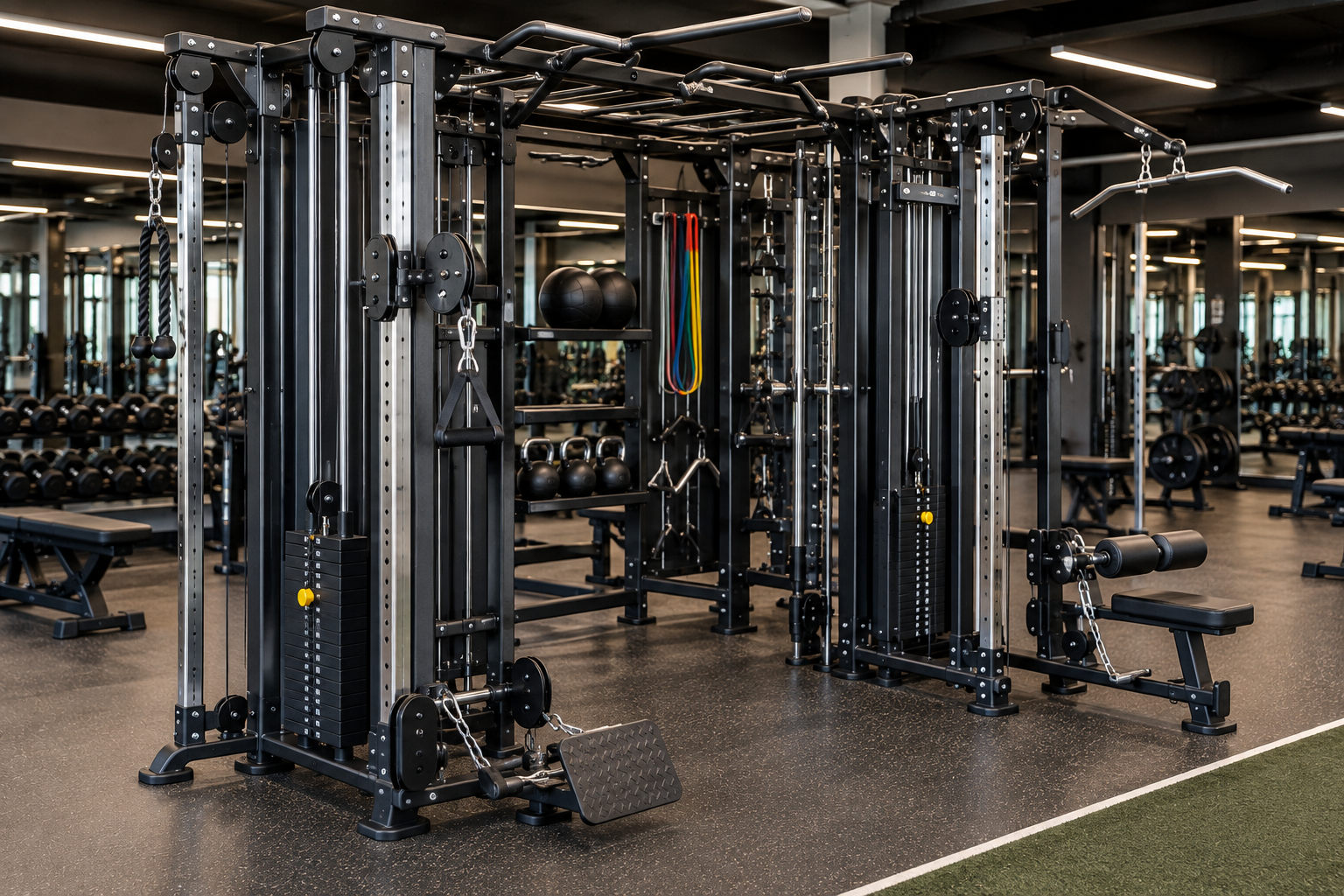
Jungle machine in a professional gym: flows, installation and total cost
A jungle machine represents a multi-function station designed to allow simultaneous training of multiple users through connected modules and dedicated weight stacks. When designing a professional gym, the choice should be based on verifiable criteria such as number of stations, available space, configuration, ease of maintenance and total cost of ownership, rather than exclusively on the purchase price.
For fitness center managers, the jungle machine can help improve the organization of the isotonic area, optimizing training flows and reducing waiting times during peak hours.
This guide analyzes the main aspects to consider when designing a professional gym with a jungle machine, focusing on layout, installation, configuration and evaluation of the overall investment cost.
- What requirements must it have?
- How to design space and flows
- How to choose the configuration
- Installation and technical requirements
- How to evaluate the total cost
- Design errors to avoid
- Verification table
- How to plan the investment
What requirements must a professional jungle machine have?
A machine intended for intensive use should offer a robust structure, intuitive adjustment systems, weight stacks appropriate to the context of use, and easily accessible components for maintenance.
Before purchasing, it is advisable to check the manufacturing quality, availability of spare parts, technical documentation and the presence of complete instructions for installation and maintenance.
The modularity of the configuration is also an important element, especially in gyms that foresee future expansions of the isotonic area.
How many stations are needed?
The number of stations should be defined by analyzing the number of users simultaneously present in the weight area, the type of training proposed and the organization of the sessions.
Why evaluate weight stacks?
The configuration of the weight stacks affects the practicality of use and the daily management of the machine. The actual characteristics must be verified in the manufacturer's technical documentation.
How to design space and training flows?
The layout should allow easy passage of users, maintain safety areas around the machine, and favor simultaneous use without interference between the various positions.
Before installation, it is advisable to analyze the gym floor plan by checking dimensions, main paths and access areas.
Correct flow design helps distribute users better during peak hours.
How much space should be considered?
It is necessary to evaluate not only the dimensions of the machine but also the operational space required for using all stations simultaneously.
Is it suitable for circuits?
A multi-function configuration can facilitate the organization of training circuits when the gym layout is designed in a coherent manner.
How to choose the most suitable configuration?
The configuration should be selected based on the number of users, the type of training proposed and the available space.
It is useful to check which modules are integrated into the machine, the possibility of adding accessories and the potential expandability of the system.
For an overview of dedicated equipment, you can consult the isotonic machines category.
Are accessories important?
Yes. Compatibility with the accessories provided by the manufacturer can broaden the usage possibilities of the machine.
Is it worth planning for future expansion?
If the facility anticipates fitness area growth, a modular solution can facilitate any expansions without replacing the entire system.
What aspects to consider during installation?
Installation should be carried out following the manufacturer's instructions and verifying the compatibility of the environment with the technical requirements of the machine.
Before assembly, it is advisable to check room height, accessibility, bearing capacity of the support surface, and availability of the planned operational space.
The flooring should also be suitable for installation according to what is indicated in the technical documentation.
Why follow the manual?
The manufacturer's instructions define assembly procedures, initial checks and subsequent controls necessary for correct use.
Is a check needed after installation?
It is advisable to check tightenings, adjustments and correct functioning of the stations before making the machine available to users.
How to evaluate the total investment cost?
The overall cost does not coincide with the purchase price alone. Installation, scheduled maintenance, any spare parts, machine downtime and operational management must also be considered.
Evaluating the total cost of ownership makes it possible to compare seemingly similar configurations using more comprehensive criteria.
The availability of technical assistance and documentation represents an additional element to include in the evaluation.
What costs are often underestimated?
Maintenance, replacement of wear-and-tear components and organization of scheduled interventions affect equipment management in the long term.
Why check spare parts?
The availability of replacement components can reduce downtime and facilitate the operational continuity of the gym.
What design errors to avoid?
One of the most common errors consists of choosing a configuration without evaluating actual user flows and required operational spaces.
It is also advisable to avoid installations that limit passageways or make access to the various stations difficult.
Neglecting maintenance, component accessibility and expansion possibilities can affect the future management of the facility.
Why size the area correctly?
Correct sizing helps maintain orderly paths and facilitate the simultaneous use of the different positions.
How much does technical documentation matter?
Manuals, technical data sheets and installation instructions represent the main reference for verifying requirements, maintenance and operating modes.
Compact evaluation table
| Criterion | What to check |
|---|---|
| Number of stations | Compatibility with user flow |
| Dimensions | Size and operational space |
| Weight stacks | Available configuration |
| Layout | Paths and accessibility |
| Maintenance | Spare parts and component access |
| Documentation | Manuals and technical instructions |
This table allows different configurations to be compared using practical and verifiable criteria before making the investment.
Definitve characteristics must always be confirmed through the manufacturer's official technical documentation.
What sources to consult?
Installation manuals, technical documentation, maintenance instructions and manufacturer data sheets represent the primary sources to verify configuration, requirements and operating modes of the machine.
What elements to compare between models?
Number of stations, modularity, ease of maintenance, availability of spare parts, dimensions, accessibility and completeness of technical documentation are useful criteria for an objective evaluation.
How to properly plan the investment?
The choice of a jungle machine should be integrated into an overall project that considers usage flows, available space, configuration of the isotonic area and management costs over time. Preliminary analysis makes it possible to identify the solution most consistent with the gym's needs without relying exclusively on the initial price.
Before purchasing, it is advisable to prepare a checklist including dimensions, number of stations, weight stack characteristics, simplicity of maintenance, availability of spare parts and technical documentation. This approach allows different configurations to be compared with concrete and verifiable criteria.
FAQ
How many stations should a professional jungle machine have? It depends on the number of users, the gym layout and the organization of training sessions.
How much space is needed? It is necessary to consider both the dimensions of the machine and the operational area required to use all planned positions.
What costs to evaluate besides the purchase? Installation, maintenance, spare parts, technical assistance and operational management contribute to the total cost of ownership.
What is the most important document? The manufacturer's manual and technical documentation represent the main reference for installation, use and maintenance of the machine.
Comments (0)