
Trolley
You have no items in your shopping cart

 Budgets
 Dumbers
 Discs
Discs
 Benches
 Racks and Rigs
 Weights Holders
 Isotonic machines
 Calisthenics
 Cardio
 Kettlebells
 Flooring
 Gym Set
 Accessories
 Combat
 ARTI MARZIALI
 CONTAINER GYM
 Tug-Of-War
 Used Gym Equipment
 PILATES MACCHINARI
 GINNASTICA ARTISTICA
 CAMPI DA PADEL
 Prodotti in Pronta Consegna
 Informazioni
 IRONMAN
 Gift Card
- Donatif
- General information
- 0 I like it
- 524 Views
- 0 comments
- gym flooring, safety flooring, gym safety, shock-absorbing materials
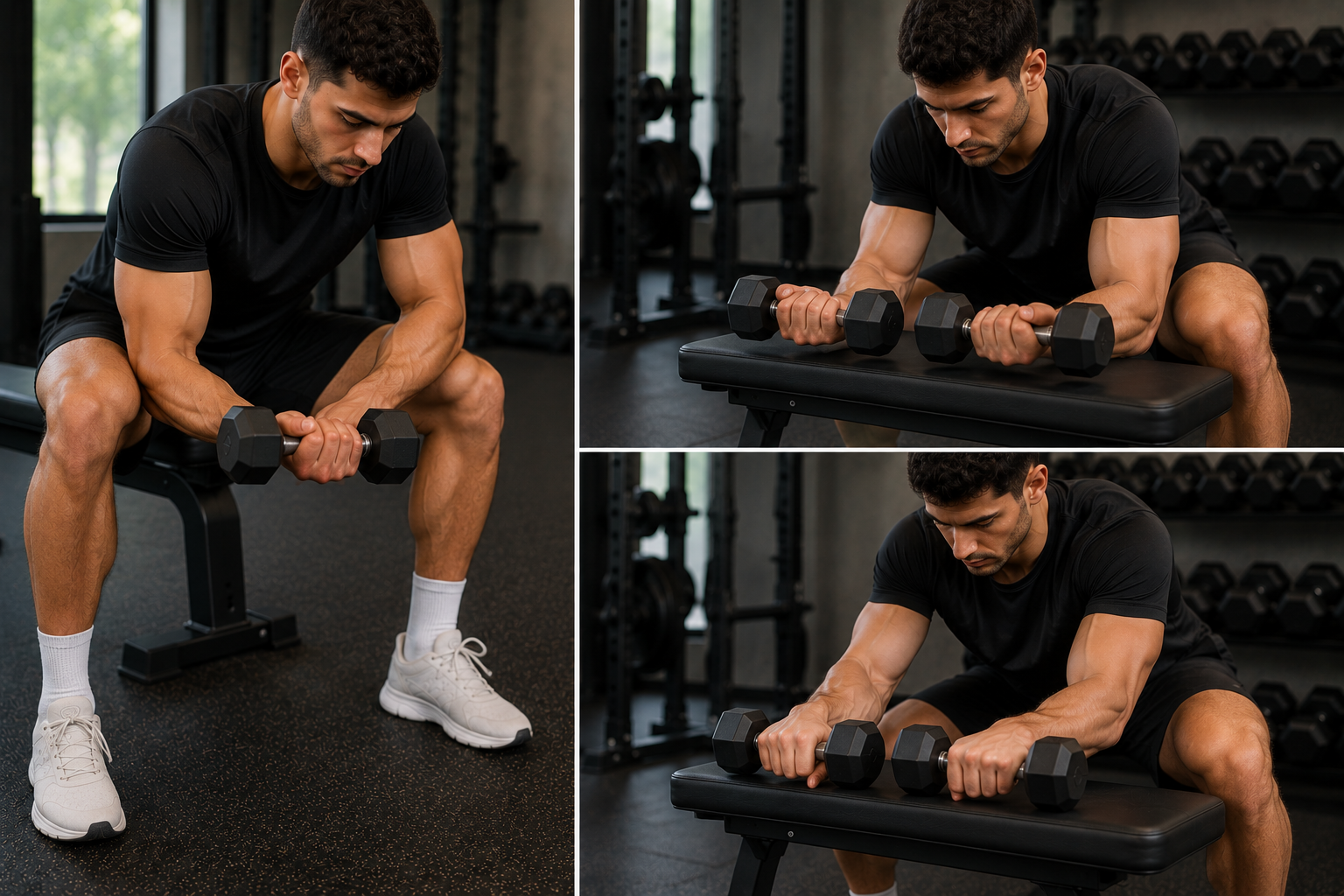
Forearm exercises with dumbbells: increase grip and strength for better lifts
Forearms are one of the most underrated muscle areas in strength training, but they represent a fundamental link between the weight being lifted and the body's ability to control it. A weak grip can limit performance in important exercises such as deadlifts, pull-ups, rows, and movements with heavy loads, even when other muscle groups possess sufficient strength to complete the work.
Dumbbell forearm exercises allow you to specifically develop muscles that are often neglected, improving the ability to squeeze, stabilize, and maintain control of the load. Through targeted protocols, it is possible to train wrist flexors, extensors, and muscles involved in grip using simple but extremely effective tools.
For athletes, powerlifting enthusiasts, and people who want to improve their overall performance, building strong forearms means eliminating a possible weak point in the muscular chain. A more solid grip allows you to better utilize overall strength and increase the quality of your workouts.
- Why train forearms with dumbbells
- Anatomy and function of the forearms
- Best dumbbell forearm exercises
- Developing grip strength
- Dumbbell farmer's walk and grip training
- Programming an effective forearm workout
- Common mistakes in grip training
- Turning grip into a strength advantage
Why train forearms with dumbbells
Many training programs focus primarily on the chest, back, legs, and shoulders, leaving the forearms with a secondary role. However, these muscles participate in almost every exercise where it is necessary to grip a load. Their ability to resist fatigue directly influences the quality of execution.
Using dumbbells to train the forearms offers several advantages because it allows for controlled movements and greater freedom compared to some guided machines. Each hand must work independently, improving stability and coordination.
For those who practice strength-oriented training, dedicating attention to grip can make the difference in progress. A limitation in the forearms can, in fact, prevent you from fully expressing the strength of larger muscles.
The role of grip in strength exercises
The grip is the direct point of contact between the athlete and the equipment. If this connection is not sufficiently strong, the body cannot transfer all the available force to the movement.
In exercises like the deadlift, a resistant grip allows you to hold the barbell longer and focus more on the production of force by the posterior chain.
Advantages of specific training
Directly training the forearms allows you to develop capabilities that are often not stimulated enough with traditional exercises. A targeted program can improve grip endurance, wrist control, and the ability to hold heavy loads.
These improvements have a positive impact on both sports activities and daily tasks that require manual strength.
Anatomy and function of the forearms
The forearms include numerous muscles with different functions. Some are responsible for closing the hand and grip strength, while others control extension, flexion, and wrist stabilization.
Knowing this structure helps to understand why a complete workout should not be limited to a single movement. To develop balanced forearms, it is necessary to work on multiple directions and capabilities.
Dumbbells are effective tools precisely because they allow you to perform specific exercises for every muscle function.
Wrist flexors and extensors
Wrist flexors are involved in closing movements and contribute to the strength needed to maintain a firm grip. Extensors, on the other hand, control the opposite part of the movement and help stabilize the joint.
Training both groups allows you to create greater balance and reduce muscle imbalances.
Forearms and load stability
During a dumbbell exercise, the forearm serves not only to squeeze the weight but also to keep it stable. Good control capability improves the precision and safety of the movement.
This aspect becomes particularly important when intensity and loads used increase.
Best dumbbell forearm exercises
Dumbbell exercises dedicated to the forearms can be inserted at the end of a strength session or within a specific program for grip. The key is to use controlled movements and choose loads appropriate to the muscle's function.
Unlike other muscle groups, the forearms can often tolerate a higher training frequency, but they must still be managed judiciously to avoid overloading.
A combination of flexion, extension, and isometric holding exercises allows you to develop complete capability.
Dumbbell wrist curls
The dumbbell wrist curl is one of the most well-known exercises for training wrist flexors. It is performed by keeping the forearm stable and focusing the movement on the final part of the joint.
The quality of execution is more important than the weight used, because the movement must remain controlled throughout the contraction phase.
Reverse wrist curl and wrist control
The reverse wrist curl allows you to work more on the forearm extensors. This exercise helps to create balance between the different muscle groups involved in hand stability.
Including it in a complete program helps to build a more resistant and functional grip.
Developing grip strength
Grip strength exercises represent a fundamental capability for those who want to improve in strength disciplines. A strong grip allows you to better control the load and reduce the risk that hand limitation becomes the factor that interrupts a set.
Developing grip requires both dynamic exercises and static work, because in sports practice, it is often necessary to hold a weight steady for several seconds.
With dumbbells, it is possible to create numerous stimuli simply by modifying the execution mode, duration, and intensity.
Static grip with dumbbells
Holding heavy dumbbells motionless for a set time is one of the simplest methods to train grip endurance. This type of work simulates many situations present in strength sports.
The difficulty increases progressively with heavier loads or longer holding times.
At-home grip strength training
An effective at-home grip strength training can be achieved without specific machines. Dumbbells allow you to perform holding exercises, loaded walks, and controlled movements even in small spaces.
This accessibility makes grip a capability that can be trained practically anywhere.
Dumbbell farmer's walk and grip training
The farmer's walk is one of the most complete exercises for developing grip, forearms, and general stabilization capability. The movement consists of walking while holding two loads at the sides of the body, focusing on posture control and muscular endurance.
This exercise is frequently used by strength athletes because it simultaneously involves the hands, forearms, shoulders, core, and legs.
The simplicity of the movement hides high effectiveness, especially when performed with well-structured progressions.
Dumbbell farmer's walk: technique and progression
The dumbbell farmer's walk requires a stable posture, controlled shoulders, and a continuous grip throughout the path. The body must remain aligned, avoiding compensations caused by fatigue.
To increase the difficulty, you can increase the distance, time under tension, or weight used.
Why the farmer's walk is a complete exercise
In addition to grip, the farmer's walk develops capabilities useful in many sports disciplines. The need to stabilize heavy loads while walking creates a global stimulus.
For this reason, it is considered an effective tool for improving overall strength.
Programming an effective forearm workout
A program dedicated to the forearms must be organized considering frequency, intensity, and recovery. Even if these muscles are used to working daily, excessive volume can cause fatigue.
The goal must be to build capability progressively, without turning the workout into a random accumulation of exercises.
Consistency over time is the most important factor for achieving visible improvements.
Training frequency and volume
Forearms can be trained multiple times during the week, especially with moderate exercises. However, the frequency must be adapted to the rest of the program to avoid interference with other movements.
A correct balance allows you to improve grip without compromising recovery.
Load progression for forearms
As with any other muscle group, forearms also require progression. Gradually increasing the weight, holding time, or number of repetitions allows you to create new stimuli.
The progression must always respect the technical quality of the movement.
Common mistakes in grip training
Many athletes make mistakes when trying to improve their grip, especially by increasing the load too quickly. Hand strength must develop progressively like any other physical capability.
A correct approach allows you to obtain better results while avoiding problems related to excessive overloading.
Knowing the most frequent mistakes helps to build a more effective path.
Using loads that are too heavy
Excessive weight can turn a grip exercise into an uncontrolled movement. The quality of the contraction and position must remain a priority.
Improvement comes from the ability to apply tension correctly.
Neglecting recovery
Forearms also need recovery to adapt to the stimuli received. Ignoring this aspect can reduce performance in main exercises.
Intelligent management allows you to train grip while keeping the overall quality of the program high.
Turning grip into a strength advantage
Training forearms with dumbbells represents an effective strategy for improving one of the most important components of physical performance. A strong grip allows you to better utilize your overall strength and tackle demanding exercises with greater confidence.
Through specific exercises such as wrist curls, holding work, and farmer's walks, it is possible to build more resistant and functional forearms without the need for complex equipment.
For athletes and enthusiasts who want to improve their performance, investing in grip training means eliminating a hidden limit and creating a more solid foundation for every future progress.
Comments (0)