
Trolley
You have no items in your shopping cart

 Budgets
 Dumbers
 Discs
Discs
 Benches
 Racks and Rigs
 Weights Holders
 Isotonic machines
 Calisthenics
 Cardio
 Kettlebells
 Flooring
 Gym Set
 Accessories
 Combat
 ARTI MARZIALI
 CONTAINER GYM
 Tug-Of-War
 Used Gym Equipment
 PILATES MACCHINARI
 GINNASTICA ARTISTICA
 CAMPI DA PADEL
 Prodotti in Pronta Consegna
 Informazioni
 IRONMAN
 Gift Card
- Donatif
- General information
- 0 I like it
- 765 Views
- 0 comments
- gym flooring, safety flooring, gym safety, shock-absorbing materials
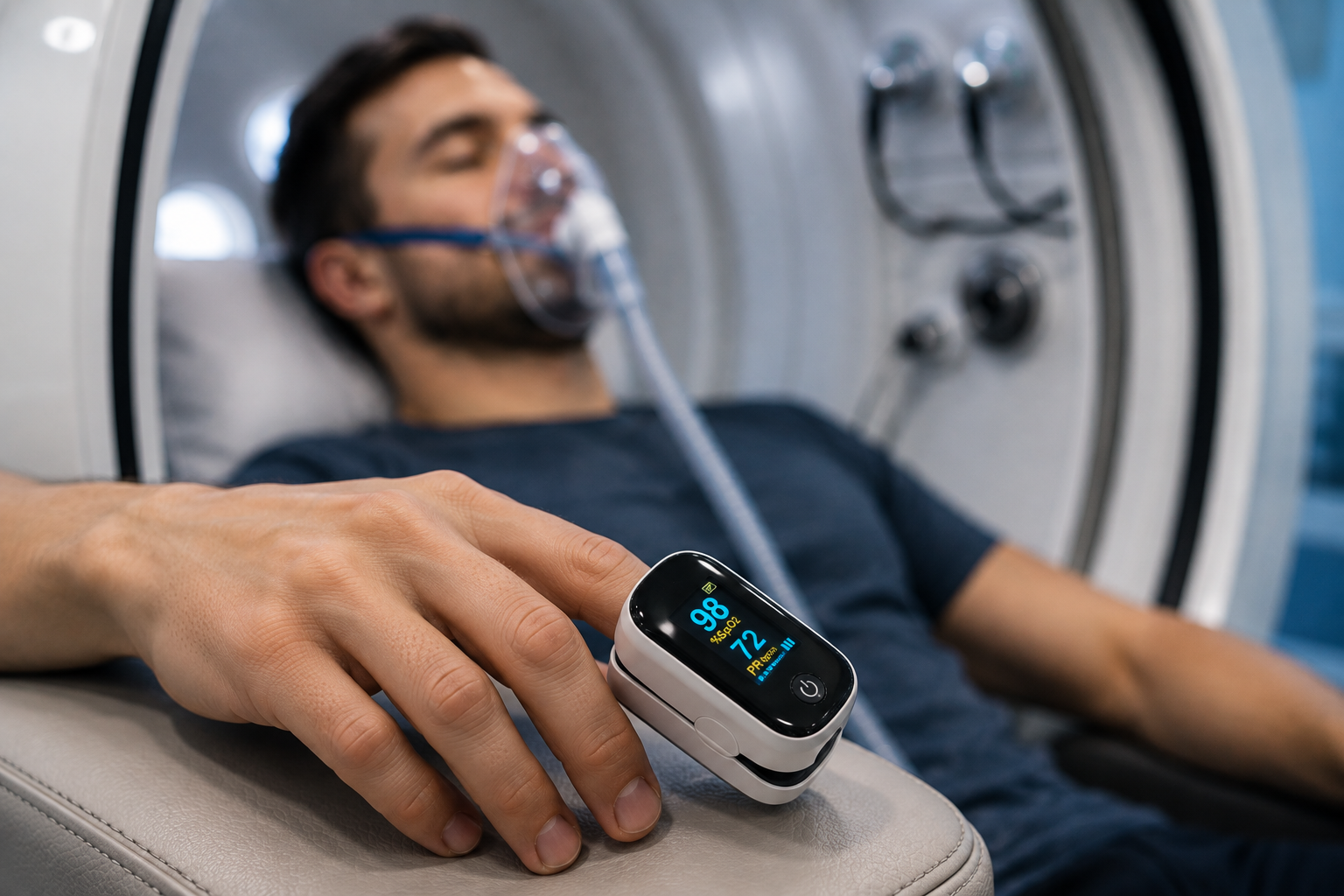
Professional Pulse Oximeters: real-time monitoring in hypoxia
During hypoxic training, the quality of decisions depends on the quality of the data collected. Controlled oxygen reduction represents a precise stimulus that must be monitored with reliable instruments, especially when the athlete is working near their limits or when a coach uses physiological information to modify the training program.
Among the most important tools for assessing the body's response are professional pulse oximeters, devices designed to detect peripheral oxygen saturation in the blood and provide useful information during sessions. In a hypoxic context, the speed and reliability of the measurement can make the difference between precise protocol management and an assessment based on incomplete data.
The choice of the correct device should not be based solely on the presence of the SpO2 function. Sensor precision, reading speed, signal stability, and reliability during movement are fundamental characteristics for those who use hypoxia as a performance tool. Understanding the differences between a simple consumer device and a professional system allows for the creation of a more controlled training environment.
The role of the pulse oximeter in hypoxic training
The pulse oximeter is one of the main tools used to observe the body's response during exposure to conditions of reduced oxygen availability. By measuring saturation, it provides an immediate indication of how the body is reacting to the hypoxic stimulus.
In a controlled environment like a hypoxic chamber, the saturation data becomes particularly important because it allows for linking the environmental conditions created by the system with the individual response of the athlete. Each person may react differently to the same level of oxygen, making a personalized approach essential.
An effective monitoring system therefore allows for avoiding overly rigid standardized management, instead offering useful information to adapt the intensity, duration, and progression of the sessions.
Control of physiological response
During a hypoxic session, the saturation value can vary in relation to the intensity of the effort, the level of available oxygen, and individual characteristics. Monitoring these variations helps the professional better understand the athlete's behavior.
Data collected in real-time allows for more timely interventions and more precise management of the protocol.
Support for coach decisions
For a coach, having reliable information means being able to base their decisions on concrete elements. The pulse oximeter thus becomes a tool to support planning and not just a control device.
The quality of the collected data directly influences the quality of the strategies applied.
Real-time hypoxia SpO2 monitoring
Hypoxia SpO2 monitoring represents one of the central aspects in managing simulated altitude training. The ability to observe saturation during the session allows for an immediate assessment of the athlete's response to the conditions created by the system.
Unlike a simple occasional measurement, monitoring during activity provides a dynamic view of physiological behavior. This aspect is particularly important in workouts where intensity and duration can rapidly change the body's response.
A professional device must therefore guarantee sufficiently stable detection even when the athlete is moving or engaged in high-intensity exercises.
Importance of detection speed
The speed with which a device returns data can influence the professional's ability to intervene during the session. A delay in the reading can make protocol management less effective.
For this reason, data latency represents an important element in evaluating the instrument.
Continuous monitoring during exercise
During physical activity, saturation can undergo significant variations. Continuous monitoring allows for observing the athlete's behavior under real working conditions.
This possibility increases the value of the information collected and improves the personalization of the training.
Difference between smartwatch and professional pulse oximeter
In recent years, smartwatches have made saturation monitoring accessible to a very wide audience. These devices offer numerous integrated functions and represent a practical solution for general daily activity control.
However, when the context is professional hypoxic training, the needs change. The priority is not just to collect data, but to obtain a reliable and timely measurement that can support technical decisions.
The main difference therefore concerns the purpose for which the device is designed. A wearable must balance many functions, while a professional pulse oximeter is developed primarily for the quality of the measurement.
Limits of wrist devices
Wrist devices can be influenced by various factors, such as movement, sensor position, and the quality of skin contact. During intense activities, these variables can affect signal stability.
For advanced sports use, these aspects must be carefully evaluated.
Data latency and immediate decisions
Latency represents the time required for a real variation to be detected and displayed. In a hypoxic protocol, where the athlete's response can change rapidly, this element takes on particular importance.
A faster device allows for more precise session management.
Sensor precision and data quality
The quality of a pulse oximeter depends primarily on the sensor's ability to correctly detect the signal and transform it into an interpretable value. Precision is not just a technical characteristic, but an element that directly influences the safety and effectiveness of the path.
Training oxygen sensors must be chosen considering the context in which they will be used. A hypoxic environment requires instruments capable of functioning under specific conditions and providing consistent data over time.
Precise data allows for comparing different sessions, evaluating progress, and identifying any anomalies in the athlete's response.
Signal reliability
During exercise, movement represents one of the main difficulties for any measurement system. Professional devices are designed to better manage these conditions and maintain greater signal continuity.
The stability of the detection increases the value of the information collected.
Maintenance and device control
Even an advanced instrument requires proper management over time. Periodic checks and adequate maintenance contribute to maintaining high standards of precision.
The quality of monitoring also depends on the care reserved for the equipment.
Professional use in fitness centers
For gyms and fitness centers that offer hypoxic training services, the pulse oximeter represents an important element to increase the level of professionalism of the service. Users who choose advanced paths expect an approach based on control and personalization.
The use of adequate tools allows operators to better follow athletes and create a more complete experience. Monitoring becomes an integral part of the proposed methodology.
In an increasingly quality-oriented market, the availability of reliable data represents a distinctive element to differentiate one's service.
Advantages for operators
A precise monitoring system simplifies the work of professionals because it provides immediate information on the user's response. This allows for more conscious session management.
Technology becomes a concrete support in the relationship between coach and athlete.
Improvement of user experience
When the athlete perceives an approach based on data and control, trust in the path undertaken increases. Monitoring therefore also contributes to the perceived quality of the service.
A professional experience is born from the integration of competence and adequate tools.
How to choose a pulse oximeter for hypoxia
The choice of the correct device must consider several factors beyond just price. Precision, reading speed, reliability during movement, and compatibility with the context of use are fundamental elements.
For those who want to know where to buy pulse oximeters for hypoxic training monitoring, it is important to evaluate specialized suppliers capable of proposing instruments consistent with professional needs.
A suitable device must easily integrate into the facility's workflow and provide information that is truly useful for training management.
Technical evaluation criteria
Among the main aspects to analyze are sensor quality, declared precision, mode of use, and the possibility of integration with other monitoring systems.
A complete evaluation allows for choosing an instrument more suited to the objectives.
Differences between amateur and professional use
An amateur athlete may have different needs compared to a fitness center or a coach who follows multiple people. In the latter case, reliability and data continuity become absolute priorities.
The choice must therefore be proportional to the expected level of use.
Investment in advanced monitoring
In a professional hypoxic training path, the value of the data is directly linked to the quality of the decisions it allows to be made. A reliable pulse oximeter is not just a measurement tool, but a fundamental component of the athlete's control process.
Investing in an advanced monitoring system means reducing uncertainty, improving personalization, and offering a more evolved service. The difference between a generic session and a truly professional path is born from the ability to use precise information.
For fitness centers, coaches, and performance-oriented athletes, monitoring technology therefore represents a strategic element. The quality of the measurement allows for transforming every session into an opportunity for analysis and continuous improvement.
Data as a performance tool
Collecting precise information allows for better understanding the individual response and optimizing the training path.
Technology thus becomes an ally for achieving more ambitious goals.
Precision and safety in the long term
Reliable monitoring contributes to creating more controlled and repeatable protocols over time.
The precision of the data represents the basis for a professional use of hypoxia.
Comments (0)