
Trolley
You have no items in your shopping cart

 Budgets
 Dumbers
 Discs
Discs
 Benches
 Racks and Rigs
 Weights Holders
 Isotonic machines
 Calisthenics
 Cardio
 Kettlebells
 Flooring
 Gym Set
 Accessories
 Combat
 ARTI MARZIALI
 CONTAINER GYM
 Tug-Of-War
 Used Gym Equipment
 PILATES MACCHINARI
 GINNASTICA ARTISTICA
 CAMPI DA PADEL
 Prodotti in Pronta Consegna
 Informazioni
 IRONMAN
 Gift Card
- Donatif
- General information
- 0 I like it
- 22 Views
- 0 comments
- gym flooring, safety flooring, gym safety, shock-absorbing materials
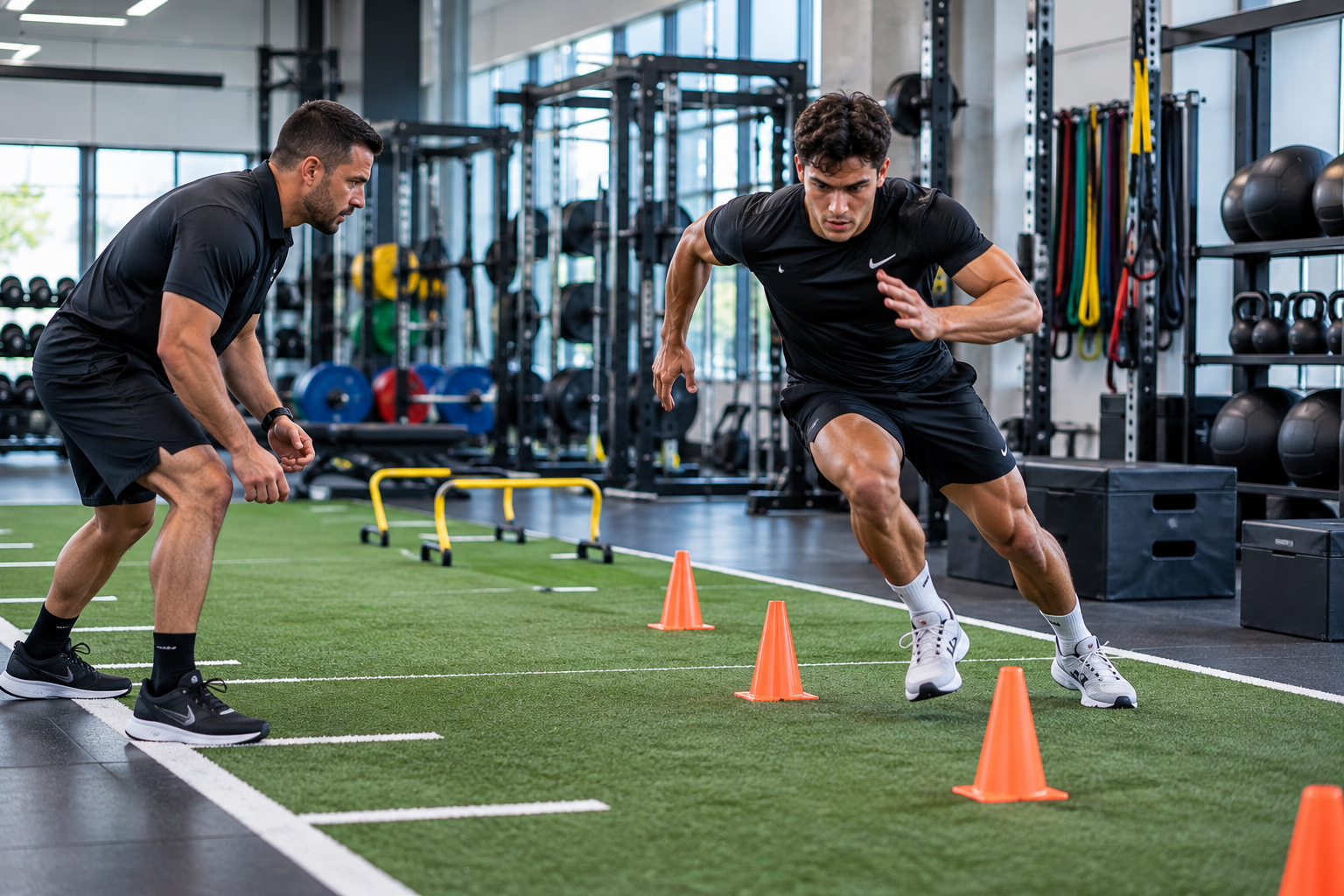
General and specific athletic preparation: how to use them effectively in athletic preparation
General athletic preparation and specific athletic preparation represent two complementary components of a training program. The first develops fundamental physical capabilities, while the second transfers these capabilities to the technical and performance demands of a specific sports discipline.
Using both correctly means organizing a progressive path that takes into account the athlete's level, the period of the season, the programming goals, and the characteristics of the sport practiced. Neither can be considered sufficient if used in isolation.
This guide illustrates how to integrate general and specific preparation through practical criteria, highlighting usage methods, the most frequent errors, and aspects to verify during training design.
- Quick answer
- What are general and specific preparation?
- How they work together
- Practical criteria for use
- Errors to avoid and safety
- How to organize the program
- FAQ
- Long-term training programming
How to use general and specific athletic preparation?
General athletic preparation develops the physical bases common to many disciplines, while specific preparation adapts these capabilities to the technical gestures of the sport practiced. To obtain an effective program, it is appropriate to combine them according to a progression consistent with the goals, the seasonal calendar, and the athlete's level.
The proportions between the two components change during the season, but both contribute to building a structured path.
An orderly planning allows for better management of loads and adapting the work to the needs of the discipline without losing continuity in the preparation.
What is the goal of general preparation?
General preparation aims to develop motor and conditioning capabilities that constitute the basis of subsequent work.
What is the goal of specific preparation?
Specific preparation directs the work toward the movements, rhythms, and performance demands typical of the sport practiced.
What are general preparation and specific preparation?
General preparation includes transversal exercises aimed at developing fundamental physical qualities.
Specific preparation instead uses exercises that reproduce technical, biomechanical, and metabolic characteristics proper to the sports discipline.
Both must be inserted into a progressive programming without being considered completely separate phases.
Developing strength
Work on strength can begin with general exercises and then evolve toward modalities increasingly close to the demands of the sport.
Training speed
Exercises dedicated to speed follow a progression that starts from basic capabilities and arrives at the specific gestures of competition.
How do they work together?
General and specific preparation are not alternatives but parts of the same training path.
During the season, their relationship varies according to the preparation period, competitive commitments, and performance goals defined by the technical staff.
Correct integration allows for the development of physical capabilities while maintaining the connection to the discipline practiced.
In the early phases of the season
General preparation normally occupies a broader space to create a basis upon which to build subsequent work.
During the competitive period
Specific preparation progressively assumes greater relevance while still maintaining general activities functional to the overall program.
What practical criteria should be used?
The choice of exercises should be made on the basis of observable criteria consistent with the training program.
Among the elements to evaluate are the athlete's experience, discipline practiced, training frequency, space availability, and equipment present.
To efficiently organize the work area, it is possible to integrate dedicated tools by consulting the gym accessories section.
Organizing the space
The subdivision of the area into functional zones facilitates the transition between general and specific exercises without interference.
Using accessories
Complementary tools must be chosen according to the session's goals and easily integrated into the programming.
What errors should be avoided?
One of the most frequent errors consists of dedicating the entire program exclusively to specific preparation while neglecting the development of basic capabilities.
It is equally important to avoid programs that remain in the general phase for too long without a progressive transfer toward the discipline practiced.
Even sudden increases in loads or unplanned modifications of the programming can reduce the quality of the training path.
Respecting progression
Exercises should evolve gradually while maintaining continuity between the different phases of preparation.
Evaluating the flooring
The training surface must be compatible with the type of exercises planned and maintained in good condition through periodic checks.
How to organize the program?
Effective programming provides clear goals, periodic checks, and the possibility of adaptation during the season.
Sessions should be organized in order to maintain consistency between developed capabilities, discipline demands, and athletes' levels.
The recording of carried-out activities facilitates the evaluation of the path and the planning of subsequent workouts.
Monitoring the path
Documenting sessions allows for verifying work progression and making any modifications according to emerged needs.
Maintaining flexibility
An adaptable program allows for responding to changes in the sports calendar and the needs of individual athletes.
FAQ on general and specific athletic preparation
Is it necessary to use both?
Yes. In most programs, the two components are integrated with different proportions during the various phases of the season.
When does specific work increase?
Generally, in phases closest to competitions, the weight of specific exercises grows while still maintaining general support activities.
Are there technical references?
Programming should refer to scientific literature on physical preparation, methodological manuals of competent sports federations, and technical guidelines applicable to the discipline practiced.
Is general preparation also useful for experienced athletes?
Yes. Basic physical capabilities continue to represent an important element even for athletes with high experience, provided that the work is adapted to the season's goals.
Long-term training programming
Integrating general preparation and specific preparation means building a path of athletic preparation capable of adapting to the evolution of the athlete and the sports season.
Planning based on verifiable criteria allows for coherently distributing loads, effectively using spaces, and organizing equipment according to real operational needs.
A progressive approach, supported by periodic checks and flexible programming, facilitates the work of coaches and trainers, helping to maintain continuity, efficiency, and quality in the entire training process.
Comments (0)