
Trolley
You have no items in your shopping cart

 Budgets
 Dumbers
 Discs
Discs
 Benches
 Racks and Rigs
 Weights Holders
 Isotonic machines
 Calisthenics
 Cardio
 Kettlebells
 Flooring
 Gym Set
 Accessories
 Combat
 ARTI MARZIALI
 CONTAINER GYM
 Tug-Of-War
 Used Gym Equipment
 PILATES MACCHINARI
 GINNASTICA ARTISTICA
 CAMPI DA PADEL
 Prodotti in Pronta Consegna
 Informazioni
 IRONMAN
 Gift Card
- Donatif
- General information
- 0 I like it
- 9 Views
- 0 comments
- gym flooring, safety flooring, gym safety, shock-absorbing materials
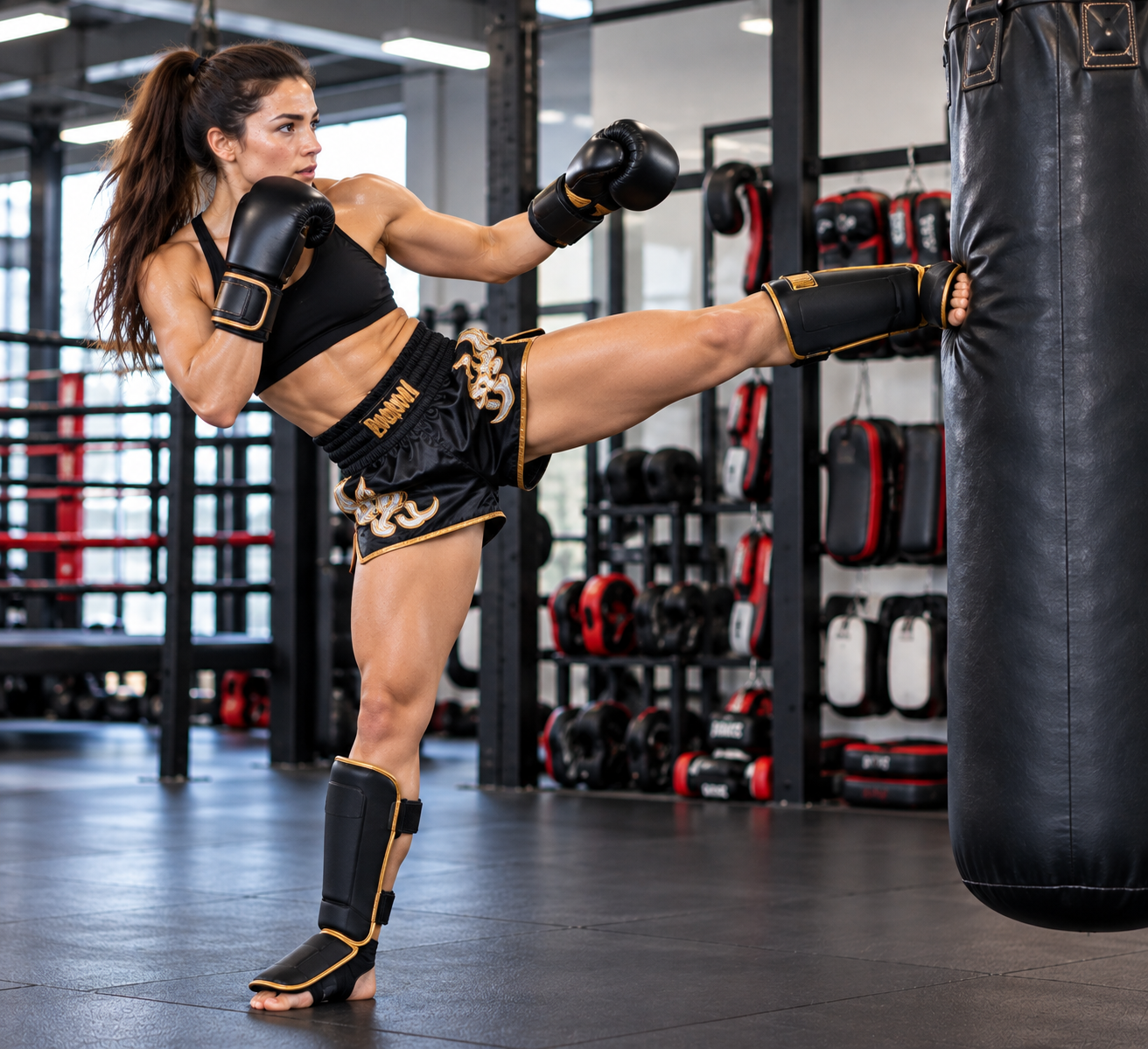
What equipment is needed for Muay Thai: a practical guide to choosing
Muay Thai equipment means equipping yourself with the necessary tools to train safely, develop technique correctly, and carry out every phase of preparation without limitations. For the practitioner, personal protections are essential, while a gym must also integrate equipment dedicated to technical work, striking, and athletic preparation.
Many beginners believe that a pair of gloves is enough to get started. In reality, the choice of equipment depends on the type of training, the frequency of lessons, the level of experience, and the environment in which you practice. Distinguishing indispensable elements from optional ones avoids unnecessary expenses and builds truly functional gear.
Even those who manage a gym must face the same evaluation from a different point of view. A well-planned outfitting allows for organizing complete lessons, improving student safety, and making the best use of available space without turning the training area into a simple equipment storage.
- Quick answer
- What features really matter
- Selection criteria
- Equipment compatibility
- Equipment for beginners
- How to set up a Muay Thai area
- Purchase mistakes
- Evaluating the investment
What equipment is really needed for Muay Thai?
To start, a few truly indispensable elements are needed: gloves, handwraps, mouthguard, and appropriate technical clothing. As experience increases, additional personal protections can be added depending on the type of training performed.
A gym, on the other hand, should provide heavy bags, pao pads, striking shields, timers, ropes, athletic preparation material, and an area designed to allow exercises safely.
The choice must always be guided by the intended use rather than the quantity of equipment purchased.
Essential equipment
Items worn directly by the practitioner are generally personal for reasons of hygiene, comfort, and adaptability.
Shared equipment
Equipment intended for collective exercises normally represents a gym investment and must be sized based on the number of participants.
What specifications really matter?
Material quality is one of the most important aspects. Sturdy seams, resistant coverings, and uniform padding contribute to the durability of the equipment during continuous use.
Dimensions must be compatible with the practitioner and the type of exercise planned. Unsuitable equipment can reduce comfort and make training less effective.
It is useful to favor products accompanied by clear instructions regarding use, maintenance, and storage.
Materials and construction
Build quality affects wear resistance and performance consistency over time.
Durability and maintenance
Regular maintenance includes cleaning, checking seams, verifying closure systems, and replacing worn elements.
What criteria to use in the choice?
The first criterion concerns the practitioner's level. A beginner does not need the same equipment as an athlete who trains daily.
The second criterion concerns the frequency of use. Regular training makes it convenient to invest in higher quality personal equipment.
The third criterion concerns the context. Training exclusively in the gym or also having a personal space changes purchase needs.
Training frequency
The greater the number of weekly sessions, the greater the importance of durable and easily maintainable materials.
Training goals
Physical preparation, individual technique, pad work, and sparring require different tools while sharing a common base.
How to check equipment compatibility?
Each element should be compatible with the gym's training program and available space.
Technical striking pads must be consistent with the instructors' level and the type of exercises proposed during lessons.
The layout of the work area must also allow fluid movements without creating interference between different groups.
Space management
The distribution of stations should allow bag exercises, partner work, and athletic preparation while maintaining adequate operating distances.
Equipment integration
Each new purchase should complement the material already present instead of duplicating underused tools.
What Muay Thai equipment for beginners?
Beginners should focus on indispensable elements, avoiding impulse purchases. An essential kit already allows participation in most classes.
Gloves normally represent the first purchase along with handwraps and mouthguard. Subsequently, other accessories can be added depending on technical evolution.
To explore the different categories dedicated to combat sports, you can consult combat equipment.
Purchase order
Proceeding by priority allows for better budget distribution without sacrificing the quality of items actually used.
Importance of personal equipment
Using personal protections promotes better hygiene management and keeps your gear always available.
How to set up a Muay Thai area in a gym?
Design should start from the available surface area and the average number of participants per class.
Training heavy bags must be installed with adequate fixing systems following the manufacturer's instructions and leaving sufficient operating space around each station.
Appropriate sports flooring contributes to comfort during movements and protects the subfloor from intensive use.
How to choose Muay Thai heavy bags and pads
It is advisable to evaluate materials, padding distribution, seam quality, ease of maintenance, and technical intended use.
Complementary accessories
Warm-up ropes, timers, stopwatches, and small athletic preparation tools effectively complete the training area.
What mistakes to avoid during purchase?
The first mistake is evaluating price exclusively without considering quality, durability, and the real intended use of the equipment.
The second mistake is purchasing advanced tools before possessing the essential gear required in every training session.
The third mistake concerns maintenance. Even good quality products require periodic checks and constant cleaning.
Buying too much material
A selection based on real needs is generally more effective than buying numerous rarely used accessories.
Ignoring available space
Every piece of equipment should be compatible with the actually usable surface without compromising class safety.
How to correctly evaluate the investment?
For the practitioner, it is advisable to invest progressively in the personal equipment most used during each training session. For a gym, the priority is instead to create a balanced equipment supply that allows carrying out all the main technical drills without overloading the available space.
Before any purchase, it is useful to check the expected frequency of use, simplicity of maintenance, availability of spare parts when applicable, and compatibility with the facility's technical program. These criteria are more useful than the simple quantity of accessories purchased.
When available, it is appropriate to refer to manufacturer manuals for installation, maintenance, and use of the equipment in addition to general safety guidelines applicable to sports environments. A choice based on verifiable criteria allows building functional, durable equipment consistent with training goals without turning the guide into a product catalog.
Comments (0)