
Trolley
You have no items in your shopping cart

 Budgets
 Dumbers
 Discs
Discs
 Benches
 Racks and Rigs
 Weights Holders
 Isotonic machines
 Calisthenics
 Cardio
 Kettlebells
 Flooring
 Gym Set
 Accessories
 Combat
 ARTI MARZIALI
 CONTAINER GYM
 Tug-Of-War
 Used Gym Equipment
 PILATES MACCHINARI
 GINNASTICA ARTISTICA
 CAMPI DA PADEL
 Prodotti in Pronta Consegna
 Informazioni
 IRONMAN
 Gift Card
- Donatif
- General information
- 0 I like it
- 19 Views
- 0 comments
- gym flooring, safety flooring, gym safety, shock-absorbing materials
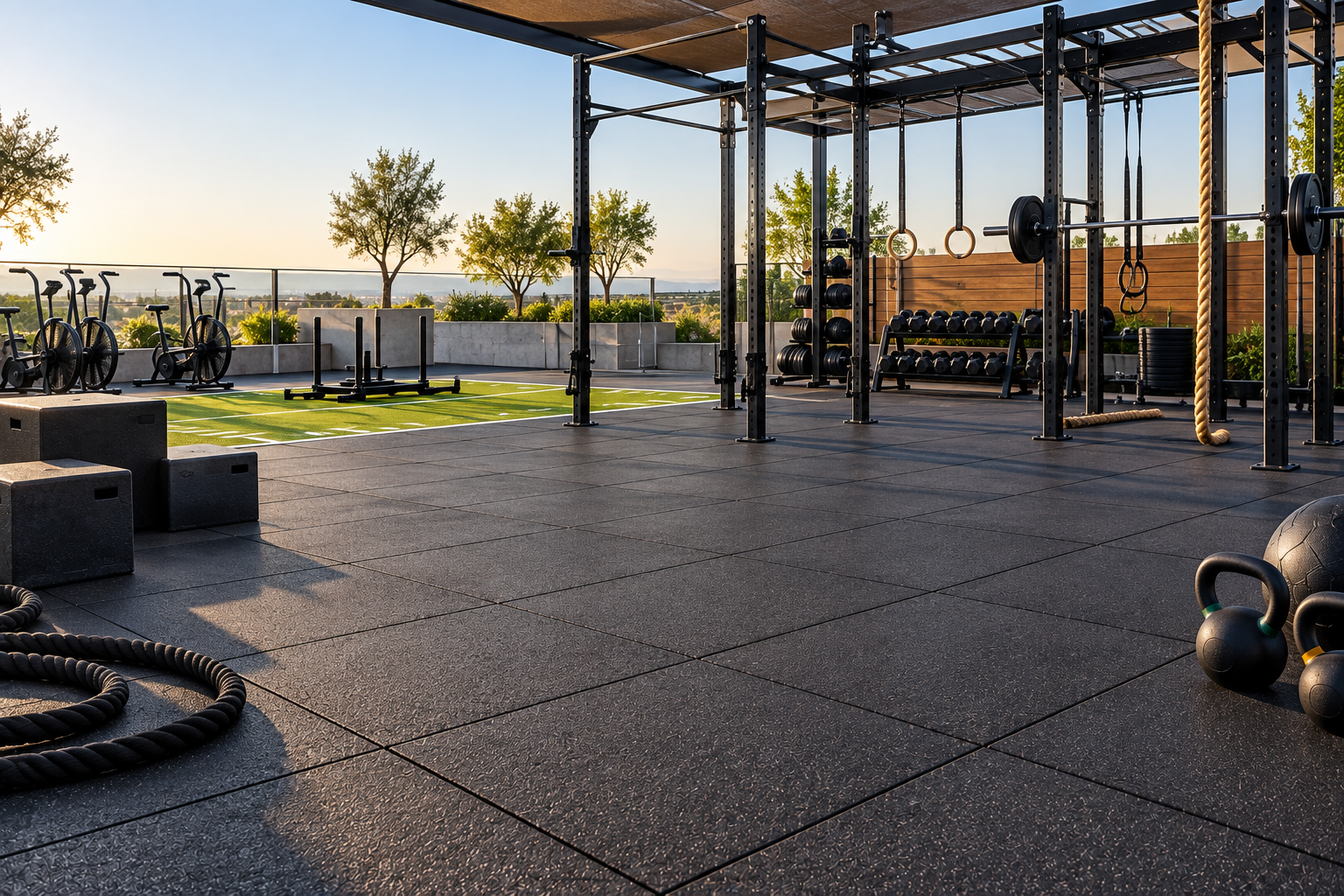
Draining outdoor flooring for fitness area: how to choose impact-absorbing flooring for outdoors
A draining outdoor flooring solution is one of the most widely used options for creating outdoor fitness areas intended for continuous training in the presence of rain, humidity, and climate variations. The ability to promote water runoff helps keep the surface usable more quickly and limits the formation of puddles.
Choosing impact-absorbing flooring for outdoors should not be based solely on the material or aesthetic appearance. It is necessary to evaluate verifiable technical features such as the drainage system, compatibility with the subfloor, resistance to atmospheric agents, intended use, and the manufacturer's instructions.
This guide examines how draining outdoor flooring for fitness areas works, illustrating practical usage criteria, errors to avoid, and aspects to verify before design or installation.
- Quick answer
- What is draining outdoor flooring
- How drainage works
- Practical selection criteria
- How to properly use the surface
- Errors to avoid and safety
- FAQ
- Evaluating the investment
What is draining outdoor flooring for a fitness area?
Draining outdoor flooring is a surface designed to allow rapid rainwater runoff while reducing standing puddles. When used as impact-absorbing flooring for outdoors, it must be chosen by considering drainage, intended use, subfloor, resistance to atmospheric agents, and proper installation methods.
Drainage capacity is only one element of the design. To achieve adequate performance, the entire system—composed of the surface, subfloor, and water disposal system—must work in a coordinated manner.
A preliminary technical assessment makes it possible to identify the most suitable solution for the characteristics of the fitness area and the environmental conditions of the site.
What elements should be checked immediately?
It is necessary to check the intended use of the area, the expected volume of use, the available slope, the water collection system, and the compatibility between the surface and the subfloor.
Why is drainage important?
Proper water management helps limit persistent puddles, facilitates routine maintenance, and keeps the surface usable more quickly after weather events.
What is draining flooring?
Draining flooring is designed so that water can either pass through or be rapidly channeled away from the usage surface, depending on the construction technology adopted.
Drainage behavior depends not only on the surface material but also on the design of the construction package, ground preparation, and the presence of adequate water collection systems.
For this reason, two apparently similar surfaces can offer different results when installed on different subfloors.
What materials are used?
Available solutions include elastic materials, modular elements, and seamless systems designed for outdoor applications. The choice must always be made considering the manufacturer's instructions and the facility design.
How important is the subfloor?
The subfloor represents one of the most important elements because it influences the stability, drainage, and overall durability of the flooring.
How does drainage work?
The operating principle consists of promoting water runoff while preventing it from remaining on the surface for prolonged periods.
To achieve this result, the slope of the area, the subfloor, the drains, and the entire water collection system must be correctly designed.
Draining flooring does not automatically eliminate all puddles if the overall design has critical issues or if the drains are clogged.
Why are slopes important?
A correct inclination facilitates the channeling of water toward the collection points provided by the design.
Does drainage require maintenance?
Yes. Leaves, soil, and debris can reduce system efficiency. For this reason, it is advisable to schedule periodic checks and cleaning of the draining elements.
What practical criteria should be used in selection?
Before purchase, it is advisable to gather objective data on the project, avoiding choices based exclusively on aesthetics or price.
The main criteria include the intended use of the area, subfloor characteristics, climate exposure, intensity of use, expected maintenance, and spare parts availability.
To learn more about the various solutions available, you can consult the section dedicated to impact-absorbing flooring for outdoors.
Evaluating space
The configuration of the area influences the number of joints, equipment layout, and water disposal system.
How to evaluate the thickness of outdoor impact-absorbing flooring?
The thickness must be consistent with the intended use, the project, and the manufacturer's technical instructions, avoiding standardized solutions valid for any application.
How to correctly use draining flooring?
A draining surface must be used in compliance with the methods provided by the design and kept free of obstacles that could compromise water runoff.
It is good practice to avoid the permanent accumulation of materials, containers, or elements that could clog the drains or alter the surface behavior.
Routine management also includes periodic checks on the state of the drainage system and the presence of any deformations.
Equipment positioning
Equipment must be installed according to the project, avoiding unforeseen loads or fixings that could modify surface behavior.
Area cleaning
Regular removal of leaves and debris keeps drainage efficient and helps limit puddle formation.
What errors to avoid?
One of the most frequent errors is considering any flooring intended for outdoor use as draining. The ability to dispose of water depends instead on the entire construction system.
It is also advisable to avoid installations on non-compliant subfloors, neglecting maintenance, or modifying the surface without verifying material compatibility.
Incomplete design can compromise both drainage functionality and intervention durability.
Evaluating UV resistance
Continuous exposure to solar radiation makes it important to verify the characteristics declared by the manufacturer for outdoor applications.
Attention to accessories
Grates, edging, fittings, and other components must be compatible with the installed system and the methods required by the project.
FAQ on draining outdoor flooring
Does draining flooring completely eliminate puddles?
No. The result depends on the overall design of the area, correct installation, maintenance, and the efficiency of the water collection system.
Is periodic maintenance required?
Yes. Cleaning the drains and removing debris help maintain the efficient draining behavior of the surface.
What standards may be relevant?
Technical references depend on the intended use of the surface. For aspects related to impact-attenuating surfaces, standards such as the EN 1177 series may apply when relevant, while design, installation, and maintenance must follow the instructions of the manufacturer and the specific project.
Does drainage replace proper design?
No. A draining surface cannot compensate for errors related to the subfloor, slopes, or the water collection system.
Evaluating draining flooring as an investment
Choosing impact-absorbing flooring for outdoors with draining characteristics should be approached by considering the entire lifecycle of the facility and not just the initial cost.
Analyzing the project, verifying compatibility with the subfloor, planning maintenance, and requesting technical documentation allows for decisions based on verifiable criteria.
A correctly designed and maintained system facilitates the management of the outdoor fitness area, improves continuity of use, and makes it easier to schedule future interventions in compliance with technical instructions and expected operating conditions.
Comments (0)