
Trolley
You have no items in your shopping cart

 Budgets
 Dumbers
 Discs
Discs
 Benches
 Racks and Rigs
 Weights Holders
 Isotonic machines
 Calisthenics
 Cardio
 Kettlebells
 Flooring
 Gym Set
 Accessories
 Combat
 ARTI MARZIALI
 CONTAINER GYM
 Tug-Of-War
 Used Gym Equipment
 PILATES MACCHINARI
 GINNASTICA ARTISTICA
 CAMPI DA PADEL
 Prodotti in Pronta Consegna
 Informazioni
 IRONMAN
 Gift Card
- Donatif
- General information
- 0 I like it
- 15 Views
- 0 comments
- gym flooring, safety flooring, gym safety, shock-absorbing materials
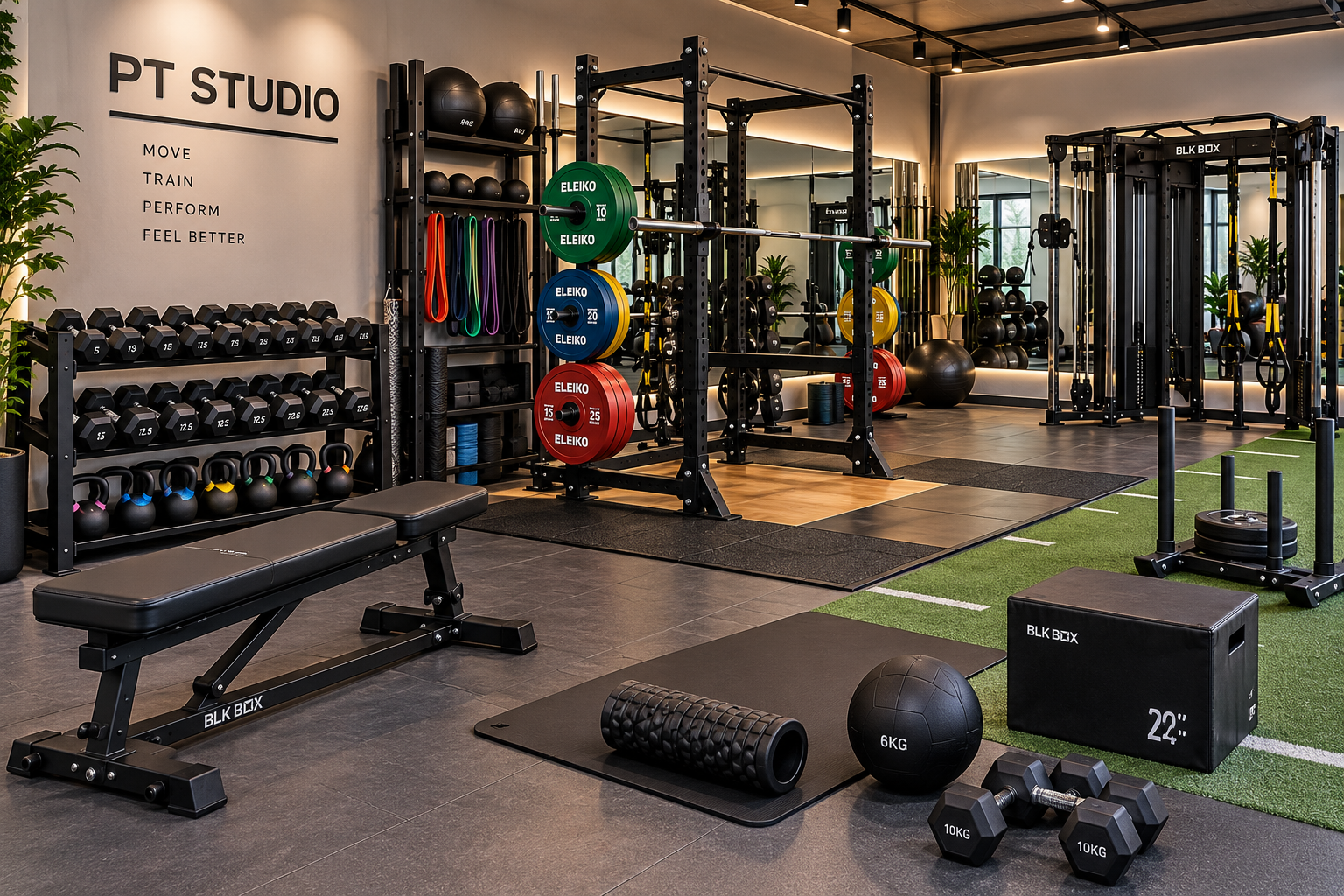
Boutique gym vs PT studio: differences, selection criteria and space design
A boutique gym and a personal training studio share the goal of offering a more personalized training experience than a traditional gym, but they respond to different organizational models. Understanding the characteristics of each format is essential to design a space consistent with the service you intend to offer and your target audience.
The choice should not be based solely on the available surface area, but also on the number of clients that can be managed simultaneously, how sessions are delivered, the type of equipment needed and the operational organization of the facility.
Analyzing these aspects right from the design phase helps avoid inconsistent investments, optimize the layout and plan a gradual evolution of the business without having to completely rethink the spaces.
- What are the main differences?
- Comparison table
- When to choose a boutique gym
- When to choose a PT studio
- How the layout changes
- What equipment to use
- Design mistakes to avoid
- How to plan the investment
What are the main differences between a boutique gym and a PT studio?
A boutique gym is generally designed to host small groups following a specific training methodology. Space organization favors flexibility and allows classes with multiple participants simultaneously.
A PT studio, on the other hand, is oriented mainly toward individual sessions or small shared workouts. The environment is developed to facilitate the direct relationship between trainer and client, with a configuration that favors service personalization.
Both models can use similar equipment, but space distribution and operational management differ.
How does the service change?
In the boutique gym, organization is oriented toward structured classes and programs, while the PT studio favors individualized paths and a direct relationship with the client.
Does the number of users influence the project?
Yes. The expected capacity of the facility represents one of the main criteria for defining the layout, surfaces and choice of equipment.
Comparison table
The following table summarizes the main operational differences between the two models.
| Element | Boutique gym | PT studio |
|---|---|---|
| Main activity | Group workouts | Personal training |
| Number of users | Multiple people per session | One or few clients |
| Layout | Open and flexible spaces | Dedicated stations |
| Equipment | Versatile and multi-function | Personalized to the work method |
| Organization | Class management | Individual paths |
| Expansion | New classes and services | Increase in operational stations |
This table represents a general comparison that must be adapted to the specific project of the facility.
Final choices should always be consistent with the business model and the objectives of the activity.
What criteria matter most?
Target audience, training methods, space availability and operational organization are the elements that impact the choice the most.
Why evaluate future development?
Flexible design facilitates the addition of new services without completely modifying the layout.
When to choose a boutique gym?
A boutique gym is recommended when the business project involves training programs organized for small groups, themed classes or highly specialized methodologies.
In this context, the space should be easily reconfigurable and allow rapid preparation of different activities throughout the day.
Design should favor versatile equipment, free areas and storage systems that keep the room orderly between one session and the next.
Why are flexible spaces needed?
Group classes may require different configurations throughout the day, making an easily modifiable arrangement useful.
How much does the client experience matter?
Comfort, organization and environmental consistency contribute to the perceived quality of the service.
When to choose a PT studio?
A PT studio better meets the needs of professionals who work primarily with individual appointments or very small restricted groups.
Design favors dedicated stations, greater privacy and an equipment layout that allows the trainer to follow each client throughout the entire session.
The management of appointments and access paths can also be simplified thanks to a more linear layout.
Why is privacy important?
A dedicated space fosters continuous interaction between professional and client throughout the session.
How does organization change?
Configuration is developed around the needs of the individual client rather than the management of a class.
How does the layout change between the two models?
In the boutique gym, the layout should leave large free surfaces to allow simultaneous movements of multiple people. Equipment is generally distributed along the perimeter or organized to facilitate the rapid resetting of the room.
In a PT studio, the layout can instead be built around permanent stations dedicated to different phases of training, while still maintaining simple and orderly paths.
Even the flooring should be chosen considering the prevailing activities and the intended type of use.
Why design clear paths?
An orderly distribution improves session management and facilitates movement within the facility.
How much does storage matter?
Well-designed organization systems help keep environments always orderly.
What equipment to use?
Both models benefit from the use of versatile equipment, but selection should be made based on the service actually offered.
The boutique gym tends to favor multi-function tools that can be shared during classes, while a PT studio can choose a configuration more personalized to the professional's methodologies.
Before purchasing, it is advisable to check dimensions, compatibility, maintenance requirements and expansion possibilities of the equipment.
Why choose multi-function equipment?
Versatile tools allow rapid adaptation of the space to different training programs.
Why check compatibility?
A consistent configuration facilitates facility management and makes it simpler to introduce new equipment.
What mistakes to avoid?
One of the most frequent mistakes consists of designing a boutique gym as if it were a PT studio or vice versa, without considering the real operational model of the activity.
It is also advisable to avoid purchasing an excessive amount of equipment, unnecessarily reducing the space available for workouts.
Neglecting the possibility of expanding the facility over time can also limit the evolution of the business project.
Do more pieces of equipment mean a better service?
Not necessarily. A selection consistent with the format is generally more effective than a very large but poorly organized supply.
Why design before purchasing?
Initial planning allows for optimizing spaces, investments and operational organization.
How to plan the investment?
The choice between boutique gym and PT studio should be guided by the service model you wish to offer, the target audience and the expected workout management. Analyzing these elements from the beginning allows you to design a facility that is easily organizable and ready to evolve over time.
Carefully evaluating boutique gym layout, multi-function equipment, space organization and equipment compatibility allows you to develop a project more consistent with business objectives.
To complete a facility oriented toward versatile workouts, it can be useful to integrate a professional dumbbell set compatible with the planned layout, maintaining order, flexibility and future expansion possibilities.
Comments (0)