
Trolley
You have no items in your shopping cart

 Budgets
 Dumbers
 Discs
Discs
 Benches
 Racks and Rigs
 Weights Holders
 Isotonic machines
 Calisthenics
 Cardio
 Kettlebells
 Flooring
 Gym Set
 Accessories
 Combat
 ARTI MARZIALI
 CONTAINER GYM
 Tug-Of-War
 Used Gym Equipment
 PILATES MACCHINARI
 GINNASTICA ARTISTICA
 CAMPI DA PADEL
 Prodotti in Pronta Consegna
 Informazioni
 IRONMAN
 Gift Card
- Donatif
- General information
- 0 I like it
- 1433 Views
- 0 comments
- gym flooring, safety flooring, gym safety, shock-absorbing materials
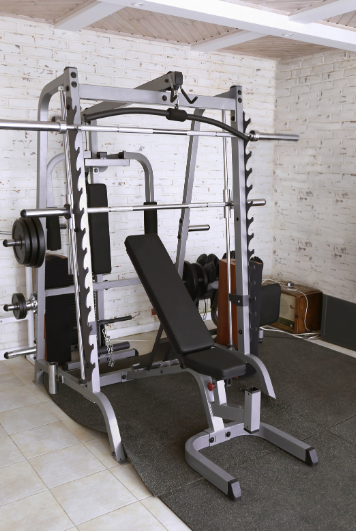
Multi-purpose room and home gym: is a modular standard solution or a fixed custom setup better?
Integrating a home gym into a multi-purpose room is one of the most practical challenges for anyone training at home. It’s not just about choosing equipment, but about understanding how it will coexist with everyday domestic life: work, relaxation, guests, and daily routines. The most common risk is turning a dynamic space into a rigid, hard-to-manage, and visually overwhelming area.
The choice between a modular standard solution and a fixed custom setup is therefore not purely technical, but deeply connected to overall quality of life at home. Understanding when to prioritize flexibility and when it makes sense to invest in a more stable structure helps avoid costly mistakes and genuinely improves daily experience.
- Compatibility between training and home life
- Modular standard solution
- Fixed custom setup
- Direct comparison
- How to choose
Compatibility between training and home life: the real starting point
When a room serves multiple purposes, the priority is not adding as much equipment as possible, but ensuring a balanced coexistence between training and everyday use. This means considering accessibility, ease of tidying up, and the visual impact of fitness elements. An effective solution should not dominate the space but adapt to its rhythms.
Many people underestimate the importance of space reversibility. A room that can quickly return to its primary function—whether work, relaxation, or hosting—retains its value over time. This is exactly where the difference between modular and fixed approaches becomes clear.
Modular standard solution: flexibility and reversibility of space
Modular standard solutions are designed to adapt. Equipment such as compact racks, foldable benches, and smart storage systems allows you to build a home gym that can be modified, reduced, or completely removed within minutes. This approach is especially effective when the space needs to remain dynamic and transformable.
The real strength of this model lies in its ability to follow changes in everyday home life. Whether you are working from home, hosting guests, or simply need to free up space, a modular setup allows you to maintain control and order without giving up your training routine.
Adaptability to everyday room use
A multi-purpose room requires elements that are not intrusive. Modular solutions allow you to reconfigure the space quickly, adapting to different moments of the day. This makes it possible to switch from a workout area to a living space without friction.
This adaptability also reduces the perception of clutter. Equipment does not become a permanent part of the environment, but rather temporary tools that integrate without compromising the room’s overall livability.
Visual order and equipment management
Another key advantage is organization. Thanks to dedicated storage systems and foldable equipment, it’s possible to maintain a visually clean space even after training. This aspect has a direct impact on overall home comfort.
An orderly environment is not only more pleasant, but also supports consistency in training. When everything is accessible yet non-invasive, it becomes easier to integrate physical activity into your daily routine.
Fixed custom setup: when it truly makes sense
Fixed custom solutions offer a higher level of integration and stability. Structures designed specifically for your space can optimize every inch, creating a home gym perfectly integrated into the environment. This approach is ideal when training is a stable priority and the space can be more permanently dedicated.
However, this choice significantly reduces flexibility. A fixed structure tends to define the room in a rigid way, making it more difficult to adapt for other uses.
Setup stability and space optimization
The main advantage of custom solutions is setup stability. Equipment is always ready to use and perfectly positioned, improving the training experience and reducing setup time.
Additionally, custom design can take advantage of irregular or challenging spaces, increasing overall efficiency. This is particularly useful in smaller but dedicated environments.
Limitations in multi-purpose contexts
In a room that must remain multi-functional, however, custom setups can become limiting. The difficulty of moving or modifying fixed structures reduces the space’s ability to adapt to different needs.
This can lead to a constant perception of clutter or to underusing the room for other purposes. For this reason, a fixed custom solution is not always the most balanced choice in dynamic home environments.
Direct comparison: modular standard vs fixed custom
The comparison between these two solutions is not only about technical features, but mainly about their impact on everyday life. Modular solutions offer reversibility, control, and adaptability, while fixed custom setups focus on stability and integration.
In a multi-purpose room, the real deciding factor is the ability to maintain balance. If the space needs to frequently change function, modularity becomes a decisive advantage. If fitness use is dominant and stable, a custom setup can provide a more structured experience.
How to choose based on your space and lifestyle
The best choice comes from analyzing your lifestyle. If the room is used for multiple activities and needs to remain flexible, a modular standard solution is the smartest option. It allows you to train without compromising the balance of your home.
On the other hand, if there is a space that can be more permanently dedicated to training, a targeted custom intervention—perhaps limited to a few key elements—can improve organization without making the environment rigid. A conscious choice is not about extremes, but about combining solutions in a way that aligns with your home and daily life.
Comments (0)