
Trolley
You have no items in your shopping cart

 Budgets
 Dumbers
 Discs
Discs
 Benches
 Racks and Rigs
 Weights Holders
 Isotonic machines
 Calisthenics
 Cardio
 Kettlebells
 Flooring
 Gym Set
 Accessories
 Combat
 ARTI MARZIALI
 CONTAINER GYM
 Tug-Of-War
 Used Gym Equipment
 PILATES MACCHINARI
 GINNASTICA ARTISTICA
 CAMPI DA PADEL
 Prodotti in Pronta Consegna
 Informazioni
 IRONMAN
 Gift Card
- Donatif
- General information
- 0 I like it
- 20 Views
- 0 comments
- gym flooring, safety flooring, gym safety, shock-absorbing materials
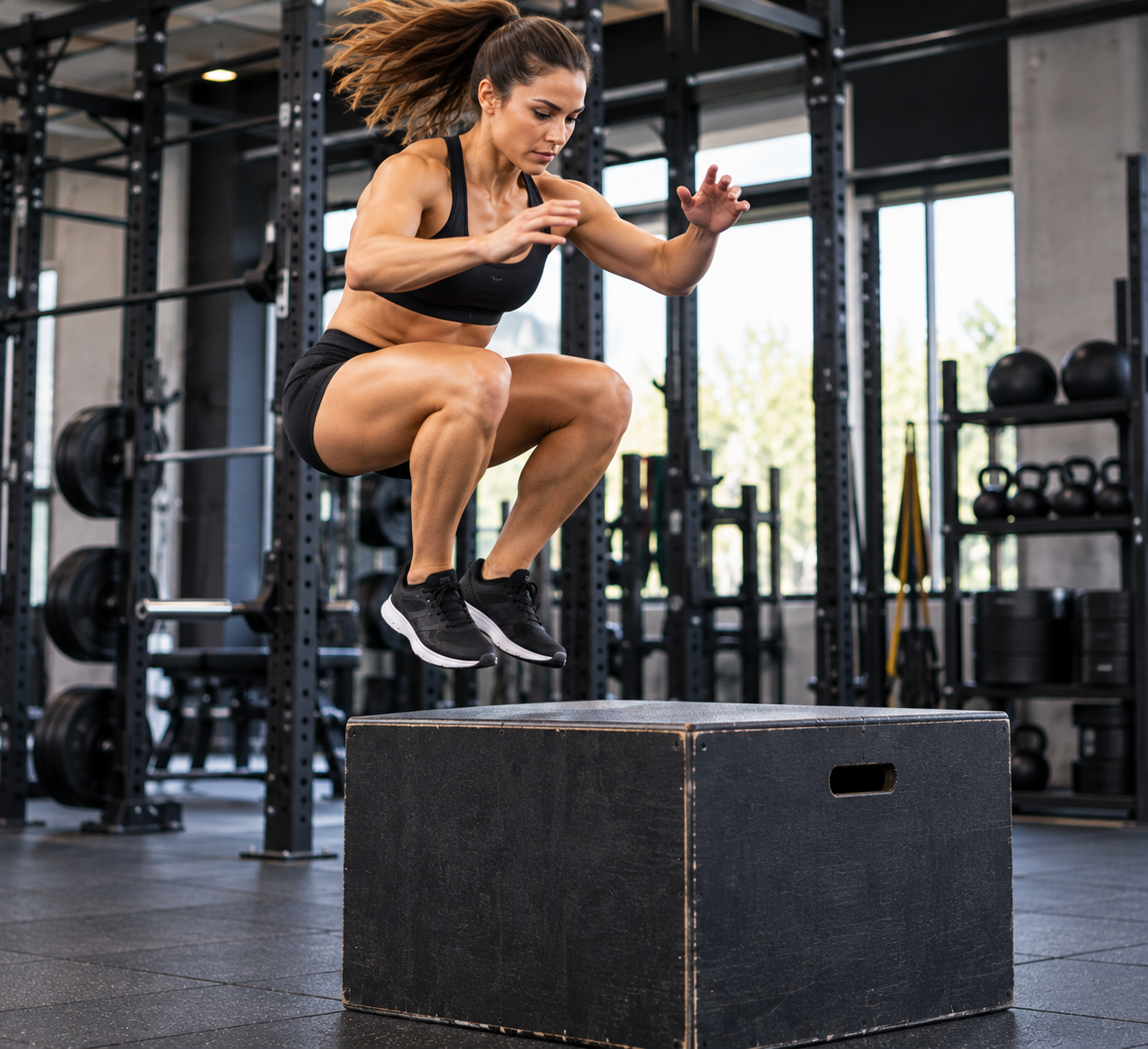
Safety in the box jump: avoiding excessive height and unstable landing
The box jump is one of the most widely used plyometric exercises for developing explosive power, coordination, and speed. However, its effectiveness depends on the quality of execution rather than the height of the box used. The pursuit of increasingly higher jumps can in fact compromise technique and increase the risk of errors during landing.
Safety in the box jump is based on proper training progression, choosing a height appropriate for one's abilities, and maintaining complete control during all phases of the movement. A stable landing represents one of the main indicators of correct execution.
This guide outlines the main risks associated with excessive box height and an unstable landing, proposing practical checks, decision criteria, and operational guidelines to perform the exercise in safer conditions.
- Quick response
- What are the main risks?
- What safety requirements should be met?
- Pre-workout checks
- Mistakes to avoid
- How to manage progression
- FAQ
- Training with verifiable technical criteria
How to improve box jump safety?
Safety in the box jump depends on choosing a height that allows for a controlled jump, an effective takeoff technique, and a stable landing. If the movement requires obvious compensations or balance is lost upon arrival on the box, it is advisable to reduce the difficulty of the exercise.
The goal is not to reach the highest box available but to maintain a consistent and repeatable technique in every set.
A gradual progression allows you to consolidate the technical movement and evaluate with greater precision when to increase the difficulty.
Why avoid excessive height?
A box that is too high can induce excessive knee tucking, alter posture, and make the quality of the jump less reliable.
Why is landing so important?
A stable landing indicates that the chosen height is compatible with the technical level and the session's objectives.
What are the main risks?
The most frequent risks stem from pursuing maximum height rather than the best execution quality.
Situations to monitor include loss of balance on the box, noisy landings, incomplete foot placement, excessive trunk flexion, and reduced control during the descent.
Even fatigue can alter the quality of the movement, making it appropriate to stop or modify the session when technique noticeably worsens.
Recognizing compensations
When the height exceeds the athlete's abilities, the likelihood of observing compensatory movements that reduce the quality of the exercise increases.
Maintaining movement control
Every repetition should start and end with a stable position without losing balance during the jump or landing.
What safety requirements should be met?
A box jump session should be performed in an orderly environment, with stable equipment and an adequate surface.
The box must be intact, positioned on a regular base, and sufficiently stable not to move during execution.
Session planning also contributes to safety by avoiding excessive volumes or sudden increases in difficulty.
Checking space
The working area must allow for a preparation phase, a safe landing, and an unobstructed descent nearby.
Checking the flooring
The surface should be stable, clean, and maintained according to the manufacturer's instructions to ensure reliable support.
What checks to perform before training?
Before starting, it is advisable to verify that the box is stable, the surface is free of obstacles, and the surrounding area allows movements without interference.
It is also useful to check that the chosen difficulty level is consistent with the day's program and the athlete's conditions.
A brief initial check reduces the risk of using unsuitable equipment or unsafe configurations.
Checking accessories
Cones, markers, or other tools used during the session must be placed so as not to interfere with the jump trajectory. To properly organize the workstation, you can consult the section dedicated to gym accessories.
Using the step-up as a progression
When jump control is not yet consolidated, the step-up can represent a useful preparatory exercise to improve balance and foot placement management on the box.
What mistakes to avoid?
One of the most frequent mistakes consists of choosing a height superior to one's abilities exclusively to increase the exercise's difficulty.
It is also advisable to avoid continuing training when technique noticeably worsens due to fatigue or when landing control is no longer consistent.
Another critical issue concerns the descent from the box, which should be performed in a controlled manner according to the planned schedule.
Do not replace the box jump with the jump squat
The two exercises have different purposes and should not be considered equivalent within programming.
Avoid sudden increases
Height, volume, and intensity should be modified progressively without simultaneously increasing all training parameters.
How to manage progression?
Progression should be determined by technical quality and not by simply clearing a higher box.
When all repetitions are controlled, gradual modifications can be evaluated while maintaining the same execution precision.
Recording sessions can help verify the evolution of the work and schedule subsequent increases.
Observing every set
Evaluating balance, precision, and landing control helps understand if the difficulty level remains adequate.
Programming recovery
Adequate recoveries help maintain technical quality and coordination throughout the session.
FAQ on box jump safety
How to tell if the box is too high?
Useful signs include loss of balance, excessive knee tucking, unstable landing, and difficulty repeating the movement continuously.
Is it correct to increase height every workout?
No. Progression should depend on execution quality and not on an automatic increase in box height.
Are there technical references?
Execution methods can be studied in depth through scientific literature dedicated to plyometrics, methodological manuals of sports federations, and instructions provided by equipment manufacturers when applicable.
When to stop a set?
If technique worsens, the landing loses stability, or fatigue prevents maintaining control of the movement, it is advisable to stop the set and reassess the workload.
Training with verifiable technical criteria
Safety in the box jump stems from a combination of technique, progression, space organization, and the choice of a height consistent with the athlete's level.
Evaluating each jump through observable indicators such as takeoff quality, landing stability, and movement control allows for more effective and easily monitorable workouts.
An approach based on verifiable criteria favors a progressive improvement of explosive capabilities while maintaining technical quality as the main reference throughout the training journey.
Comments (0)