
Trolley
You have no items in your shopping cart

 Budgets
 Dumbers
 Discs
Discs
 Benches
 Racks and Rigs
 Weights Holders
 Isotonic machines
 Calisthenics
 Cardio
 Kettlebells
 Flooring
 Gym Set
 Accessories
 Combat
 ARTI MARZIALI
 CONTAINER GYM
 Tug-Of-War
 Used Gym Equipment
 PILATES MACCHINARI
 GINNASTICA ARTISTICA
 CAMPI DA PADEL
 Prodotti in Pronta Consegna
 Informazioni
 IRONMAN
 Gift Card
- Donatif
- General information
- 0 I like it
- 720 Views
- 0 comments
- gym flooring, safety flooring, gym safety, shock-absorbing materials
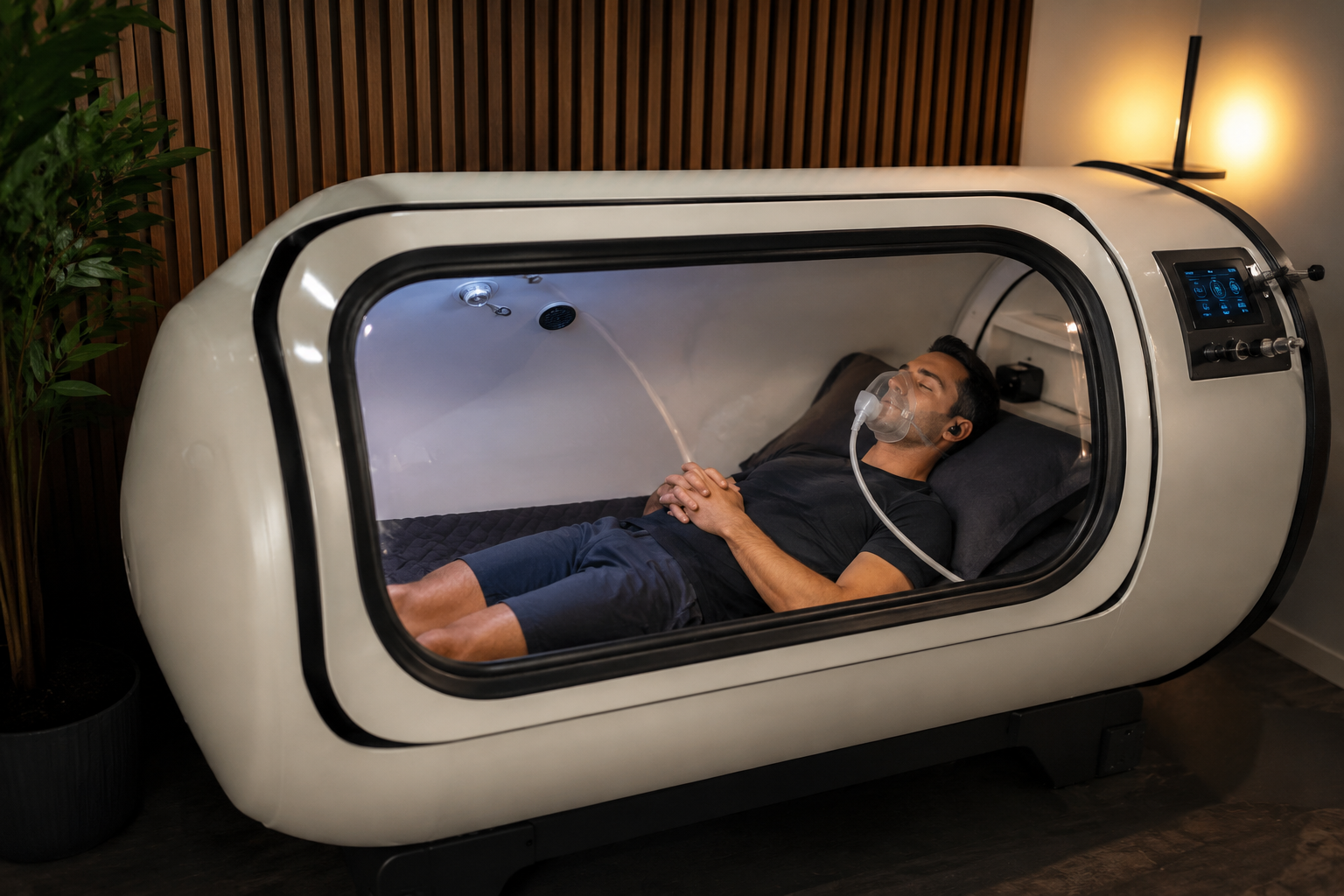
Integrated Monitoring Systems in Hypoxic Chambers: the brain of automatic control
A professional hypoxic chamber is not just an environment in which the oxygen concentration is modified, but a complex technological ecosystem where numerous parameters must be controlled simultaneously. The quality of the experience offered to users depends on the system's ability to maintain stable, predictable, and safe conditions during every session.
At the heart of this management are integrated monitoring systems, tools designed to collect information from the various sensors present in the environment and automatically coordinate the operation of the main components. Oxygen, carbon dioxide, temperature, and humidity are monitored continuously to ensure that the chamber operates according to defined parameters.
For fitness centers, specialized gyms, and facilities that use hypoxia as an advanced service, investing in an advanced control system means reducing the margin of error and increasing the perceived level of professionalism. Technology is not just used to display numbers, but to transform that data into automatic decisions useful for the safety and efficiency of the facility.
- The role of integrated monitoring systems
- How automatic hypoxic chamber control works
- Oxygen control and environmental stability
- Hypoxic chamber CO2 control and safety
- Humidity management and environmental comfort
- Home automation and professional hypoxia control
- Investment in integrated hypoxic chamber control
The role of integrated monitoring systems
The integrated monitoring systems in hypoxic chambers represent the central point of the environment's technical management. Their function is to collect data from the various installed sensors and use them to keep internal conditions within the desired values.
In a professional configuration, control cannot be based on a single measurement. Oxygen concentration, CO2 level, humidity, and other environmental parameters must be evaluated as parts of a single interconnected system.
This integrated vision allows for overcoming manual management and creating a more reliable environment, where adjustments are made automatically in response to detected variations.
From manual monitoring to intelligent control
Traditional systems often require manual intervention to verify and correct environmental parameters. This approach can be less efficient, especially in facilities where the chamber is used frequently.
An integrated system instead allows for continuous control, reducing the need for constant intervention by operators.
Advantages for gyms and fitness centers
For a professional facility, automation represents an important organizational element. Operators can focus more on managing users while the system controls the technical parameters.
This improves the quality of service and contributes to creating a more reliable experience for athletes.
How automatic hypoxic chamber control works
The operation of an integrated system is based on communication between sensors, the control unit, and operational components. Sensors continuously detect environmental conditions, while the software interprets this data and determines any necessary adjustments.
If a parameter deviates from the set value, the system can intervene by modifying the operation of the generator, ventilation, or other connected elements. This process allows for maintaining greater stability compared to exclusively manual management.
The ability to react automatically to variations represents one of the main advantages of modern systems, especially in environments where the number of users and operating conditions can change frequently.
Integration between sensors and control unit
The control unit represents the coordination point of the entire system. It receives information from the sensors and manages the responses necessary to keep the environment controlled.
Effective communication between all components is essential to achieve precision and reliability.
Automation of adjustments
Automation allows for reducing errors related to manual management and ensuring greater operational continuity. The system can adapt to variations without requiring frequent interventions.
This approach is particularly useful in facilities that use the hypoxic chamber as a daily service.
Oxygen control and environmental stability
Oxygen concentration represents the main parameter of any hypoxic system. The generator has the task of modifying the air composition, but the monitoring system must continuously verify that the result corresponds to the programmed value.
Precise oxygen control allows for maintaining more consistent protocols and ensuring that every session is carried out under the expected conditions.
The stability of the parameter is particularly important when users follow structured and progressive programs, in which the repeatability of the environment influences the quality of the training.
Hypoxic environment sensors and parameter detection
The sensors installed in the environment collect fundamental information for the automatic operation of the system. The quality of the detection directly influences the precision of the adjustments made.
Reliable components allow for maintaining more stable management over time.
Reduction of oxygen fluctuations
During use, variations may occur due to the entry of people, internal movements, or changes in airflow. An integrated system is designed to compensate for these variations.
This contributes to creating a more uniform experience for all users.
Hypoxic chamber CO2 control and safety
When talking about hypoxic environments, attention is often focused on oxygen reduction. However, carbon dioxide control represents an equally important element for the quality and safety of the environment.
The hypoxic chamber CO2 control allows for monitoring a parameter that can vary in relation to the presence of people, air exchange, and the duration of the session. Proper CO2 management contributes to maintaining more comfortable and controlled conditions.
A professional system must therefore consider oxygen and carbon dioxide simultaneously, because the quality of the environment depends on the balance between different factors.
Why CO2 requires attention
The presence of people inside a closed space naturally modifies the composition of the air. For this reason, CO2 monitoring becomes essential in chambers used frequently.
Controlling this parameter allows for better management of ventilation and operating conditions.
Integrated management of O2 and CO2
An advanced system does not consider oxygen and CO2 as separate elements, but as parts of a single environment to be controlled.
This integration increases the precision of management and reduces the risk of non-optimal conditions.
Humidity management and environmental comfort
In addition to the gases present in the environment, humidity also influences the perceived quality of a hypoxic session. An inadequate level can modify respiratory comfort and the user's general sensation.
Integrated monitoring systems allow for including this parameter in the overall management of the chamber, creating more pleasant and controlled conditions.
For facilities offering premium services, environmental comfort represents an important element in the evaluation of the final experience.
Balance between environmental parameters
An effective hypoxic chamber must maintain a balance between different factors. Oxygen, CO2, and humidity interact with each other and must be considered as a whole.
Integrated management allows for obtaining a more complete view of the environment.
Improvement of user experience
A comfortable environment promotes a better perception of the service and allows users to concentrate more on their own path.
Technology therefore also contributes to the overall quality of the experience.
Home automation and professional hypoxia control
The growing integration between technology and environment management has also brought increasingly automated solutions to the hypoxic sector. Hypoxia home automation allows for connecting different systems and simplifying the daily management of the chamber.
Through digital interfaces and remote controls, operators can monitor the status of the system and intervene more quickly when necessary.
This evolution is particularly interesting for fitness centers and facilities that want to offer technologically advanced services.
Remote chamber control
The ability to access data and settings remotely improves operational management. Operators can verify the system status without necessarily being present near the equipment.
This increases efficiency and practicality.
Reduction of operational risk
Automation helps reduce the risk of manual errors and allows for maintaining more standardized procedures.
For professional facilities, this represents a significant advantage in daily management.
Investment in integrated hypoxic chamber control
An integrated monitoring system represents much more than a simple data visualization tool. It is the decision-making center that allows the hypoxic chamber to function precisely, safely, and consistently over time.
Investing in reliable sensors, automation, and parameter control means reducing the margin of error and improving the quality of service offered to users. For a gym or fitness center, this technology becomes a distinctive element capable of enhancing the entire facility.
Professional hypoxia management requires attention to every detail. Oxygen control is fundamental, but true quality comes from the ability to monitor the entire environment: CO2, humidity, and operating conditions must be managed as parts of a single intelligent system.
Safety as a technical priority
An integrated system allows for addressing hypoxia management with greater awareness, providing continuous information and supporting more precise decisions.
Technology thus becomes a concrete tool for increasing reliability and control.
The value of automatic precision
Automation allows for maintaining high standards even during intensive use. Each parameter is checked continuously to offer more stable conditions.
For modern fitness centers, this capability represents an important competitive advantage.
Comments (0)