
Trolley
You have no items in your shopping cart

 Budgets
 Dumbers
 Discs
Discs
 Benches
 Racks and Rigs
 Weights Holders
 Isotonic machines
 Calisthenics
 Cardio
 Kettlebells
 Flooring
 Gym Set
 Accessories
 Combat
 ARTI MARZIALI
 CONTAINER GYM
 Tug-Of-War
 Used Gym Equipment
 PILATES MACCHINARI
 GINNASTICA ARTISTICA
 CAMPI DA PADEL
 Prodotti in Pronta Consegna
 Informazioni
 IRONMAN
 Gift Card
- Donatif
- General information
- 0 I like it
- 455 Views
- 0 comments
- gym flooring, safety flooring, gym safety, shock-absorbing materials
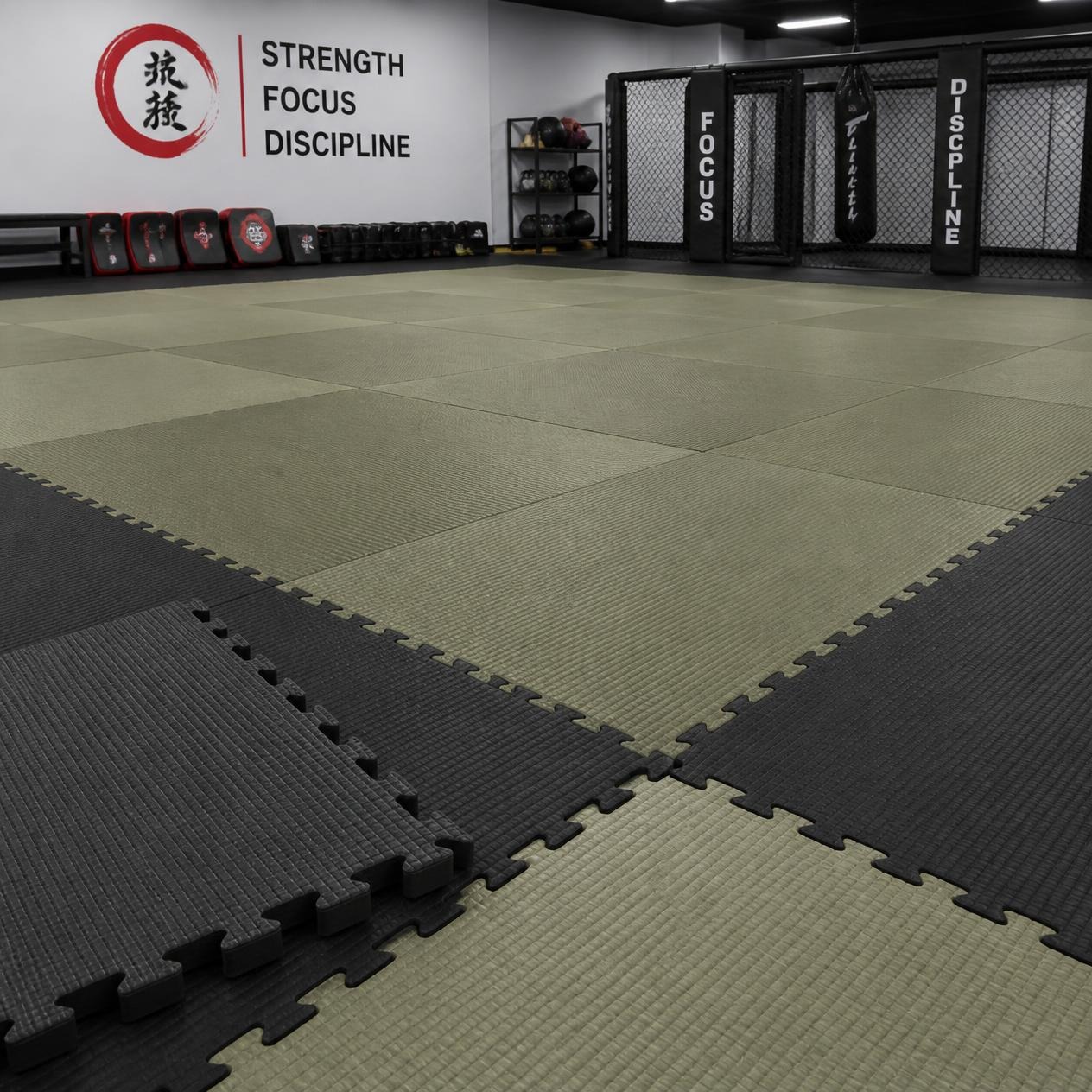
Interlocking Tatami: How to prevent modules from separating during use
Installing tatami flooring seems, at first glance, a simple operation: the interlocking modules are placed next to each other until the entire surface is covered. In practice, however, many gym owners, fitness centers, and home gym enthusiasts face a recurring problem: after a few weeks of use, the modules begin to separate, small gaps are created, and the surface loses its compactness. This phenomenon is not just an aesthetic inconvenience, but can compromise the comfort, safety, and durability of the entire flooring.
The causes of module separation are numerous. In addition to the quality of the interlocking joints, factors such as subfloor preparation, installation technique, temperature variations, humidity levels, type of use, and even the way the edges are finished play a role. Focusing exclusively on the puzzle system means neglecting many other factors that determine the long-term stability of the floor.
For those who manage a professional gym or wish to create an advanced home gym, knowing the correct installation procedures allows you to avoid subsequent repairs, reduce maintenance costs, and offer users a surface that is always stable during martial arts training, functional training, fitness, and combat sports. In this guide, we analyze the most important technical aspects for obtaining a durable and perfectly assembled floor.
- Why modules separate
- Correctly preparing the subfloor
- Puzzle tatami assembly techniques
- Managing thermal expansion
- When to secure tatami to the floor
- Maintenance to keep the surface stable
- The importance of interlocking quality
- A choice that protects your investment
Why modules separate during use
Module separation rarely depends on a single factor. In most cases, it is the result of a combination of incorrect installation, intensive use, and environmental characteristics. Every workout generates lateral thrusts, twists, and movements that subject the joints to continuous stress.
If the underlying floor has irregularities or the installation was performed without respecting the correct expansion gaps, the elements tend to shift progressively. Even small initial misalignments can amplify over time.
Understanding the root of the problem allows you to intervene preventively, avoiding frequent repairs and premature replacement of the flooring.
The effect of dynamic loads
Jumps, throws, dragging, and continuous movements generate lateral forces that test the strength of the joints. The more intense the gym usage, the greater the importance of a correctly executed installation.
The most common mistakes during installation
Modules that are not perfectly aligned, a dirty subfloor, lack of space for expansion, and hasty assembly are the main causes of gaps forming between elements.
Correctly preparing the subfloor
The quality of the installation depends first and foremost on the support surface. A stable, dry, and level subfloor allows the modules to distribute loads evenly without localized deformations.
Before installation, it is advisable to remove dust, debris, and any irregularities that might prevent the perfect coupling of the panels. Even small bumps can compromise the overall stability of the floor.
Investing a few hours in preparation avoids problems that could manifest after just a few days of intensive use.
Checking flatness and leveling
A uniform surface limits module shifting and improves weight distribution during workouts.
Cleaning before installation
Residues of dirt or foreign materials can prevent the correct coupling of the joints and encourage unwanted movement.
Correct puzzle tatami assembly techniques
During installation, it is essential to assemble the modules without forcing them and to constantly verify the alignment of the entire surface. Proceeding row by row allows you to immediately correct any misalignments.
The joints must be fully seated while maintaining uniform pressure along the entire edge. Excessive force or unsuitable tools can damage the profile of the teeth, compromising future hold.
A final check of the entire floor allows you to quickly identify any critical points before the gym is put into operation.
Following an orderly sequence
Installing the modules starting from a corner and proceeding progressively makes it easier to maintain the overall geometry.
Verifying all joints
Before the first use, it is advisable to check that every connection is fully inserted and free of deformations.
Correctly managing thermal expansion
The foam materials used in tatami can expand or contract slightly depending on the ambient temperature. This behavior is normal and must be anticipated during installation.
Leaving a small expansion gap along the perimeter allows the floor to adapt to climate changes without creating tensions that could push the modules inward or cause them to separate.
In facilities characterized by significant temperature fluctuations, proper management of expansion contributes significantly to the stability of the flooring.
Influence of temperature
Very hot environments or those subject to direct sunlight can cause more pronounced dimensional variations compared to climate-controlled rooms.
Why leave space at the edges
An adequate perimeter margin allows the modules to absorb natural dimensional variations without compromising the joints.
When to secure tatami to the floor
Not all installations require permanent fixing. In many gyms, the overall weight of the flooring is sufficient to keep the entire system stable.
However, there are situations where additional anchoring can be useful, for example in areas subject to frequent movement, intensive use, or temporary modular configurations.
The choice of the most suitable solution depends on the intended use, the available surface, and the possibility of making future modifications.
Permanent installations
In professional sports centers, it may be appropriate to adopt perimeter containment systems or other solutions provided by the manufacturer.
How to manage tatami edges
The edges play an important role both from an aesthetic point of view and in stabilizing the flooring. Keeping them intact helps to limit the movement of peripheral modules.
Maintenance to keep the surface stable
Regular maintenance allows you to preserve the efficiency of the joints and extend the useful life of the floor. Dust, dirt, and residues can accumulate between the joints, reducing the precision of the coupling.
Periodically inspecting the flooring allows you to promptly identify any damaged elements before the problem affects surrounding areas.
Proper cleaning also contributes to maintaining high surface performance over the years.
Cleaning the joints
Regularly removing dirt present in the connections keeps the system efficient and reduces profile wear.
Scheduled checks
Scheduling periodic checks allows you to intervene quickly on any worn or damaged modules.
The quality of the joints makes the difference
Not all puzzle systems are the same. Dimensional precision, material quality, and manufacturing tolerances directly affect the ability of the flooring to maintain its compactness over time.
Products made with accurate workmanship guarantee more stable connections and better resistance to the continuous stress typical of sports activities.
To evaluate professional solutions, it is advisable to rely on specialized manufacturers and consult a dedicated range of tatami flooring, designed for intensive use in the sports sector.
Manufacturing precision
Accurate cuts and reduced tolerances ensure a more stable and uniform coupling along the entire surface.
Superior quality materials
High-density foams and resistant coatings help keep the performance of the joints unchanged even after years of use.
A choice that protects your investment
A stable floor improves user safety, reduces maintenance interventions, and enhances the image of the gym. For this reason, the choice of tatami should not be based solely on price, but on the overall quality of the product and the reliability of the interlocking system.
Carefully considering subfloor preparation, correct assembly, expansion management, maintenance, and construction quality allows you to obtain a durable and professional surface, capable of maintaining its performance even in the presence of intensive training.
For gym owners, sports entrepreneurs, and enthusiasts who want to create an advanced home gym, adopting the correct installation procedures is the most effective way to avoid module separation and maximize the return on investment in the long term.
Comments (0)