
Trolley
You have no items in your shopping cart

 Budgets
 Dumbers
 Discs
Discs
 Benches
 Racks and Rigs
 Weights Holders
 Isotonic machines
 Calisthenics
 Cardio
 Kettlebells
 Flooring
 Gym Set
 Accessories
 Combat
 ARTI MARZIALI
 CONTAINER GYM
 Tug-Of-War
 Used Gym Equipment
 PILATES MACCHINARI
 GINNASTICA ARTISTICA
 CAMPI DA PADEL
 Prodotti in Pronta Consegna
 Informazioni
 IRONMAN
 Gift Card
- Donatif
- General information
- 0 I like it
- 19 Views
- 0 comments
- gym flooring, safety flooring, gym safety, shock-absorbing materials
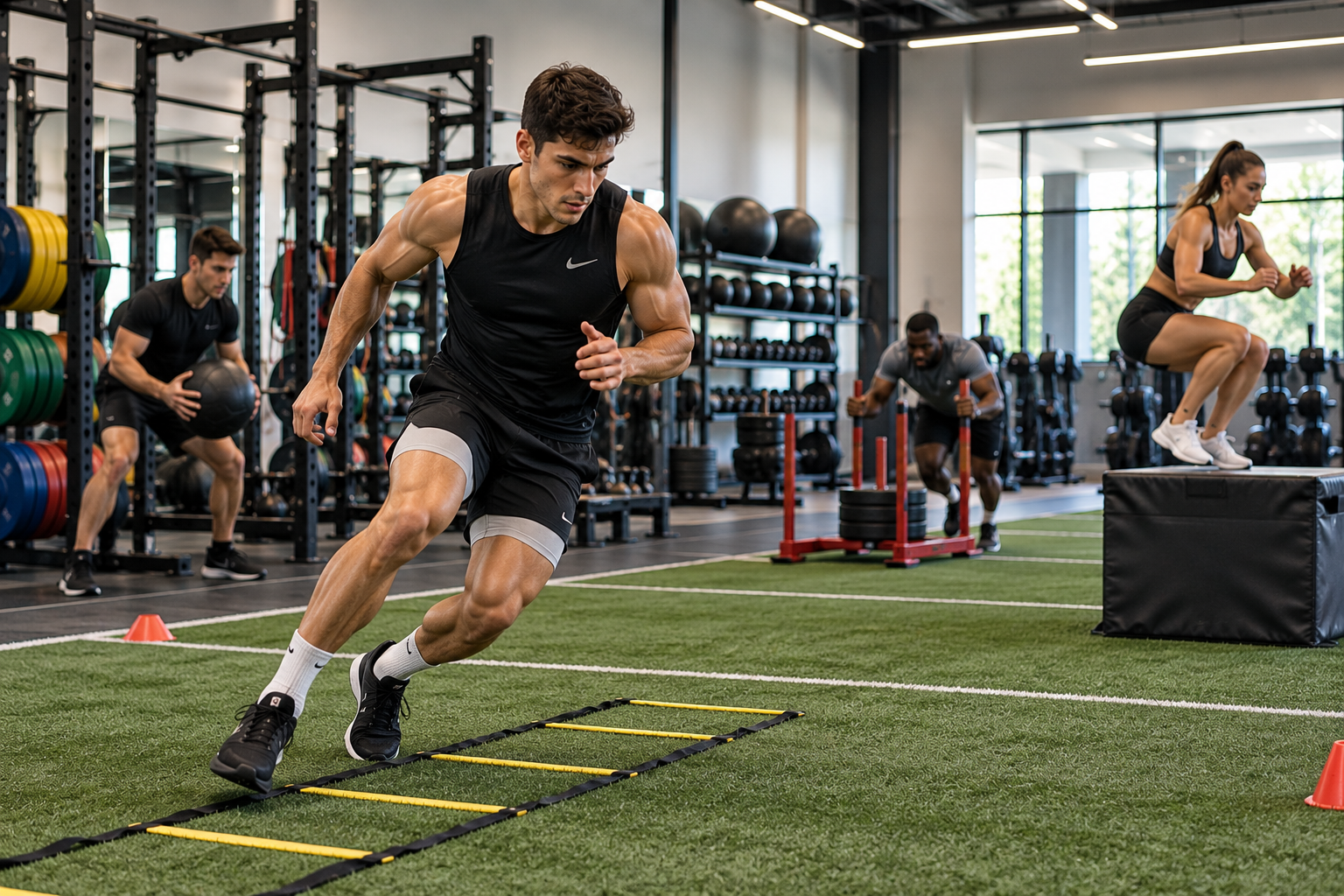
Athletic training equipment: how to choose the right gear
Athletic training equipment allows for the development of physical qualities such as strength, speed, coordination, balance, and neuromuscular capabilities through programmable exercises that can be adapted to different sports disciplines. Their selection must be made by considering technical objectives, the level of the athletes, and the characteristics of the available space.
An effective setup does not necessarily coincide with a high number of tools. It is preferable to select versatile equipment that is easily integrated with one another and consistent with the training schedule rather than purchasing redundant products or items that can only be used in specific situations.
This guide provides operational criteria for choosing, using, and organizing equipment dedicated to athletic training, highlighting the most common mistakes and aspects to check before purchase.
- Quick answer
- What are athletic training equipment?
- How to use them correctly
- Practical selection criteria
- Errors to avoid and safety
- How to organize the setup
- FAQ
- Evaluating the equipment over time
What equipment is needed for athletic training?
Athletic training equipment includes tools intended for the development of physical and coordinative capacities. The choice should be based on training objectives, the number of users, the discipline practiced, the available space, and the possibility of adapting the setup to the evolution of the programming.
Each piece of equipment should be selected based on the role it plays in the training program and not exclusively on its popularity or the number of exercises it promises to offer.
A preliminary assessment of the facility's needs helps avoid poorly functional purchases and improves the efficiency of the investment.
What is the main function?
The tools support the development of motor skills through progressive exercises that can be adapted to different levels of experience.
Where to start?
It is useful to identify the training objectives, the type of athletes, and the expected frequency of use before defining the setup.
What categories of equipment can be used?
The setup varies depending on the sports discipline but can be organized by operational categories.
Among the most used tools are those intended for strength development, coordination exercises, speed work, functional workouts, and mobility activities.
A multi-functional facility should prioritize solutions that allow for multiple configurations while keeping daily management simple.
Equipment dedicated to strength
Barbells, dumbbells, kettlebells, sleds, and other tools allow for the development of programs oriented toward overload according to the needs of the discipline and programming.
Equipment dedicated to speed
Cones, hurdles, agility ladders, elastic bands, and boundary systems are used for exercises dedicated to acceleration, changes of direction, and coordination.
How to correctly use the equipment?
The effectiveness of the tools depends on their inclusion within a consistent and progressive program.
Each exercise should be selected based on the session's objectives, avoiding the use of the same equipment for purposes not provided for by the program.
The layout of the workspace also contributes to the quality of the training by facilitating movements and limiting interference between groups.
Organizing the exercise sequence
The equipment should be placed following the order expected by the session, reducing movements and downtime.
Applying a progression
The use of the tools must follow a progression consistent with the level of the athletes and the objectives of the preparation.
What criteria to use in the selection?
The selection of equipment should be based on verifiable criteria rather than simple commercial availability.
It is advisable to evaluate versatility, manufacturing quality, maintenance possibilities, space compatibility, and adaptability to different training programs.
To complete the setup, it is possible to explore solutions dedicated to gym accessories, useful for organizing multi-functional areas dedicated to athletic training.
Evaluating space
The availability of space influences the number of stations, the configuration of pathways, and the possibility of simultaneously using multiple work groups.
Choosing accessories
Complementary tools should be compatible with the training program and easily stowed away at the end of the session.
What errors to avoid?
One of the most frequent errors consists of purchasing numerous pieces of equipment without defining a real strategy for use.
It is also advisable to avoid tools that require spaces incompatible with the facility or that prove difficult to integrate into daily programming.
Safety also depends on proper maintenance, user training, and compliance with the manufacturer's instructions.
Attention to flooring
The surface must be compatible with the type of exercises planned and the characteristics of the equipment used.
Scheduling checks
Periodic checks allow for the identification of wear, loose fasteners, and components to be replaced before they can compromise the use of the equipment.
How to organize an efficient setup?
A well-organized setup facilitates the work of the technical staff and improves session management.
The equipment should be divided by function, maintaining clear pathways and areas dedicated to different types of exercises.
It is useful to provide storage systems that allow for quick access to the tools and proper storage at the end of the training.
Organizing the layout
The layout should follow the logic of the programming, avoiding crossings between different activities.
Planning maintenance
Scheduled maintenance helps keep the setup efficient and extends its lifespan over time.
FAQ on athletic training equipment
Is it necessary to buy a lot of equipment?
No. A targeted selection of versatile tools can satisfy numerous training needs if included in a well-structured program.
How to choose the most suitable tools?
It is appropriate to evaluate training objectives, the discipline practiced, the number of users, space availability, and maintenance possibilities.
Are there technical references?
For the choice and use of equipment, it is advisable to consult manufacturer manuals, available technical documentation, and applicable standards for sports equipment and training environments when relevant.
Does each discipline require different equipment?
Yes. Many pieces of equipment can be shared among different sports, but the final configuration should be adapted to the objectives of the specific athletic training.
Evaluating the setup as an investment
The choice of equipment for athletic training should be approached by considering their contribution to training organization, facility flexibility, and the possibility of adapting programs over time.
A setup designed according to verifiable criteria makes it possible to use spaces more efficiently, facilitate the work of the technical staff, and improve the operational management of sessions.
Investing in versatile tools, maintained through periodic checks and included in a consistent program, allows for the construction of a functional training environment that is easily adaptable to the future needs of athletes and sports clubs.
Comments (0)