
Trolley
You have no items in your shopping cart

 Budgets
 Dumbers
 Discs
Discs
 Benches
 Racks and Rigs
 Weights Holders
 Isotonic machines
 Calisthenics
 Cardio
 Kettlebells
 Flooring
 Gym Set
 Accessories
 Combat
 ARTI MARZIALI
 CONTAINER GYM
 Tug-Of-War
 Used Gym Equipment
 PILATES MACCHINARI
 GINNASTICA ARTISTICA
 CAMPI DA PADEL
 Prodotti in Pronta Consegna
 Informazioni
 IRONMAN
 Gift Card
- Donatif
- General information
- 0 I like it
- 10 Views
- 0 comments
- gym flooring, safety flooring, gym safety, shock-absorbing materials
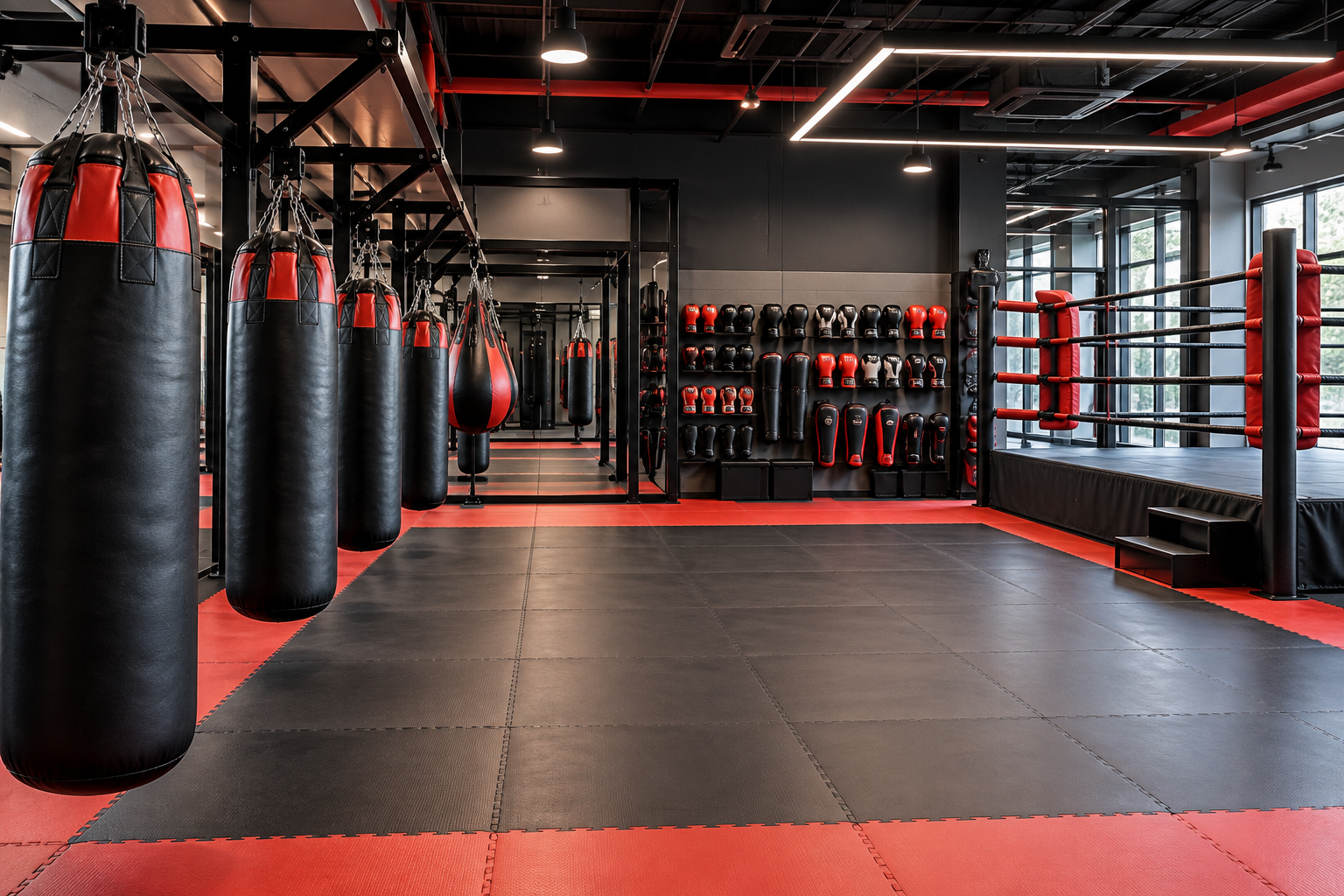
How to set up a Muay Thai area in the gym: a design guide
Muay Thai equipment must be organized in an area that encourages technical learning, pad work, heavy bag training, and partner drills while ensuring order, safety, and operational continuity. Effective planning considers available space, equipment layout, movement paths, flooring, and maintenance all at once, avoiding turning the area into a simple collection of equipment without a functional logic.
Every gym has different needs based on the number of practitioners, the type of classes, and the technical level of the athletes. For this reason, there is no universal layout. The configuration should always start with an analysis of the available space and the instructions provided in the manuals for the equipment and installation systems.
This guide illustrates the practical criteria for designing a professional Muay Thai area by analyzing space organization, equipment configuration, safety, maintenance, and design errors to avoid. When applicable, it is advisable to consult manuals, technical datasheets, and official manufacturer documentation, which represent the primary sources for installation, weight capacity, anchoring, and proper use of the equipment.
- What requirements must the area have
- How to organize space and layout
- What equipment to provide
- How to configure the stations
- Safety and maintenance
- Design errors to avoid
- How to organize the activity
- How to evaluate the project
What requirements must a Muay Thai area have?
An area dedicated to Muay Thai equipment should allow the main drills to be carried out without interference between different activities.
The project should provide distinct spaces for heavy bag work, technique exercises, pad usage, athletic preparation, and equipment storage.
The organization of the space should also facilitate supervision by the instructor during classes.
Define the goals of the area
Before setup, it is useful to establish whether the space will be dedicated primarily to beginners, competitive athletes, or mixed groups with different levels of experience.
Number of practitioners
The configuration should be proportioned to the maximum number of users expected during classes without compromising freedom of movement.
How to organize space and layout?
The layout represents one of the most important elements of the entire project. Each zone should be easily identifiable and allow fluid movement from one station to the next.
The space required depends on the room dimensions, the number of installed equipment pieces, and the intended usage methods.
The main pathways should always remain free of obstacles to facilitate entry, exit, and class management.
Circulation paths
Passage areas should allow athletes and instructors to move without interfering with those performing exercises on the heavy bags or pads.
Flooring
The flooring must be suitable for the discipline, stable, and compatible with the characteristics of the environment and equipment according to the manufacturer's instructions.
What equipment is actually necessary?
The setup should exclusively include equipment consistent with the gym's goals and the proposed technical program.
Among the most common elements are training bags, striking shields, pao pads, protective gear, storage racks, and accessories intended for athletic conditioning.
Each piece of equipment should be chosen by verifying manufacturing quality, installation methods, and ease of maintenance.
Heavy bag area
Suspension systems must be installed strictly following the instructions provided in the manufacturer's technical documentation.
Pads and protective gear
Pads should be easily accessible and stored neatly when not in use.
How to correctly configure the stations?
Each station should allow the execution of exercises without interfering with activities taking place in neighboring areas.
Operating distances must be defined based on the characteristics of the installed equipment and the guidelines provided by the manufacturer.
An orderly configuration facilitates both technical work and instructor supervision.
Organization of accessories
Accessories should be stored on dedicated racks or supports to keep the training area clear.
Instructor position
The instructor should be able to observe all main operating stations simultaneously during the class.
What safety and maintenance aspects should be considered?
A Muay Thai area requires scheduled checks of the equipment, anchoring systems, and training surfaces.
Inspections should follow the maintenance plan indicated by the manufacturers and include visual checks before activities begin.
Regular cleaning of the equipment also helps maintain its functionality and lifespan.
Periodic checks
Before classes, it is advisable to check the integrity of the bags, anchor points, pads, supports, and flooring conditions.
Technical documentation
Manufacturer manuals represent the main reference for the installation, maintenance, and correct use of the equipment.
What design errors should be avoided?
One of the most frequent errors consists of installing an excessive number of equipment pieces, reducing athletes' freedom of movement.
Another critical issue concerns the lack of a clear division of areas dedicated to different exercises.
It is also advisable to avoid mounting systems that do not comply with the manufacturer's instructions or disorderly storage of materials along pathways.
Insufficient space
An excessive density of equipment makes class management more complex and limits the quality of training.
Lack of organization
An irrational arrangement of equipment increases preparation time and makes area control more difficult.
How to organize daily activity?
Effective management includes opening and closing procedures for the area, equipment checks, and an orderly distribution of materials before classes begin.
It is useful to define access paths, areas dedicated to warming up, and procedures for tidying up equipment at the end of the workout.
Consistent planning improves operational continuity, safety, and the quality of the experience for practitioners and instructors.
Flow management
User movements should be organized to avoid interference between those training and those accessing the area.
Operational procedures
Control checklists and shared procedures facilitate daily room management and help maintain high organizational standards.
How to evaluate a Muay Thai area project?
Before setup, it is advisable to evaluate the manufacturing quality of the equipment, space configuration, ease of maintenance, potential for future expansion, and compatibility with the gym's technical program. A well-planned project improves operational management and reduces the need for subsequent modifications.
To explore solutions dedicated to combat sports, you can consult the combat equipment category, which is useful for comparing different types of equipment intended for training areas.
Before installation, it is appropriate to consult manuals, technical datasheets, assembly instructions, and official manufacturer documentation, which represent the primary sources for anchor points, configuration, maintenance, and usage requirements. Design based on verifiable criteria allows for the creation of a functional Muay Thai area without turning it into a simple equipment catalog.
FAQ: is it necessary to separate the heavy bag area from the pad work area?
Yes, when space permits, it is useful to organize dedicated zones to reduce interference between different activities and facilitate class management.
FAQ: which documents should be used as a starting point for designing the area?
It is advisable to consult manufacturer manuals, equipment technical datasheets, and installation instructions to verify anchoring, configuration, and maintenance requirements.
Comments (0)