
Trolley
You have no items in your shopping cart

 Budgets
 Dumbers
 Discs
 Benches
 Racks and Rigs
 Weights Holders
 Isotonic machines
 Calisthenics
 Cardio
 Kettlebells
 Flooring
 Gym Set
 Accessories
 Combat
 ARTI MARZIALI
 CONTAINER GYM
 Tug-Of-War
 Used Gym Equipment
 PILATES MACCHINARI
 GINNASTICA ARTISTICA
 CAMPI DA PADEL
 Prodotti in Pronta Consegna
 Informazioni
 IRONMAN
 Gift Card
- Donatif
- General information
- 0 I like it
- 206 Views
- 0 comments
- gym flooring, safety flooring, gym safety, shock-absorbing materials
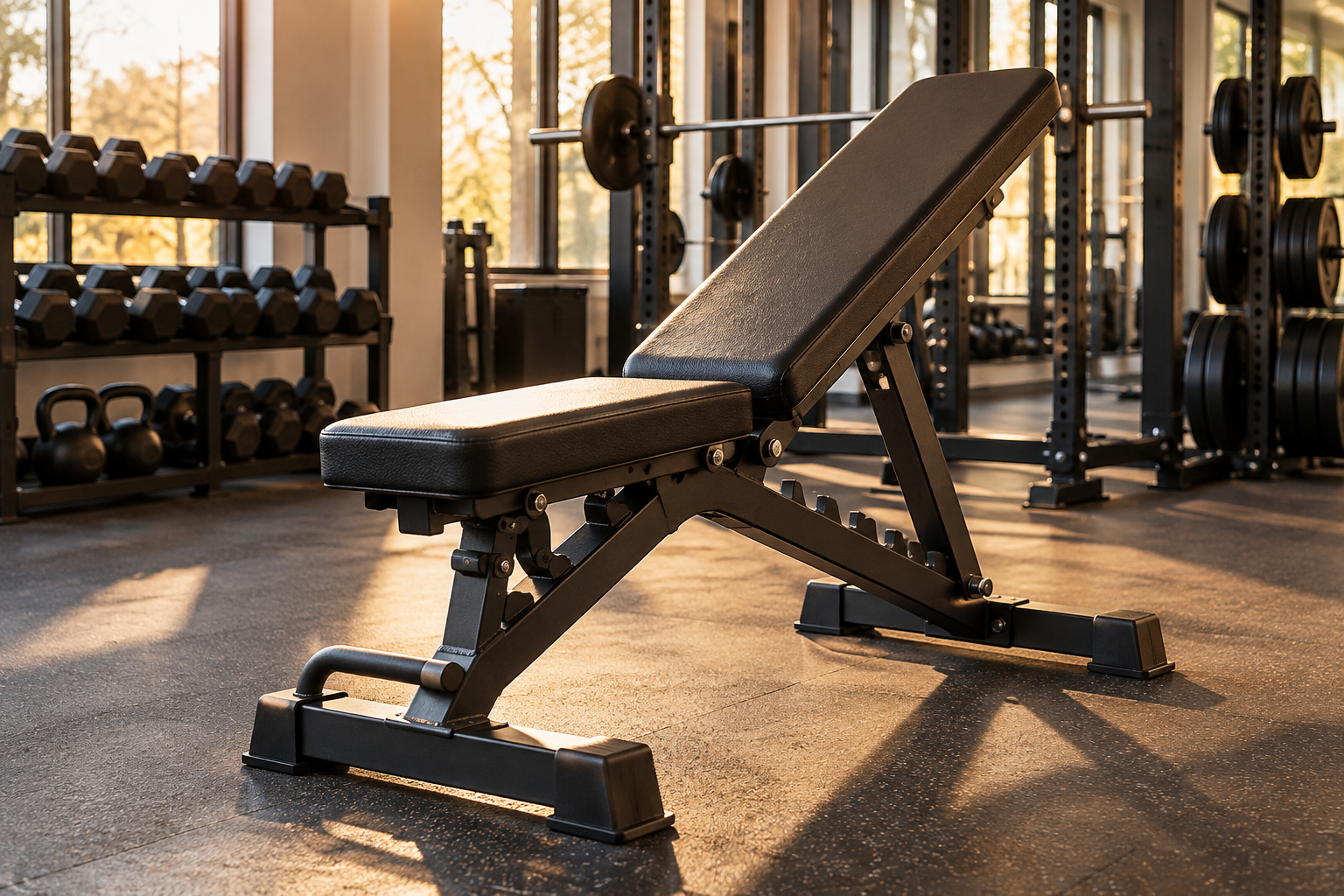
Weight training bench: choosing the right configuration
A bench is often considered a simple element of the weight room. In reality, it must allow users to lean back, reach loads, and change positions with control. Choosing one means connecting geometry, adjustments, and conditions of use to the exercises that will be performed.
To understand how to choose a weight training bench, it is useful to start with a concrete question: what movements must it make possible in your room? A flat bench, an adjustable one, and a station with integrated supports can meet different needs.
The following process helps managers and strength area technicians formulate a precise request. Final features must be verified on the actual models, without attributing a load capacity, intended use, or compatibility to a trade name if they are not documented.
Before comparing, involve those who teach the exercises and those who manage cleanup. A purchase can change paths, assistance methods, and the position of the weights. Gathering these aspects at the beginning allows you to evaluate the bench as part of a complete station, rather than as an isolated object.
To make the demonstration useful, prepare the same questions in advance for each model. Ask staff to note where they encounter difficulties and which operations are immediate. The comparison will be clearer if impressions are referred to a specific exercise and an identified configuration.
- Translate the program into requirements
- Flat, adjustable, or with supports
- Dimensions and quality of the support
- Load capacity, structure, and limits
- Insert the bench into the layout
- Services and maintenance
- Compare and approve the purchase
Translate the program into requirements
Movements and frequency
List the planned activities: barbell presses, dumbbell exercises, seated work, or movements that require an inclined backrest. Indicate which ones are performed every day and which only occasionally. This distinction helps understand if an adjustable function is really needed or if a fixed configuration already covers the main demand.
Also consider how users take turns. A shared bench during guided classes can be adjusted many times in a short period; a station dedicated to the same exercise can remain in the same position. The frequency of changes affects ease of use and the time the instructor spends on preparation.
Different users in the same room
Do not base your choice solely on the most experienced person. Observe how users of different body types and experience manage to sit, place their feet, and reach loads. A demonstration with the staff can help identify access difficulties before purchase.
Prepare two or three representative situations from the room and use them to compare each proposal. For example, a dumbbell press and a seated exercise can show different requirements. The test must respect instructions and limits, avoiding high loads introduced only to impress or demonstrate robustness.
Flat, adjustable, or with supports
Simplicity of the flat bench
The flat bench offers a fixed surface and can be suitable when the program does not require inclinations. The simplicity of the configuration can make the transition between users immediate, but it does not alone demonstrate quality or safety: structure, dimensions, and destination must still be verified.
If used inside a rack, measure the relationship with uprights and barbell supports. The person must be able to position themselves and receive assistance without interference. A bench that physically fits into the rack may still prove impractical if the legs or frame prevent the necessary approach.
Versatility of the adjustable bench
An adjustable bench allows for different positions, but the number of inclinations is only useful when it matches the exercises. Check if the seat and backrest adjust separately, how easy it is to locate the locks, and how the distance between the two surfaces changes in the planned configurations.
Benches with integrated supports require a separate comparison: the adjustment of the hooks, access, and any protections become part of the station. Check whether the solution offers the required functions or reduces the freedom to use the bench for other activities. Avoid comparisons based exclusively on the number of components.
Dimensions and quality of the support
Height and padding
Height should be observed along with how the person places their feet and reaches the starting position. The width of the backrest must be evaluated in the actual exercise. There is no automatically comfortable measurement for everyone: product data and observation of intended users are required.
Padding should not be judged solely by pressing it with your hand. During an appropriate test, evaluate support, feeling of stability, and ease of changing position. A very soft material may feel different under the body than a brief demonstration without exercise suggests.
Upholstery and contact points
Ask how to clean the upholstery and whether it is replaceable. Edges, seams, and fastening must be consistent with the intended use; unauthorized cleaning products can damage them. If the bench will be used frequently, upholstery management deserves an explicit question before ordering.
Also check handles and parts that the user touches to move or adjust the bench. They must be accessible without requiring awkward grips on joints or pinch points. The controls must be understandable even to those using the station for the first time.
Load capacity, structure, and limits
Reading the declared load
The declared load capacity must be accompanied by a definition: ask if it includes the user and weights and if it applies to all positions. Do not interpret an isolated number as authorization for any exercise. The applicable conditions are those of the manufacturer for the specific model.
Compare the limit with the scenarios planned in the room and with any accessories. A high figure does not automatically demonstrate longer durability or better ergonomics. If model datasheets use different definitions, ask for clarification instead of creating a ranking based on inconsistent figures.
Frame and supports
Check how the frame rests on the floor and how much space the legs occupy. The surface must be suitable and flat according to the instructions. Feet, fasteners, and moving parts require checks; an uneven floor can alter the support even of a properly built bench.
During a test, observe any wobbling or shifting and ask how they should be evaluated. Do not perform impacts or improvised overloads. A practical check helps recognize difficulties, but does not replace technical documentation or scheduled maintenance over time.
Insert the bench into the layout
Operating area and assistance
Draw the station with its footprint in different inclinations and the space to use loads, approach, and assist. Consider where dumbbells will be placed and how to stand up at the end of the set. The surface occupied by the stationary bench does not describe the entire area needed.
Gym benches can be compared by category, but the room layout must use the measurements of the offered model. Verify that the delivered configuration matches the datasheet on which you built the layout.
Movement and storage
Wheels and a handle can make moving the bench easier, but they must be used according to the instructions. Test the intended route without a load and check thresholds, passages, and storage position. Do not assume a bench can be stored vertically if the manufacturer does not allow it.
If the room changes layout during the day, establish who performs the move and who checks the new position. A repeatable procedure prevents the bench from being left in a passage or on an unsuitable surface. Cleanup time must also enter the evaluation.
Services and maintenance
Delivery and preparation
Ask if the supply includes transport, handling to the room, and assembly. Indicate access points and any stairs before the quote. Street-level delivery requires different organization than a station that is already assembled and ready for commissioning checks.
Verify which documents accompany the product and who will explain the adjustments to the staff. Model, quantity, accessories, and conditions must be identified in the offer. If a service is still to be confirmed, highlight it before approving the order, without considering it implicitly included.
Checks and assistance
Integrate the manufacturer's indicated checks for fasteners, locks, and upholstery into the facility's plan. Define who can perform them and how to report a damaged component. If suitability is doubtful, make the bench unavailable until proper verification.
Before purchasing, clarify spare parts availability, assistance procedure, and warranty conditions. The presence of an assembly service does not imply subsequent maintenance. Keep the manual and identifying data so that anyone opening a request can indicate the model without relying on a generic description.
Compare and approve the purchase
A consistent datasheet for every proposal
Report functions, dimensions, adjustments, load capacity and its definition, cleaning, spare parts, and services. Add test observations, distinguishing them from manufacturer data. Missing cells become questions to ask the supplier, not features to deduce from the product's appearance.
Prioritize requirements before comparing prices. An additional adjustment is worth it if the program needs it; a simple configuration can be adequate if it covers the requested exercises. Comparing the total makes sense after clarifying which performances and functions are truly equivalent.
From order to daily use
Upon delivery, check configuration and components against the offer and follow the assembly procedure. Before use, check adjustments and support with competent staff. Introduce the model and the channel for reporting anomalies to the instructors, so guidance to users remains consistent.
After the first few weeks, gather difficulties regarding access, movement, and adjustments. These observations can suggest organizational improvements or clarifications in the instructions. The choice remains useful when the bench meets the exercises and can be managed correctly in the real context of the room.
Comments (0)