
Trolley
You have no items in your shopping cart

 Budgets
 Dumbers
 Discs
Discs
 Benches
 Racks and Rigs
 Weights Holders
 Isotonic machines
 Calisthenics
 Cardio
 Kettlebells
 Flooring
 Gym Set
 Accessories
 Combat
 ARTI MARZIALI
 CONTAINER GYM
 Tug-Of-War
 Used Gym Equipment
 PILATES MACCHINARI
 GINNASTICA ARTISTICA
 CAMPI DA PADEL
 Prodotti in Pronta Consegna
 Informazioni
 IRONMAN
 Gift Card
- Donatif
- General information
- 0 I like it
- 2464 Views
- 0 comments
READING TIME: 5 MINUTES ➤➤
How to Choose an Office Chair (or Exercise Ball) to Work More Comfortably Without Expecting Posture Miracles
If you spend many hours a day working at a computer, it's natural to look for solutions that can improve your posture and reduce the discomfort associated with prolonged sitting. However, it's important to understand that no ergonomic office chair or office exercise ball can work miracles on its own. The quality of the equipment matters, but what truly makes the difference is how consciously and dynamically you use it. In this practical guide, we'll explore how to choose the seating option that best fits your needs without falling for unrealistic promises.
- Why a Good Chair Isn't Enough: The Importance of Active Posture
- Ergonomic Chair or Exercise Ball: What's the Real Difference?
- How to Evaluate a Quality Ergonomic Chair
- Office Exercise Ball: A Practical Buying Guide
- How to Use These Tools Effectively Every Day
- Conclusion: Helpful Tools, Not Miracle Solutions
Why a Good Chair Isn't Enough: The Importance of Active Posture
The Myth of Ergonomic Equipment
Many people purchase an office chair for back pain expecting it to solve every posture-related problem by itself. This belief is often reinforced by marketing that presents ergonomic chairs as a complete solution. The reality is more nuanced: even the most advanced chair becomes ineffective if it's used passively for hours without changing position or incorporating regular movement throughout the day.
Posture Is About Behavior, Too
Posture isn't a fixed position—it's a continuous series of small adjustments. Even the most ergonomic chair cannot prevent muscle tension if the body remains motionless for too long. Being aware of your sitting habits while working is therefore essential. Active posture—the ability to change positions frequently, take short breaks, and adopt dynamic sitting habits—is your greatest ally for long-term comfort and well-being.
Ergonomic Chair or Exercise Ball: What's the Real Difference?
Biomechanical Differences Between the Two
A well-designed ergonomic office chair supports the lower back, offers multiple adjustment options, and minimizes pressure points. An office exercise ball, on the other hand, encourages balance and pelvic mobility, promoting a more active sitting posture. Both options have advantages and limitations, and it's important to understand that they are complementary tools rather than interchangeable solutions.
When an Exercise Ball Can Help (and When It Can't)
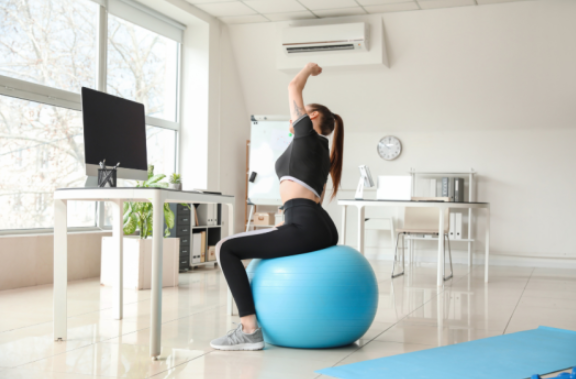
An exercise ball can be particularly useful for shorter work sessions or as an occasional alternative to a traditional office chair. However, using it for extended periods—or at the wrong height—may fatigue your postural muscles and lead to discomfort. For this reason, it's best used as part of a dynamic sitting strategy, rather than as a full-time replacement for an ergonomic chair.
How to Evaluate a Quality Ergonomic Chair
Essential Technical Features
A good chair for healthy posture should provide adjustable lumbar support, customizable seat height, a comfortable seat cushion, and breathable materials. Features such as a reclining backrest, synchronized tilt mechanism, and adjustable armrests are also essential for long-term comfort tailored to your body.
Adjustability, Materials, and Personal Fit
Every body is different, so choosing a chair with a wide range of adjustment options is essential. Materials should be durable while remaining comfortable enough for everyday use. The ability to adapt the chair to your workstation—including desk height, monitor position, and floor setup—is a key factor in making a worthwhile investment.
Office Exercise Ball: A Practical Buying Guide
Choosing the Right Size for Dynamic Sitting
Not every exercise ball is suitable for office use. Selecting the correct diameter—typically 55 cm or 65 cm depending on your height—is essential for maintaining an active and balanced sitting posture. It's also worth choosing a model with a non-slip base or stabilization ring to reduce unwanted rolling and improve safety.
Durability, Stability, and Alternating Use
A quality exercise ball should be made from anti-burst material and retain air effectively over time. Some models are specifically designed for office environments, featuring stylish covers and anti-roll systems. Alternating between an ergonomic chair and an exercise ball helps vary your sitting position, encourages movement, and supports productivity throughout the workday.
How to Use These Tools Effectively Every Day
Movement Routines and Active Breaks
The most effective way to improve comfort while working isn't relying on a single product, but developing consistent micro-habits: standing up every 30 to 60 minutes, taking short walks, and performing simple stretches for your neck and shoulders. Deep breathing can also help relax tense muscles and encourage a more natural, balanced posture.
Vary Your Sitting Position and Listen to Your Body
Alternating between an ergonomic chair and an exercise ball—or incorporating short standing sessions with a height-adjustable desk—helps keep your postural muscles engaged and reduces stiffness. Listening to your body's signals, such as muscle tension, discomfort, or declining concentration, allows you to respond early and reduce the risk of developing chronic pain.
Conclusion: Helpful Tools, Not Miracle Solutions
Building a Truly Ergonomic Workstation
Creating an ergonomic workspace means combining the right equipment with smart movement habits and effective time management. The right chair alone isn't enough. A proactive mindset—one that's willing to adapt the workspace to your needs rather than expecting the opposite—is what truly makes the difference. The goal isn't simply to sit better, but to work more comfortably, with less physical strain and greater body awareness.
Long-Term Sitting Sustainability
Investing in an ergonomic chair or an exercise ball only makes sense if it's accompanied by gradual improvements in your daily habits. Ergonomics isn't a destination but an ongoing process of awareness, adaptation, and refinement. In this sense, making an informed choice today helps reduce post-purchase regret and supports a healthier, more sustainable relationship between your body, your workspace, and the way you work.
Comments (0)